
Tetrix undulata
Tetrix undulata
Description
How to identify
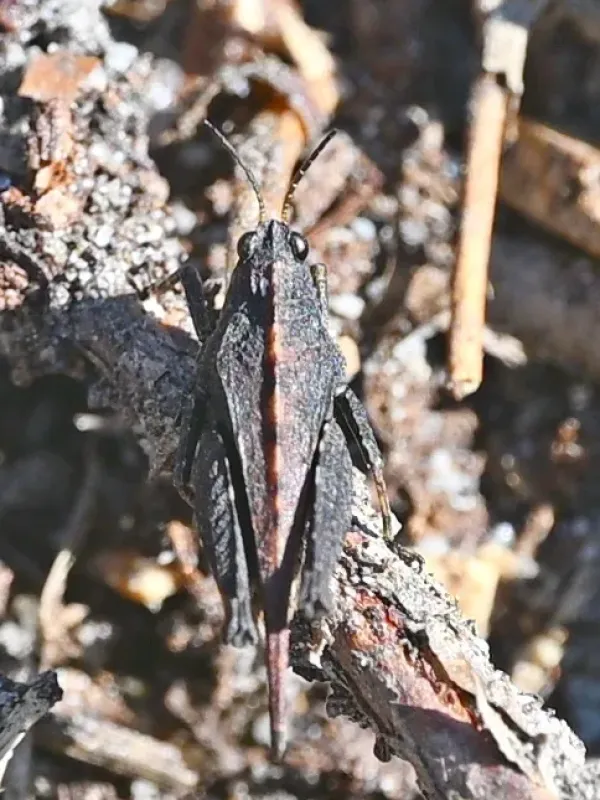
Tetrix undulata, commonly known as the common groundhopper, belongs to the order Orthoptera and the family Tetrigidae. These are small insects, typically measuring between 7 and 12 millimeters in length.
They resemble miniature grasshoppers but feature an elongated pronotum that fully covers the abdomen and often extends beyond its tip, providing excellent camouflage.
The coloration of these insects is highly variable, ranging from light gray and sandy to dark brown or black, often with a mottled pattern that mimics soil or leaf litter.
A distinctive anatomical feature is the head shape with a specific protrusion and the absence of functional auditory organs, which is common among groundhoppers.
Unlike other grasshoppers, groundhoppers lack arolia (pads) between their tarsal claws, which limits their ability to climb smooth vertical surfaces.
What it damages
The primary diet of this species consists of algae, lichens, mosses, and decaying plant material, making them generally less destructive than major locust species.
However, under intensive farming conditions, they can damage young seedlings of winter crops, vegetable sprouts, and young nursery plants when populations are dense.
Significant damage is typically observed in humid areas where these insects congregate near fields to feed on soil microflora and young weed tissues.
While direct consumption of crops is often sporadic, their activity can cause mechanical damage to delicate plant tissues during the early growth phase.
Most damage is indirect, related to the disturbance of the soil surface microclimate, which may cause stress to young plants during periods of moisture deficit.
When it appears
These insects overwinter primarily as adults, hiding in forest litter, under tree bark, or within dense moss layers found in field borders.
The first activity of adults is observed in early spring once the soil temperature reaches 10–12 degrees Celsius, often coinciding with the start of field operations.
The breeding season occurs during late spring and early summer, when females deposit eggs in small groups directly into moist soil or onto organic substrates.
Nymphs, having completed their development, emerge in mid-summer and feed actively until the onset of steady autumn cold, after which they seek winter shelters.
Usually, there is one generation per year, but under favorable weather conditions and a prolonged autumn, the activity cycle of specific groups may be extended.
Signs of infestation
The primary signs of presence include small nibbled patches on the leaves of seedlings or young plants situated close to the ground surface.
On moist soil, one can notice characteristic sudden jumps of these insects as they disappear into the vegetation or between soil clumps when approached.
The presence of a high number of small groundhoppers during a visual inspection indicates the need to monitor crop conditions in the early morning hours.
Partial damage to young tissues can facilitate the development of secondary infections, as bite marks act as entry points for various phytopathogens.
Aggregations are most often seen in low-lying areas of fields with dense grass cover, which provides both shelter and essential food sources.
Control measures
An effective agrotechnical measure is the elimination of weed vegetation around field perimeters, as these serve as natural reservoirs for the pest.
Timely soil cultivation (discing, plowing) in the autumn significantly reduces the number of overwintering adults by destroying their primary habitats.
Draining waterlogged areas makes the environment less suitable for the development of this species, as they prefer consistently moist microhabitats.
When the economic injury level is reached, contact and stomach-action insecticides authorized for use on the specific crop should be applied.
It is recommended to monitor the fields using sticky traps, which allow for an accurate assessment of population density and timely decision-making regarding protective measures.
Taxonomy
- Latin name
- Tetrix undulata
- Order
- Orthoptera (locusts)
- Family
- Tetrigidae
- EPPO code
- TETXUN
Discussion
No discussions yet — be the first.