
Groundhopper
Tetrix
Description
How to identify
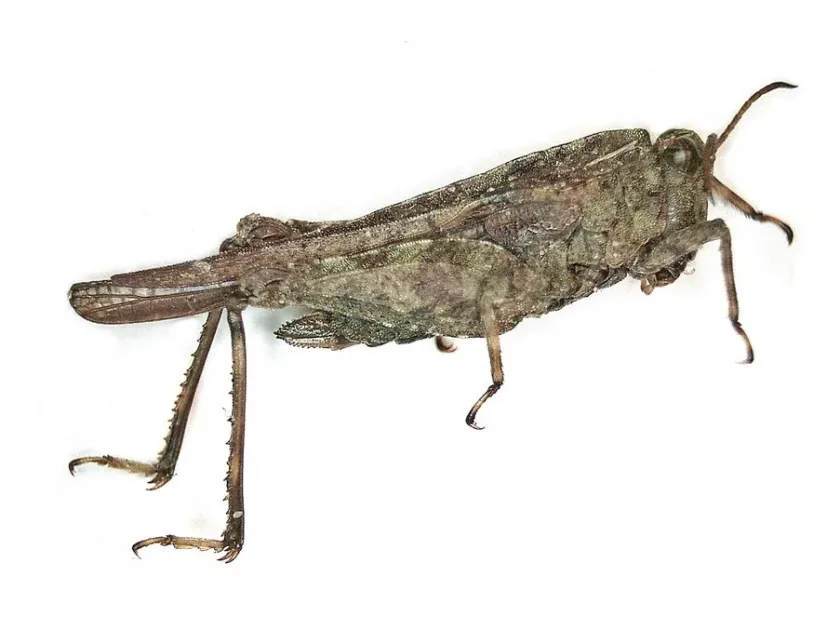
Groundhoppers (genus Tetrix) belong to the family Tetrigidae, commonly known as pygmy grasshoppers. They are small insects, typically measuring 7–15 mm in length, easily identifiable by their elongated pronotum that extends over the abdomen and often reaches the tip of the wings.
Their coloration is highly variable, often mimicking the patterns and shades of soil, decaying leaves, and moss. This excellent camouflage makes them difficult to detect in agricultural fields, as they blend seamlessly with the forest floor or moist soil environments.
Unlike standard grasshoppers, groundhoppers lack arolia (pads between their claws), which is a key diagnostic feature. Their hind legs are robust and adapted for powerful jumping, which they use as an primary escape mechanism when threatened by predators or agricultural equipment.
The eyes of a groundhopper are prominent and set high on the head, providing a broad field of vision. Their antennae are relatively short, consisting of 12–14 segments, which is well-suited for their ground-dwelling lifestyle in dense vegetation or moist soil.
Although they possess wings, many species of groundhoppers are not strong fliers. They primarily utilize their wings for short, assisted flights or gliding during jumps, preferring to remain close to the ground where they find shelter and food.
What it damages
Groundhoppers are primarily phytophagous, feeding on detritus, mosses, algae, and lichens. They are usually considered minor pests, but in specific conditions, they can cause damage to seedlings and young crops in moist environments.
When natural food sources like moss and algae dry out due to seasonal droughts, groundhoppers may migrate into agricultural fields. In such instances, they can chew on the young, tender foliage of vegetables, grains, or berry crops.
The damage is most noticeable on young plants that have not yet developed enough leaf mass to withstand herbivory. Losing leaves during the initial growth stage can significantly stunt plant development and make them more susceptible to environmental stress.
In greenhouses and nursery beds where high moisture is maintained, groundhoppers can thrive. If left unchecked, their feeding activities can create small lesions on the stems or leaves, which may serve as entry points for various fungal or bacterial pathogens.
While large-scale devastation is rare, their presence should not be ignored in sensitive horticultural systems. Their ability to multiply in damp, sheltered areas makes them a recurring challenge in certain micro-climates.
When it appears
The life cycle of the groundhopper is well-adapted to temperate climates. They typically overwinter as adults, finding refuge under thick layers of leaf litter, in deep soil crevices, or within dense, damp moss patches where temperatures remain stable.
As spring approaches, the overwintered adults become active with the first signs of warming temperatures. This is when they begin their mating and egg-laying activities, often concentrating in areas where moist soil remains available for their offspring.
Throughout the summer, the nymphs undergo several molting stages. These nymphs look like miniature versions of the adults but are wingless. They are most active during the warmer months, feeding continuously to accumulate energy for their growth.
By late summer and early autumn, the new generation of adults reaches maturity. They continue to feed actively until the temperature drops significantly, at which point they begin searching for suitable hibernation sites.
The seasonal appearance of groundhoppers is closely linked to soil moisture levels. Periods of high rainfall often coincide with increased activity levels, as these conditions favor their food sources and support the survival of nymphs.
Control measures
Management of groundhoppers is largely focused on cultural practices that make the environment less hospitable to them. Since they thrive in damp, undisturbed areas, modifying the habitat is the most effective approach to reducing their population.
Draining low-lying, waterlogged areas in or around fields can significantly lower the density of groundhoppers. Eliminating stagnant water prevents them from establishing large colonies near crop fields.
Agricultural operations such as deep plowing in the autumn help destroy their hibernation sites. By burying plant debris and disrupting the soil surface, farmers can expose the insects to predators and unfavorable winter conditions, reducing survival rates.
Maintaining clean fields by removing excess weeds and decaying plant matter is crucial. Removing these hiding spots deprives groundhoppers of shelter and forces them to move to less favorable areas away from the cultivated crops.
- Improve soil drainage to reduce moisture levels
- Deep autumn plowing to disrupt overwintering sites
- Weed control and removal of organic debris from field edges
- Monitoring in early spring when adults are most mobile
Taxonomy
- Latin name
- Tetrix
- Order
- Orthoptera (locusts)
- Family
- Tetrigidae
- EPPO code
- TETXSP
Discussion
No discussions yet — be the first.