
Southern grouse locust
Paratettix meridionalis
Description
How to identify
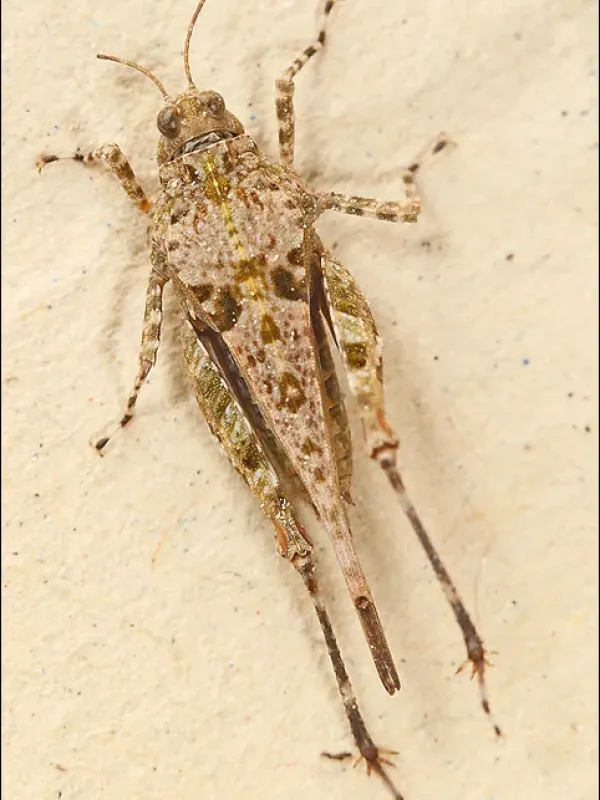
The Southern grouse locust (Paratettix meridionalis) belongs to the family Tetrigidae within the order Orthoptera. These are small insects, typically measuring 10–12 mm in length, often displaying brownish or grayish coloration that provides camouflage against damp soil and plant debris.
A defining morphological feature is the elongated pronotum, which extends back to cover most of the abdomen and partially covers the wings. The head is small with prominent eyes, and the antennae are notably slender and short.
Unlike many other grasshoppers, this species lacks tympanal hearing organs. Their hind legs are specialized for leaping, but they are also capable of swimming, which is why they are often found in close proximity to water bodies.
Nymphs resemble the adults but are smaller in size and possess only wing pads instead of fully developed wings. They undergo several molting stages, increasing in size throughout their development.
Precise field identification requires a magnifying glass to observe specific traits such as the shape of the pronotum and the length of the hind tibiae, which are critical for distinguishing the species.
What it damages
The Southern grouse locust primarily feeds on algae, mosses, lichens, and decaying organic matter found in riparian or marshy environments.
In intensive agricultural settings, this species may damage crop seedlings located in waterlogged fields where water management is poorly controlled.
Significant damage is occasionally observed in rice paddies, particularly during the germination phase and early growth stages, where insects may graze on the tender epidermis of the stems.
While not a major pest capable of total crop destruction, high populations in specific micro-habitats can result in reduced crop density in localized areas.
Damage is almost exclusively restricted to damp spots or areas near irrigation ditches, making it highly dependent on the local moisture regime.
When it appears
Activity usually begins with the onset of warm spring temperatures, which trigger the emergence of nymphs from their diapause state.
Population peaks are typically observed during the summer months when a combination of warmth and consistent soil moisture provides optimal conditions for development.
The species overwinters mainly as adults or late-stage nymphs, taking shelter in dense ground litter or moist soil crevices near water sources.
The number of generations per year is dictated by regional climatic conditions; in warmer latitudes, the species may complete two or more life cycles in a single season.
As autumn temperatures decline, the activity level drops significantly, and the locusts transition into a period of dormancy to survive the winter months.
Signs of infestation
The first signs of infestation include small, irregular chewing marks on the cotyledons and young leaves of crops growing in damp field corners.
Insects can often be spotted on the surface of damp soil; when approached, they exhibit characteristic rapid jumping, which is a primary defensive mechanism.
Visual inspections of irrigation channels and wet field edges are effective for locating clusters of the insects on open mud or damp substrates.
In rice cultivation, evidence of damage manifests as grazed stem surfaces or leaf margins, typically concentrated in areas where water has stagnated.
An absence of damage on dry, well-drained soil segments serves as a strong indicator that the observed harm is caused by this moisture-dependent species.
Control measures
The primary control strategy involves effective water management, such as maintaining functional drainage systems to prevent long-term waterlogging of fields.
Agronomic practices, including deep autumn plowing, help destroy overwintering sites, effectively reducing the population for the following growing season.
Controlling weed growth along irrigation ditches and field margins reduces the habitat and food sources that sustain localized populations.
Chemical control is rarely necessary and should only be considered if pest density exceeds the economic injury level, focusing exclusively on affected spots.
- Optimization of drainage systems.
- Deep tillage in the autumn.
- Management of riparian vegetation.
- Targeted monitoring of high-moisture zones.
Taxonomy
- Latin name
- Paratettix meridionalis
- Order
- Orthoptera (locusts)
- Family
- Tetrigidae
- EPPO code
- PTTXME
Discussion
No discussions yet — be the first.