
Sand grouse locust
Tetrix arenosa
Description
How to identify
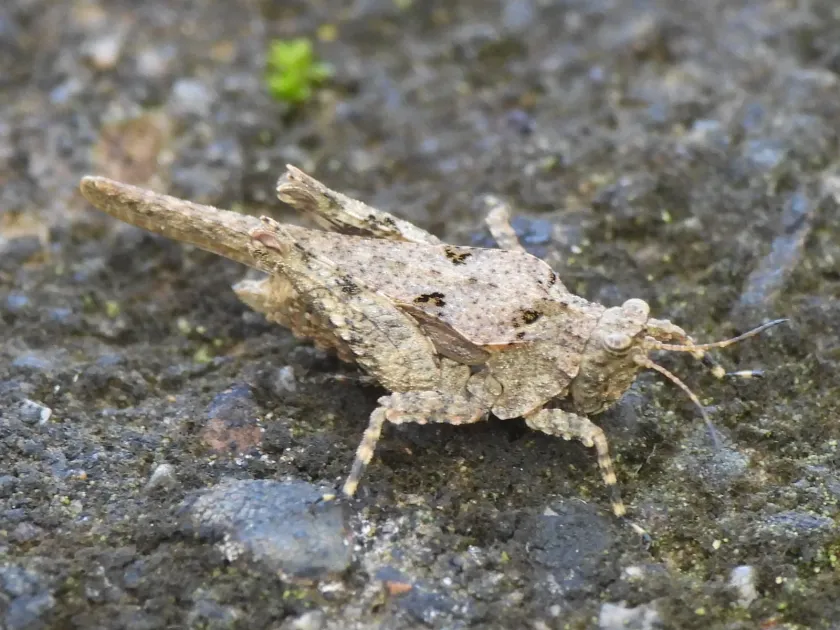
The sand grouse locust (Tetrix arenosa) is a small insect belonging to the Tetrigidae family. It resembles a miniature locust, though it is distinguished by an elongated pronotum that extends backwards, covering most of the abdomen.
Their coloration is highly variable, ranging from light sandy tones to dark brown and grey. This camouflage allows them to blend in perfectly with various soil types, sand, and decaying plant matter, making them difficult to spot in the field.
Adult insects typically measure between 8 and 11 millimeters in length. They possess well-developed hind legs that allow them to perform powerful, quick jumps, which serves as their primary escape mechanism when threatened.
The life cycle includes eggs, nymphs, and adults. Nymphs resemble miniature versions of the adults but lack developed wings. They undergo several molts before reaching maturity, steadily increasing in size throughout the summer.
Unlike many other orthopterans, this species has the ability to overwinter at various life stages, including as adults or nymphs, which significantly enhances their resilience in fluctuating environmental conditions.
What it damages
The sand grouse locust is considered a polyphagous insect that feeds on a variety of organic matter, including mosses, algae, and the young tissues of developing agricultural plants. They cause the most harm during the germination and seedling stages.
These pests frequently damage young vegetable crops, cereals, and garden plants. They chew on the edges of leaves and tender stems, which can severely weaken or even kill young seedlings, leading to reduced stand density.
The greatest damage is observed in areas with high humidity, such as poorly drained fields, nurseries, or edges of plots. In these microenvironments, the population can grow rapidly due to the availability of abundant food and favorable moisture.
While an individual locust consumes a relatively small amount of plant tissue, mass infestations can cause substantial economic loss, especially during the early spring when plants are most vulnerable to environmental stress.
Furthermore, damage caused by their feeding often makes plants more susceptible to secondary fungal or bacterial infections, as the wounds provide entry points for various phytopathogens that further compromise crop health.
When it appears
Activity begins in early spring as soon as the soil temperature rises sufficiently. Overwintered adults and nymphs emerge from their shelters to begin active feeding and, subsequently, the reproductive phase.
Throughout the summer, multiple generations can occur, extending the period of potential damage until the onset of autumn. Peak population numbers are often recorded during warm, humid periods of the growing season.
As temperatures decline in the autumn, the insects begin to migrate toward wintering sites. They seek protection under crop residues, clods of soil, or thick vegetation to endure the winter period successfully.
The rate of development and the number of generations depend largely on regional climatic conditions, with warmer southern climates supporting faster development cycles and higher population densities.
Winter survival is high because the insects find sheltered micro-habitats that protect them from extreme frost, ensuring that a significant portion of the population survives to initiate the next season.
Signs of infestation
The primary indicators of infestation include irregular holes or ragged edges on the cotyledons and leaves of young seedlings. These feeding signs are often noticeable during morning inspections of the crop rows.
One of the most characteristic signs is the sudden jumping of insects when approached. If you disturb the ground near the base of young plants, the insects will scatter rapidly, revealing their presence in the field.
Localized wilting of plants, especially in moist or low-lying areas of the garden, can also be a secondary sign that feeding has occurred, as the root systems or stems may have been weakened by prolonged locust activity.
Due to their cryptic coloration, detecting them requires careful observation. In greenhouses or intensive vegetable plots, one should look for debris on the soil surface, which often accompanies active feeding areas.
Mass appearance is particularly evident after rainfall when the soil remains damp, creating the perfect conditions for the insects to move and feed on the surface layers of the soil.
Control measures
Effective control of the sand grouse locust relies on a combination of cultural practices and preventive measures designed to disrupt their life cycle and make the environment less hospitable for them.
- Deep autumn plowing to disturb overwintering sites and reduce the number of hibernating insects.
- Regular removal of weeds and plant debris that provide food and shelter for the locusts.
- Frequent inter-row cultivation to mechanically disturb soil-dwelling nymphs and expose them to natural predators.
- Implementation of crop rotation to prevent the buildup of pest populations in specific areas.
- Use of row covers or physical barriers for early-stage vegetables to protect them from direct feeding.
If population densities exceed the economic threshold, the use of approved insecticides may be necessary; however, non-chemical methods should always be prioritized to maintain ecosystem balance.
Improving soil drainage is a highly effective long-term preventive measure, as sand grouse locusts thrive in moist, damp conditions and are less likely to persist in well-drained, dry garden plots.
Taxonomy
- Latin name
- Tetrix arenosa
- Order
- Orthoptera (locusts)
- Family
- Tetrigidae
- EPPO code
- TETXAR
Discussion
No discussions yet — be the first.