
Mexican pygmy grasshopper
Paratettix mexicanus
Description
How to identify
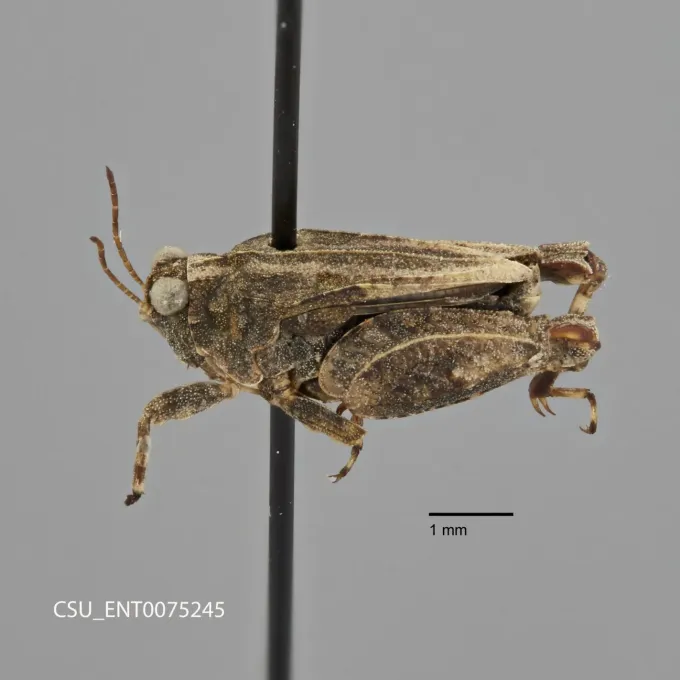
The Mexican pygmy grasshopper (Paratettix mexicanus) belongs to the Tetrigidae family of the order Orthoptera. These insects are small, typically measuring between 8 and 12 millimeters in length.
Their most distinguishing feature is the pronotum, which is greatly elongated and extends backward over the abdomen, often covering the wings entirely. This morphology gives them a cryptic appearance resembling bits of soil or debris.
The body color is highly variable, ranging from light brown to blackish tones, which serves as effective camouflage in their natural habitat. This mimicry makes them difficult to spot during routine field inspections.
They possess relatively short antennae consisting of about 12 to 14 segments. Their eyes are prominent and located on the dorsal part of the head, providing a wide field of vision for detecting threats.
These grasshoppers are moisture-loving organisms. They are most commonly found in damp environments, such as stream banks, marshy areas, and heavily irrigated agricultural fields where high humidity prevails.
What it damages
The primary diet of the Mexican pygmy grasshopper consists of algae, mosses, lichens, and decaying organic matter on the soil surface. However, they can shift to cultivated plants when their natural food sources are scarce.
The main risk occurs during the seedling stage of crops. The grasshoppers may feed on the tender cotyledons or young leaves, causing stunted growth or complete destruction of young seedlings.
Damage symptoms manifest as small, irregular notches along the edges of leaves. While individual damage is minor, high population densities can lead to significant thinning of crop stands.
These insects can also act as mechanical vectors for plant pathogens. By moving across contaminated organic matter and then onto healthy seedlings, they can facilitate the spread of fungal diseases.
Economic damage is most pronounced in greenhouses and nurseries. In these high-humidity settings, the population can increase rapidly, causing noticeable stress to young plant batches.
When it appears
The lifecycle begins in early spring as temperatures rise, signaling the emergence of adults from hibernation. They quickly resume feeding and search for suitable sites for oviposition.
There are typically one to two generations per year, depending on the climatic conditions. Peak activity usually coincides with the mid-summer period when nymphs are most numerous.
Overwintering occurs primarily in the adult stage. During the colder months, they seek shelter in cracks in the soil, under dense mulch, or within dense tufts of vegetation to survive the winter.
Reproduction is heavily influenced by soil moisture levels. Females lay their eggs in small clusters within damp soil, which is essential for the survival and successful development of the nymphs.
As autumn approaches and temperatures drop, the insects reduce their activity and gradually move towards their overwintering sites, where they enter a state of dormancy until the next spring.
Signs of infestation
The presence of the pest is best identified by checking for "bitten" leaves on young seedlings in the early morning. Unlike slugs, these grasshoppers leave no slime trails behind.
Field inspectors can detect them by walking through damp sections of the field; the grasshoppers will jump and scatter rapidly when disturbed, making them briefly visible against the dark soil.
The presence of tiny, dark fecal pellets near the base of the stems serves as a reliable indicator of their feeding activity. These pellets are usually concentrated in damp, protected areas.
In managed crops, look for localized damage patterns in areas with poor drainage. If the damage is strictly occurring in persistently wet soil patches, it is a hallmark sign of this species.
Monitoring boards or sticky traps placed near the ground in damp zones can also help in confirming the presence and estimating the density of the pygmy grasshopper population.
Control measures
The most effective long-term management strategy is improving field drainage. By preventing water stagnation, the environment becomes less hospitable for the grasshopper's lifecycle.
Good agricultural practices, including thorough field cleaning to remove crop residues, significantly reduce the availability of food and shelter for the insects.
Deep autumn plowing can be effective in disrupting the overwintering sites of the adults, thereby lowering the population pressure for the following planting season.
If economic thresholds are reached, chemical control using targeted insecticides is an option. It is crucial to choose products that are effective against Orthoptera and approved for use on the specific crop.
Biological control methods are increasingly popular, utilizing entomopathogenic fungi to reduce populations in an eco-friendly manner. These treatments are particularly useful in controlled environments like greenhouses.
Taxonomy
- Latin name
- Paratettix mexicanus
- Order
- Orthoptera (locusts)
- Family
- Tetrigidae
- EPPO code
- PTTXMX
Discussion
No discussions yet — be the first.