
Depressotetrix depressa
Depressotetrix depressa
Description
How to identify
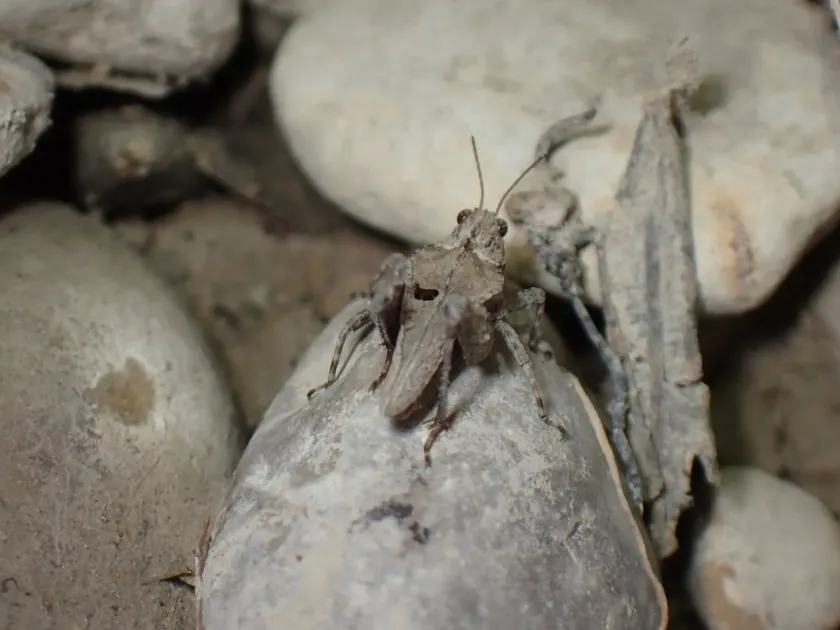
Depressotetrix depressa belongs to the Tetrigidae family, commonly known as grouse locusts or pygmy grasshoppers. The species name reflects its distinct flattened body structure.
These insects are masters of camouflage, possessing colors that blend seamlessly with soil and debris, making them difficult to spot in their natural habitat.
Equipped with powerful hind legs, they move primarily through short, sudden jumps, which allows them to quickly escape potential threats in the field.
The species usually lacks fully functional wings for long-distance flight, which contributes to their localized distribution in moist, open environments.
Their head structure features widely spaced eyes, providing an excellent field of vision to detect movement in their immediate surroundings.
What it damages
This pest is primarily known for damaging young seedlings of vegetable and cereal crops, especially those grown in high-humidity areas.
Damage is most severe during the early developmental stages, as the succulent tissues of young sprouts are highly attractive and easy for the insect to consume.
By feeding on the stem bases and cotyledons, the insects often cause the seedlings to wither and eventually collapse, leading to significant stand loss.
Beyond cultivated crops, the species can feed on mosses, lichens, and decomposing organic matter, allowing it to persist in the field environment.
Feeding sites can serve as entry points for various fungal and bacterial infections, compounding the damage caused by the insect itself.
When it appears
The life cycle of the pest is heavily influenced by soil temperature and moisture levels, which dictate their emergence and subsequent activity periods.
Nymphs typically emerge in the spring once the soil temperature reaches a threshold suitable for their initial development and foraging.
Adults remain active throughout the summer, often congregating in moist, poorly drained areas where vegetation is sparse but available.
They overwinter in the soil or under dense surface litter, where they are protected from temperature fluctuations and extreme winter conditions.
In warm climates, the species may undergo multiple generations within a single growing season, leading to rapid population growth if left uncontrolled.
Signs of infestation
Evidence of infestation often includes irregular, jagged holes along the edges of leaves and missing chunks of tissue near the soil line of stems.
A noticeable thinning of the plant stand and the appearance of stunted, wilting seedlings are key field indicators of a developing population.
Because they are most active during the cooler, humid parts of the day, early morning scouting is the most effective way to detect them.
- missing plant tissues on stems;
- wilting of young seedlings;
- visible insects jumping upon disturbance;
- small depressions on the root collar area.
If large numbers of insects are observed near the base of the plants, it is a definitive sign that immediate control actions should be considered.
Control measures
Effective management begins with cultural practices such as improving field drainage and maintaining weed-free rows to reduce favorable habitats.
Soil cultivation is highly effective as it disrupts the life cycle by destroying egg-laying sites and exposing nymphs to the elements.
When populations exceed economic thresholds, contact and systemic insecticides can be applied to suppress the pest population effectively.
Integrated Pest Management (IPM) programs should prioritize rotating chemical classes to prevent the development of insect resistance over time.
Encouraging natural enemies, such as ground beetles and certain bird species, can also help maintain population levels below the damage threshold.
Taxonomy
- Latin name
- Depressotetrix depressa
- Order
- Orthoptera (locusts)
- Family
- Tetrigidae
- EPPO code
- DPTXDE
Discussion
No discussions yet — be the first.