
Slender groundhopper
Tetrix subulata
Description
How to identify
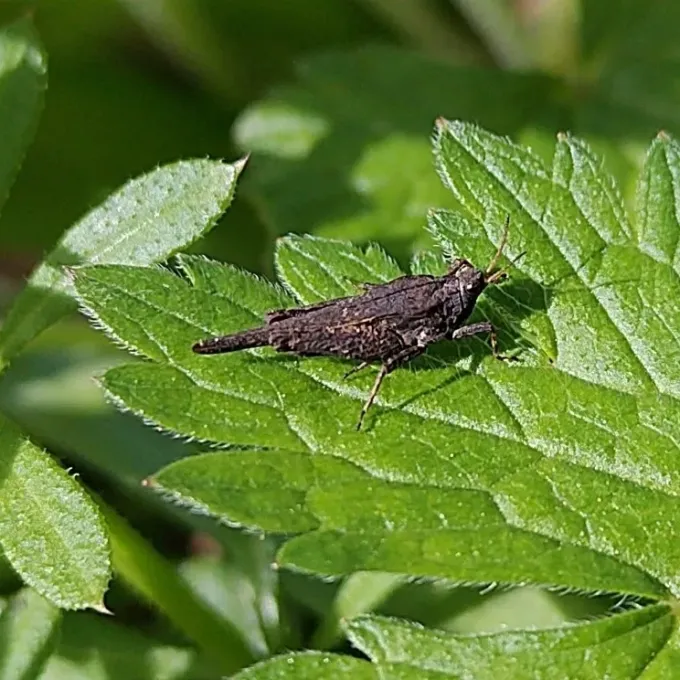
The Slender groundhopper (Tetrix subulata) belongs to the order Orthoptera and the family Tetrigidae. This small insect, ranging from 8 to 14 mm in length, is easily recognized by its pronotum, which extends far back over the abdomen, ending in a sharp point.
Its coloration is highly variable, ranging from light brown to nearly black, allowing it to camouflage perfectly against various types of soil and organic debris. Unlike common grasshoppers, groundhoppers lack arolia (pads) between their tarsal claws.
These insects prefer damp environments, making them common in fields near wetlands, ditches, and in areas with poor soil drainage. They are diurnal, active during the day, and use jumping as their primary mode of locomotion.
The life cycle includes eggs, nymphs, and adults. Notably, they are capable of overwintering as adults or late-stage nymphs, allowing them to resume activity immediately when weather conditions become favorable in the spring.
Reproduction takes place in the soil, and females typically lay their eggs in damp, mossy, or soil-rich environments near water sources.
What it damages
The main damage is caused during the early spring when overwintering individuals feed on the tender shoots of emerging cereal and vegetable crops. This consumption reduces plant vigor at a critical stage.
Damage often manifests as small holes or frayed edges on the leaves of seedlings, which can lead to stunted growth or even the total loss of plants in localized areas with high population density.
While the damage is usually not economically catastrophic across large fields, it can be severe in low-lying, poorly drained sections where environmental conditions are optimal for the species.
Beyond cultivated crops, the species feeds on various weed species, which helps maintain the population within the agricultural ecosystem throughout the season.
The level of damage is directly correlated with the humidity levels in the field, as these insects are strictly hygrophilous and thrive in moist soil conditions.
Signs of infestation
Visual identification of infestation involves observing uneven, jagged holes in the leaves of young seedlings. These symptoms are often found near field borders adjacent to wetlands.
During morning observations, farmers can see small, jumping insects moving away from the plants, which is a classic behavioral indicator of their presence.
Affected fields often show irregular patches of weak or damaged plants, particularly in low spots or near irrigation ditches where soil moisture remains high.
Entomological monitoring using a sweep net is the most effective way to quantify the population density and determine the necessity of control measures.
The absence of typical grasshopper swarming behavior suggests that damage is caused by localized populations rather than migratory outbreaks.
Control measures
The primary control strategy involves improving field drainage to eliminate the damp habitats that support the groundhopper’s life cycle.
Effective weed management, particularly on the edges of fields and near drainage ditches, removes alternative food sources and shelters for the insects.
Fall tillage is an essential practice that disrupts the soil surface and destroys the overwintering sites, significantly reducing the survival rate of the population.
Chemical control, using registered insecticides, should be considered only if the population exceeds the economic threshold for the specific crop and growth stage.
Monitoring should be focused on the early spring period, as the impact on young seedlings is most severe during this time, often requiring immediate intervention.
Taxonomy
- Latin name
- Tetrix subulata
- Order
- Orthoptera (locusts)
- Family
- Tetrigidae
- EPPO code
- TETXSU
Discussion
No discussions yet — be the first.