
Grouse locust
Tetrix ornata
Description
How to identify
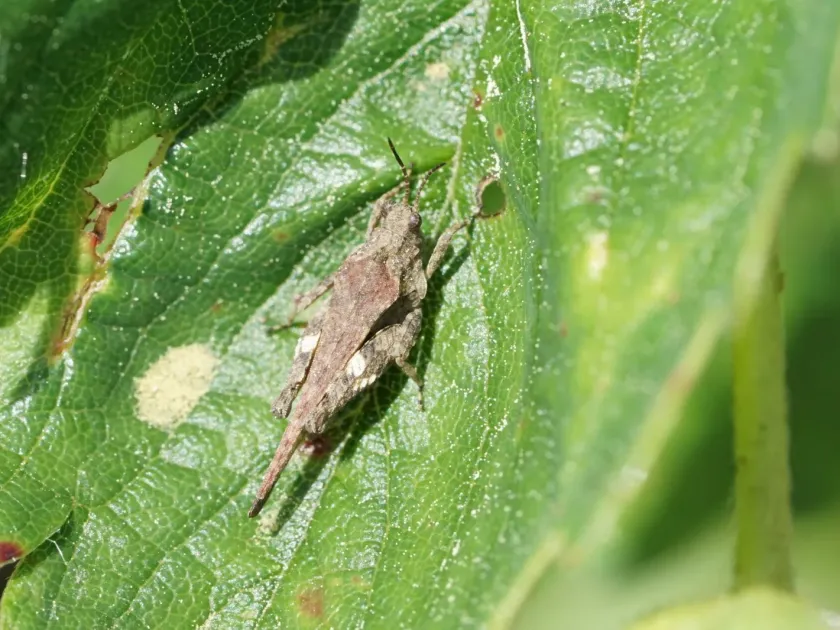
The grouse locust (Tetrix ornata) is a member of the order Orthoptera and the family Tetrigidae. It is a small insect, typically measuring between 10 and 12 millimeters in length.
It is easily recognized by its elongated pronotum, which extends backward to cover the abdomen and the wings. The coloration is highly variable, providing excellent camouflage against soil, dead leaves, or moss.
The wings are well-developed, allowing the adults to fly, although jumping is the primary method of movement. Short antennae, consisting of 12 to 14 segments, serve as a key identifying feature distinguishing them from other grasshoppers.
They typically overwinter as adults or older nymphs in the soil, under rocks, or within plant debris. With the onset of spring warmth, they emerge from their winter refuges to begin the reproductive cycle.
The biology of this species is closely tied to high humidity; therefore, they are most frequently found near water bodies, damp meadows, and along irrigation channels.
What it damages
While the grouse locust is generally considered a minor pest, feeding primarily on algae, mosses, and organic decay, it can become problematic during mass outbreaks.
Vegetable crops grown in greenhouses or on waterlogged fields are at the highest risk, as these insects may feed on seedling leaves and growth points.
In greenhouse environments, they pose a threat to young transplants, as feeding damage creates open wounds that facilitate the entry of secondary fungal and bacterial pathogens.
High population densities can lead to significant damage to cereal crop seedlings, especially in low-lying areas where soil moisture remains elevated after the growing season begins.
The injury manifests as irregular leaf edges and can lead to stand loss, directly impacting the crop density and overall yield quality.
When it appears
Active life cycle begins in early spring, as soon as the soil temperature reaches approximately 10–12 degrees Celsius, prompting the emergence from overwintering sites.
Peak activity is usually observed during May and June, which is the primary period for mating and egg-laying in the surface layer of moist soil.
One generation is produced during the summer season, although partial second generations may occur in warmer regions with favorable moisture conditions.
Towards the end of August, adult activity begins to decline as they move toward hibernation sites to survive the cold months.
In greenhouse settings, if sanitation is ignored, these insects can remain active year-round by migrating through the soil and micro-refuges within the structure.
Signs of infestation
The primary sign of infestation is the presence of small, irregular bites on the soil surface and at the base of stems, often occurring overnight.
Because they are timid and jump away at the slightest disturbance, visual detection is difficult unless one specifically inspects damp corners and moist soil patches.
The sight of numerous small insects jumping when disturbed in the field is a clear indicator of a significant localized population.
Excrement deposits on the soil surface within greenhouses can serve as a warning sign of an active colony feeding near the crops.
Stunted growth or yellowing of seedling edges without clear signs of disease often suggests hidden damage caused by these pests.
Control measures
Management of the grouse locust focuses on cultural practices aimed at reducing humidity and eliminating favorable breeding habitats.
- Improving drainage systems in fields to prevent waterlogging and excess moisture.
- Regular weeding to remove alternative food sources and hiding spots for the insects.
- Deep autumn tillage to disrupt wintering sites within the soil surface.
- Installation of fine-mesh screens on greenhouse vents and doors to limit insect migration.
In cases where populations exceed economic thresholds, the application of registered systemic insecticides may be necessary to protect the crop.
Biological control using entomopathogenic fungi can be highly effective in greenhouse environments, where humidity supports the success of such treatments.
Taxonomy
- Latin name
- Tetrix ornata
- Order
- Orthoptera (locusts)
- Family
- Tetrigidae
- EPPO code
- TETXOR
Discussion
No discussions yet — be the first.