
Japanese grouse locust
Tetrix japonica
Description
How to identify
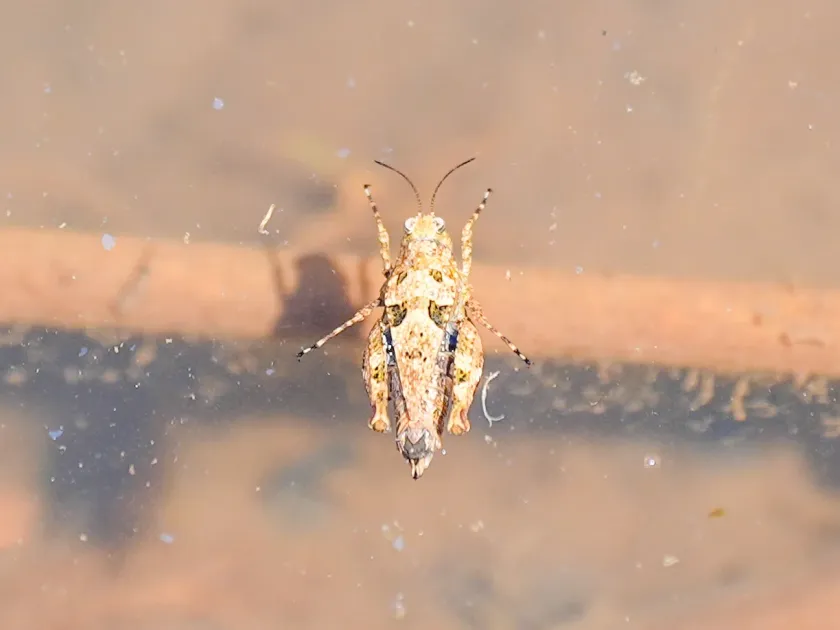
The Japanese grouse locust (Tetrix japonica) is a member of the Tetrigidae family within the order Orthoptera. These insects are small, typically measuring 10–12 mm in length, and are characterized by a long pronotum that extends over the abdomen.
They exhibit significant color polymorphism, ranging from light gray to dark brown or black, providing excellent camouflage against soil and leaf litter. Unlike grasshoppers, they lack hearing organs and are adapted for powerful, short-range jumping.
The head features prominent eyes that extend above the vertex, offering a wide field of view. Their wings are often reduced or absent, reinforcing their role as terrestrial insects that thrive in moist environments.
Their life cycle includes incomplete metamorphosis consisting of egg, nymph, and adult stages. They typically overwinter as late-stage nymphs or adults hidden in the topsoil or organic debris.
These insects prefer damp habitats where moss, algae, and lichens are abundant, as these form the base of their natural diet in undisturbed ecosystems.
What it damages
While their primary diet consists of mosses, algae, and decaying plant matter, Tetrix japonica can become a secondary pest in agricultural settings by feeding on young plant seedlings.
They pose a risk to vegetable crops and greenhouse seedlings, especially in areas with high humidity where they find shelter among the vegetation and soil surface.
The insects graze on the epidermis of young stems and leaves, causing physiological stress to the plant and leading to reduced growth rates or stunted development in early life stages.
In cases of high infestation, they may gnaw on the base of the stems, causing the seedlings to wilt or topple over, which is particularly detrimental to high-value nursery crops.
The damage is usually localized to the immediate vicinity of their humid hiding spots, but their presence can cause significant gaps in crop rows if left unmanaged during the germination phase.
Signs of infestation
Signs of infestation include irregular, jagged holes in the leaves of young seedlings, which are indicative of the feeding behavior of nymphs and adults.
Visual observation in the early morning or late evening often reveals small, jumping insects that retreat rapidly into the soil when disturbed by human presence.
The presence of mossy patches or persistently wet, poorly drained soil in or near the garden beds is a strong indicator of an environment suitable for these pests.
Wilting of seedlings that appears sudden, without signs of fungal or bacterial rot, may indicate that the stem base has been damaged by the insects during the night.
Yellowing or browning of leaf edges on developing plants, combined with stunted growth, often points to the lingering feeding activity of localized populations.
Control measures
Effective management begins with cultural practices, primarily ensuring proper soil drainage and removing excessive moss or debris from the vicinity of crop beds.
Deep cultivation or tilling of the soil is highly effective at disrupting their life cycle, as it exposes the overwintering nymphs and adults to predators and adverse conditions.
In greenhouse or indoor gardening conditions, maintaining low humidity and ensuring good air circulation are essential to deter these moisture-loving insects.
- Regular weeding to reduce available shelter.
- Application of contact insecticides if populations reach economic damage thresholds.
- Use of natural enemies or bio-pesticides for integrated pest management.
Chemical control should be applied judiciously, focusing on the specific areas of high density, as these insects do not usually migrate over long distances in large numbers.
Taxonomy
- Latin name
- Tetrix japonica
- Order
- Orthoptera (locusts)
- Family
- Tetrigidae
- EPPO code
- TETXJA
Discussion
No discussions yet — be the first.