
Artichoke moth
Tebenna micalis
Description
How to identify
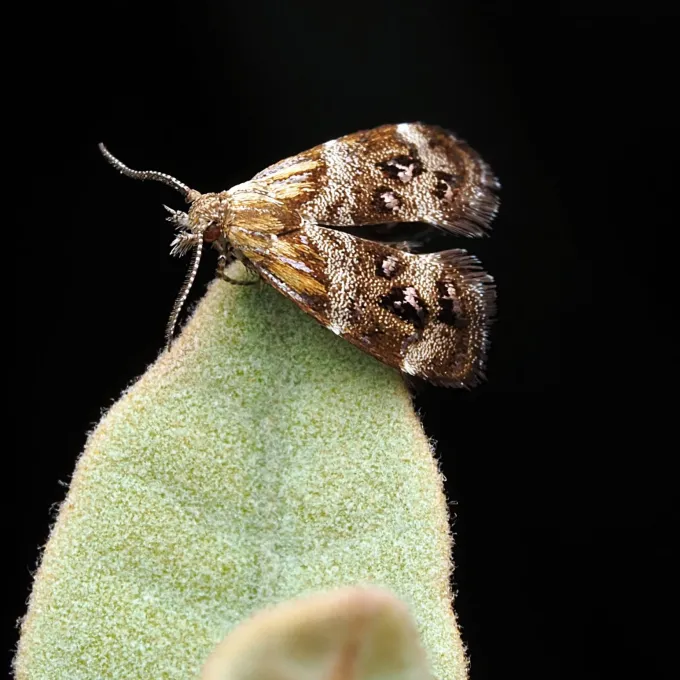
The artichoke moth (Tebenna micalis) is a small moth belonging to the Choreutidae family. The adult moth has a wingspan of approximately 10–12 mm, with brownish-gray forewings featuring metallic scales and faint light spots.
The larvae are about 10 mm long when fully grown. They possess a yellowish-green body covered in sparse, fine hairs and a distinct dark head capsule, which helps in distinguishing them from other garden caterpillars.
The life cycle undergoes complete metamorphosis, including egg, larva, pupa, and adult stages. Depending on local climatic conditions, the moth can produce several generations throughout a single growing season.
Pupation occurs within dense, white silken cocoons. These are often found attached to the underside of the leaves or hidden within dried plant debris remaining on the soil surface.
Adult moths are primarily nocturnal, showing most of their activity during dusk. However, they can occasionally be spotted during daylight hours in dense foliage if the weather remains overcast or humid.
What it damages
The artichoke moth primarily targets members of the Asteraceae family. While the globe artichoke is the most economically significant host, the moth also frequently infests various thistles, burdock, and related wild plants.
Larvae feed on the leaf tissue, creating mines or skeletonizing the leaves by eating the mesophyll while leaving the upper cuticle intact. This damage reduces the plant's ability to photosynthesize effectively.
Heavy infestations can result in the destruction of the apical growth point, leading to stunted plant growth and the deformity of young developing leaves.
The most severe damage occurs when larvae bore into the developing flower buds of the artichoke. This ruins the commercial value of the crop, as the buds become unsightly and prone to premature decay.
Damaged plants often show increased susceptibility to secondary bacterial and fungal pathogens, which thrive in the wounds created by the feeding larvae, further weakening the plant.
Signs of infestation
The first sign of an infestation is the appearance of light, translucent patches on the leaves. These "windows" occur where the larvae have consumed the internal leaf tissues.
The presence of fine webbing is a diagnostic feature. Larvae often use silk to bind leaf margins or hold young leaves together, creating a protected microenvironment for their feeding activity.
Small, dark, pellet-like excrement left on the underside of leaves or around the feeding sites provides clear evidence that larvae are actively present on the host plant.
When inspecting flower buds, look for small boreholes and dark-colored tunnels. These indicate that the larvae have penetrated the inner scales of the artichoke bud.
Plants under stress from this moth will exhibit general chlorosis, distorted foliage shapes, and an overall lack of vigor compared to non-infested specimens in the same area.
Control measures
Effective management begins with strict field sanitation. Removing and destroying crop residues immediately after harvest eliminates the overwintering sites for the pupae, breaking the life cycle.
Deep plowing or soil cultivation during the off-season helps bury debris and disturb the pupation sites, significantly reducing the emergence rate of adults the following spring.
Implementing monitoring programs using pheromone traps allows farmers to detect the arrival of adults early and determine the optimal timing for intervention before larval populations explode.
Biological control agents, such as Bacillus thuringiensis-based insecticides, are highly effective against young larvae and offer a more environmentally friendly alternative to traditional pesticides.
- Application of systemic insecticides if the economic threshold is reached.
- Encouraging natural predators and parasitoids in the surrounding area to maintain ecological balance.
- Using row covers in small-scale plantings to physically exclude moths from laying eggs on the crop.
Taxonomy
- Latin name
- Tebenna micalis
- Order
- Lepidoptera (butterflies)
- Family
- Choreutidae
- EPPO code
- TEBEMI
Discussion
No discussions yet — be the first.