
Apple-and-thorn skeletonizer
Anthophila
Description
How to identify
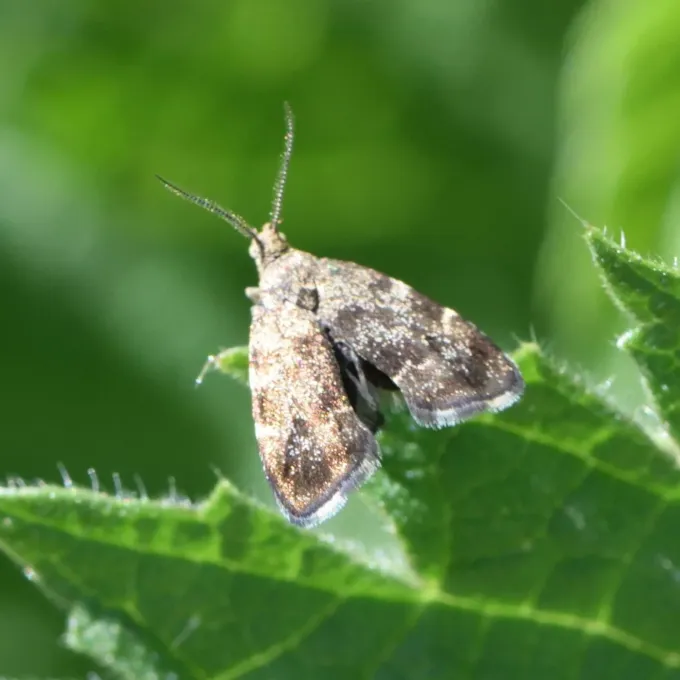
The apple-and-thorn skeletonizer (Anthophila pariana) belongs to the family Choreutidae, order Lepidoptera. Adult moths have a wingspan of approximately 10–12 mm, featuring intricate, mottled brown and metallic patterns on their wings.
Larvae are typically yellowish-green in color with a distinctive dark head capsule. They are known for their habit of reacting rapidly to vibrations or touch by dropping from the leaf on a silk thread.
The life cycle involves complete metamorphosis, including egg, larva, pupa, and adult stages. Depending on the geographical region, this species can produce multiple generations per year.
Pupation occurs within a thin, white, spindle-shaped cocoon, which the larvae spin on the undersides of leaves or in crevices of the bark, effectively protecting the developing insect.
Accurate identification is based on the specific leaf-feeding patterns and the presence of small, characteristic cocoons found attached to the host foliage during the active season.
What it damages
This pest primarily attacks members of the Rosaceae family, with a strong preference for apple, pear, cherry, and hawthorn trees, causing damage that can be significant in orchards.
Young larvae feed on the leaf epidermis, while older larvae skeletonize the leaf by consuming the soft tissues between the veins, leaving behind only the veins and the upper cuticle.
Heavy infestations lead to widespread leaf browning and premature defoliation, which severely limits the tree's ability to photosynthesize and accumulate resources for the next season.
While direct fruit damage is less common, the physiological stress caused by foliage loss can negatively impact fruit size, sugar content, and the formation of flower buds for the following year.
The accumulation of larval silk and frass on the leaves can create a favorable microclimate for secondary bacterial or fungal infections on the stressed plant tissue.
When it appears
The insect typically overwinters as an adult moth in sheltered locations, such as under loose bark, in leaf litter, or in protected areas around orchards and nearby structures.
Activity commences in early spring as temperatures rise, with the first moths emerging to mate and lay eggs on the newly developing foliage of host trees.
Larval activity peaks throughout the spring and summer months, often overlapping with the peak physiological needs of the host plants for fruit development and foliage maintenance.
Multiple generations allow the population to increase steadily if environmental conditions remain favorable, making mid-to-late summer a critical monitoring period for growers.
By autumn, the population transitions towards the final generation, which seeks out overwintering sites, signaling the end of the active feeding season for the pest.
Signs of infestation
The most prominent sign of infestation is the skeletonized appearance of leaves, where the soft tissue has been consumed, leaving only a lace-like network of veins.
The presence of fine, silky webbing stretched across the surface of the leaves, often used by larvae as a protective shelter, is a clear indicator of active feeding activity.
Observers should look for small, white, spindle-shaped cocoons tucked into leaf folds or along the leaf margins, which indicate the late larval or pupal stages of the pest.
Tiny dark droppings (frass) scattered on the leaves beneath the feeding sites are a reliable sign of larval presence, especially in the early stages of infestation.
Visible curling and drying of leaf margins, often accompanied by a brownish discoloration of the entire canopy, point to a serious outbreak requiring immediate management action.
Control measures
Sanitation is a cornerstone of management: removing and destroying fallen leaves during autumn eliminates many overwintering cocoons and reduces the initial population for the next spring.
Manual removal of heavily infested clusters of leaves is effective in small gardens, as it physically reduces the number of larvae and pupae present on the trees.
Biological control using Bacillus thuringiensis (Bt) sprays can be highly effective against young larvae, offering a selective option that minimizes impact on beneficial insect populations.
Chemical intervention should be reserved for threshold-exceeding infestations, utilizing targeted applications to ensure the protection of the crop while minimizing collateral damage to pollinators.
- Monitoring with pheromone traps to time interventions correctly
- Promoting natural predators like ladybugs and lacewings
- Maintaining healthy soil fertility to support tree resilience
- Strategic pruning to improve canopy air circulation and spray penetration
Taxonomy
- Latin name
- Anthophila
- Order
- Lepidoptera (butterflies)
- Family
- Choreutidae
- EPPO code
- AHPHSP
Discussion
No discussions yet — be the first.