
Choreutis
Choreutis
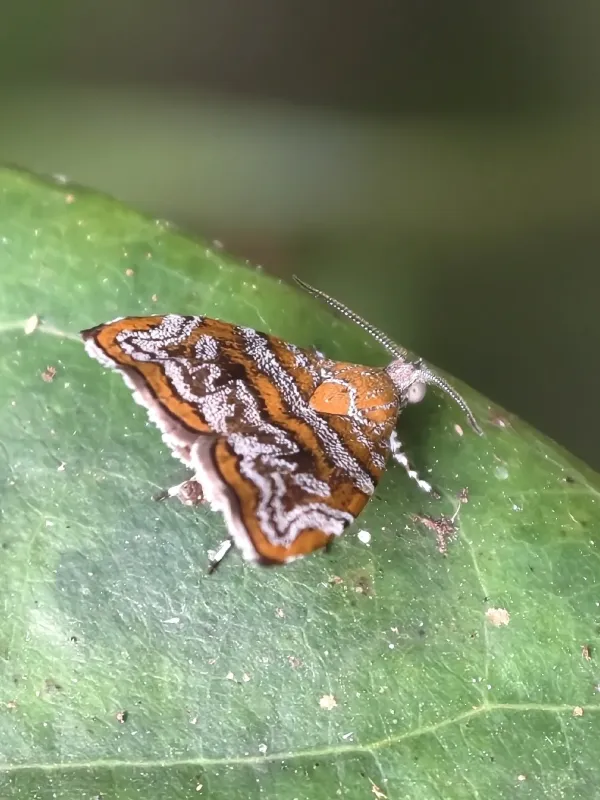
Description
How to identify
Choreutis is a genus of small moths belonging to the family Choreutidae. These insects typically have a wingspan of about 10–15 mm, often featuring metallic scales or intricate patterns that provide excellent camouflage on foliage.
Adult moths are primarily diurnal, which distinguishes them from many other moth species that are nocturnal. The larvae have cylindrical bodies, usually yellowish-green with dark spots, making them well-adapted to blend in with leaf tissues.
Systematically, this genus belongs to the order Lepidoptera. Their life cycle includes the egg, larva, pupa within a dense silken cocoon, and adult stages, consistent with most Ditrysia moths.
Identifying the pest at an early stage is difficult due to the secretive habits of the larvae, which prefer to dwell on the undersides of leaves or within rolled leaf structures.
For precise species identification, specialists must analyze the morphology of the adult genitalia, as different species within the genus often exhibit striking morphological similarities.
What it damages
These pests specialize in feeding on a wide range of plants, including members of the Asteraceae and Boraginaceae families, as well as various fruit and berry crops.
The primary damage is caused by the larvae, which feed voraciously on leaf tissues, skeletonizing the foliage or creating small "windows" by eating the mesophyll while leaving the epidermis intact.
During mass outbreaks, Choreutis populations can destroy a significant portion of the plant's photosynthetic surface, leading to stunted growth, reduced photosynthesis, and substantial yield loss.
Damaged leaves are often curled or tied together by the larvae using silk threads, creating protected shelters where they continue their feeding cycle undisturbed.
Severe infestations can lead to premature leaf drop, which significantly weakens the plant and decreases its overall winter hardiness against environmental stress.
When it appears
The activity of this pest is closely linked to seasonal temperature patterns. The first generation of adults typically emerges in late spring or early summer.
The development cycle of Choreutis is multi-generational, often producing two or even three broods per season, depending on regional climate and accumulated degree days.
The peak feeding intensity of the larvae usually occurs in mid-summer, coinciding with the period of maximum vegetative growth for the host plants.
Insects typically overwinter as adults in protected micro-habitats, such as under tree bark, in dry grass, or within leaf litter, allowing them to survive harsh winter temperatures.
In the spring, once stable temperatures are reached, the overwintered adults emerge to mate and lay eggs on young shoots and leaves of host plants.
Signs of infestation
The first signs of a Choreutis infestation include characteristic silken webbing on the foliage, within which larval frass (excrement) can usually be found.
The presence of specific "windows"—patches where only the leaf pulp has been consumed, leaving the outer skin intact—is a key visual marker of this pest's activity.
Leaf rolling or deformation, caused by the larvae pulling leaf tissues together with silk, is a common indicator of their presence on the plant.
Directly spotting the larvae while inspecting the underside of leaves provides definitive proof of an infestation within the plot or on specific crops.
A fine, dust-like accumulation of debris beneath leaf surfaces serves as a strong indicator of high larval activity in the immediate vicinity.
Control measures
Effective management of Choreutis involves cultural practices such as timely weeding to remove alternative hosts and deep soil cultivation in autumn to disrupt pupation sites.
Biological control options include the use of products based on Bacillus thuringiensis, which demonstrate high efficacy against early-instar larvae.
During high-pressure infestations, the application of contact-stomach insecticides registered for use on specific crops is recommended for immediate control.
It is critical to time insecticide applications strictly with the mass emergence of larvae, as they are most vulnerable to chemical exposure during their initial growth stages.
Regular monitoring using pheromone traps allows growers to detect the onset of adult moth flights, enabling the planning of protective measures before significant crop damage occurs.
Taxonomy
- Latin name
- Choreutis
- Order
- Lepidoptera (butterflies)
- Family
- Choreutidae
- EPPO code
- CRTUSP
Discussion
No discussions yet — be the first.