
Tebenna moth
Tebenna
Description
How to identify
The genus Tebenna belongs to the family Choreutidae, commonly known as metalmark moths. These are small insects distinguished by their broad wings and intricate metallic patterns that often shimmer in the light.
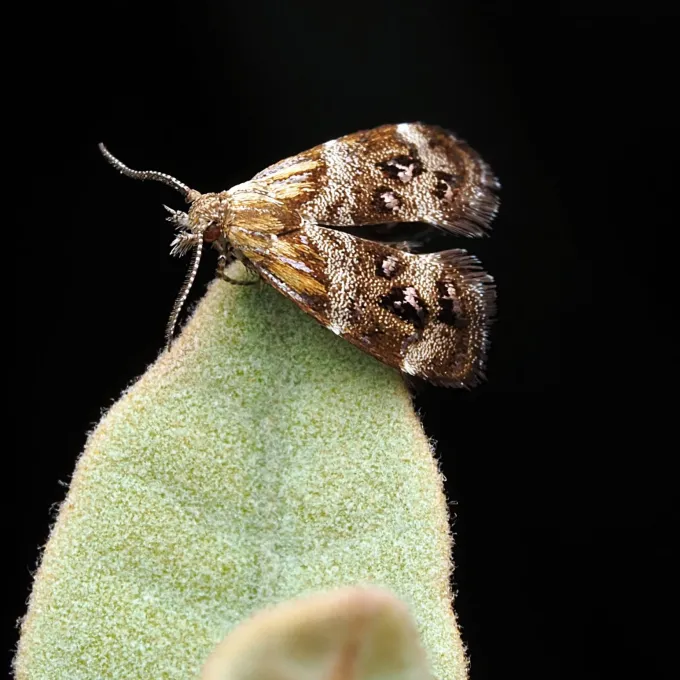
Unlike many moths that are strictly nocturnal, adult Tebenna are frequently active during the daytime. They have a wingspan typically ranging from 10 to 15 mm, with colors spanning dark browns, blacks, and vibrant spots.
The larvae are highly mobile caterpillars with well-developed legs. They often construct shelters by webbing leaves together, providing them with a secure environment to feed and develop safely.
Pupation occurs within a tough, white, silken cocoon. These cocoons are strategically placed on the underside of leaves or within folded foliage, protecting the developing moth from environmental stressors.
The life cycle is closely synchronized with the growth stages of their host plants. Depending on local temperature and humidity, these moths can complete multiple generations per growing season.
What it damages
Tebenna caterpillars primarily feed on plants within the Asteraceae family. Common hosts include plants like artichokes, thistles, and various ornamental Aster species.
The larvae cause significant damage to the plant's foliage. They initially skeletonize leaves by consuming the parenchyma and leaving only the vascular network, which severely hinders the plant's ability to photosynthesize.
In high-density infestations, the larvae may also target flower buds and developing inflorescences. This behavior can lead to reduced yields and significant loss of aesthetic value in ornamental plants.
The feeding sites create entry points for secondary infections, such as bacterial or fungal pathogens. These complications can exacerbate the damage, often leading to necrosis or premature defoliation.
The overall impact on plant health is proportional to the caterpillar population density. Neglected infestations can stunt plant development and significantly reduce overall vigor.
Signs of infestation
Visible white or pale spots on the leaves are often the first sign of Tebenna activity. These spots expand as the larvae grow, eventually creating large, irregular holes in the leaf tissue.
A fine, silk-like web on the underside of leaves is a diagnostic feature. Caterpillars are often found nestled within these webs or inside the folds of partially consumed leaves.
Dark granular frass (excrement) scattered on the leaf surfaces or caught in web clusters is a clear indicator that feeding is currently taking place.
Deformation of growing tips and curling leaves are frequent symptoms. If a plant appears suddenly wilted or damaged in specific sections, closer inspection of the foliage is necessary.
Gardeners should monitor the lower foliage during the early season, as this is where the larvae typically establish their initial feeding sites before moving upward.
Control measures
Cultural control is a primary defense; removing weeds that serve as alternative hosts is critical to breaking the life cycle of the moth near your crops.
Manual removal of infested leaves containing caterpillars or cocoons is highly effective in small-scale gardens or greenhouses where insect numbers are still low.
Biological control using Bacillus thuringiensis (Bt) sprays can be very successful in managing larvae without causing harm to beneficial insects or the surrounding environment.
If chemical intervention becomes necessary, systemic insecticides should be applied carefully to target the larvae while minimizing impact on local pollinator populations.
- Monitor insect populations with pheromone traps.
- Maintain proper plant spacing to reduce micro-climate humidity.
- Encourage natural predators like predatory beetles and parasitic wasps.
Taxonomy
- Latin name
- Tebenna
- Order
- Lepidoptera (butterflies)
- Family
- Choreutidae
- EPPO code
- TEBESP
Discussion
No discussions yet — be the first.