
Tarophagus
Tarophagus proserpina
Description
How to identify
Tarophagus (Tarophagus proserpina) is a species of planthopper belonging to the family Delphacidae. The adult is a small insect characterized by wings with distinctive dark markings, which assist in camouflage against the host plant leaves.
The insect undergoes several life stages: egg, nymph, and adult. Adults are highly mobile and capable of rapid movement between plants, making population monitoring in field conditions quite challenging.
Nymphs of the pest look similar to adults but are smaller in size and lack fully developed wings. They tend to aggregate in leaf axils, where a humid and protected microclimate is maintained for feeding.
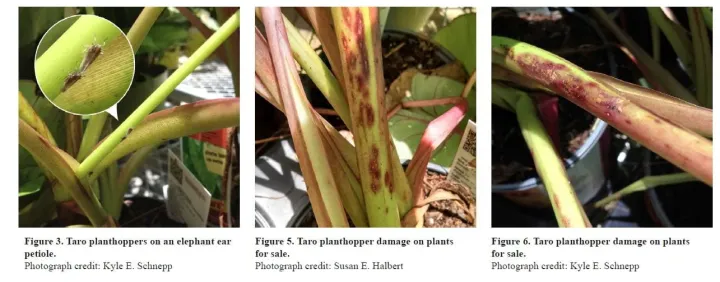
Primary identification involves visual inspection of the taro petiole bases, where these insects prefer to hide during daylight hours. When disturbed, adults quickly jump or fly away, which serves as a common behavioral cue for detection.
The biology of this pest is intrinsically linked to moisture availability, which explains why its peak activity consistently coincides with the active growing season of the crop under high relative humidity.
What it damages
The primary crop damaged by this pest is taro (Colocasia esculenta). The insect feeds by piercing the tender tissues of young leaves and petioles to extract plant sap.
During feeding, the pest injects toxic saliva, causing overall plant stress and deformation of the leaf blade. This directly impacts the quality and market value of the end product — the corms.
Tarophagus is also a significant vector for plant viruses. The transmission of viral infections often causes greater economic loss than the direct physical damage caused by the insect's feeding.
Under heavy infestation, a significant reduction in tuber yield is observed, as the plant redirects its metabolic resources toward repairing damaged tissues instead of developing high-quality corms.
Severe infestations can lead to premature leaf senescence, which critically impairs the plant's photosynthetic capacity and slows the growth of the entire plantation.
Signs of infestation
The first sign of infestation is the presence of characteristic white waxy secretions left by nymphs on the surface of leaves and within leaf axils. These secretions are easily visible during routine inspections.
Leaves of infested plants often appear curled or distorted. Chlorosis, or yellowing of tissue around feeding punctures, is commonly observed and becomes more prominent under bright lighting.
The presence of sooty mold, which grows on the honeydew excreted by the pests, serves as an indirect but reliable indicator of high Tarophagus population density.
Stunted growth of the taro plantation without obvious nutritional deficiencies often signals hidden damage by these planthoppers, especially if mass wilting of young shoots is noted.
Upon careful examination of the leaf undersides, one can find egg clusters embedded within the petiole tissue, appearing as small scars or slight swellings on the stem surface.
Control measures
An effective management strategy involves using clean, virus-free planting material. Strict quarantine measures at borders help prevent the spread of the pest into new regions.
Agronomic practices include regular weeding and the removal of crop residues from previous seasons, which can act as reservoirs for maintaining the pest population during the off-season.
Biological control emphasizes the use of natural enemies, such as predatory bugs, spiders, and parasitic wasps, which can significantly reduce the numbers of nymphs and adults.
In cases of critical infestation, systemic insecticides are applied. It is crucial to perform treatments during early morning or evening hours when the pests are most active on the leaf surfaces.
- Implementation of crop rotation.
- Utilization of taro varieties with natural resistance.
- Manual removal of severely infested leaves.
- Regular monitoring of plantations using yellow sticky traps.
Taxonomy
- Latin name
- Tarophagus proserpina
- Order
- Hemiptera (bugs, aphids, leafhoppers)
- Family
- Delphacidae
- EPPO code
- TAROPR
Discussion
No discussions yet — be the first.