
Delphacodes
Delphacodes
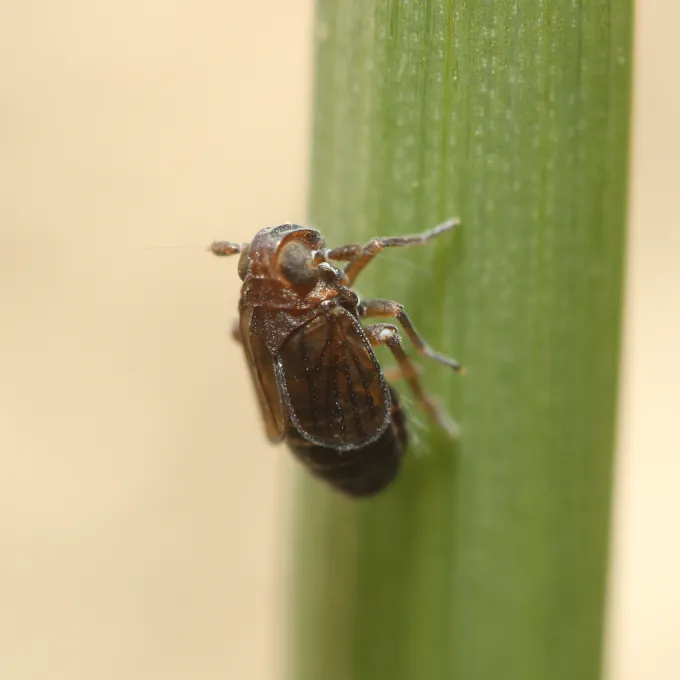
Description
How to identify
Delphacodes is a genus of insects within the Delphacidae family, commonly known as planthoppers, which are part of the Hemiptera order.
Adult planthoppers typically measure between 2 and 5 mm in length. Their coloration ranges from light brown to black, often blending with the surrounding crop foliage.
A defining morphological feature of this family is the large, movable spur at the apex of the hind tibiae, which facilitates their characteristic jumping behavior.
The nymphs resemble smaller, wingless versions of the adults. Their development involves incomplete metamorphosis, meaning they transition through several nymphal stages without a pupal phase.
These insects are highly agile and are often difficult to detect until their populations reach significant numbers in a field environment.
What it damages
Delphacodes primarily targets cereal crops, including wheat, barley, oats, and rye, as well as various wild grasses that serve as alternative hosts.
Both nymphs and adults feed by piercing plant tissues with their stylets to ingest sap, which depletes the plant's nutrient reserves and disrupts physiological processes.
Severe infestations cause yellowing of leaves, stunted growth, and a general decline in plant vigor, which directly impacts grain yield and quality.
Crucially, some Delphacodes species are primary vectors for various plant viruses, including oat sterile dwarf virus, which can cause total crop failure.
The physical damage combined with viral transmission makes these insects a major concern for commercial cereal production globally.
When it appears
Activity typically begins in early spring when overwintering nymphs emerge from hibernation as soon as temperatures rise above the development threshold.
The main dispersal flights of adults occur during late spring and early summer, allowing them to colonize new fields of spring-sown cereal crops efficiently.
Delphacodes often completes multiple generations throughout the growing season, necessitating ongoing vigilance and monitoring by farmers throughout the summer.
As autumn approaches, the insects prepare for winter by laying eggs in the tissues of perennial grasses or winter cereals, ensuring the population's survival.
Population density is heavily influenced by weather conditions, with warm and humid seasons often leading to explosive growth in planthopper numbers.
Signs of infestation
The first visual signs of infestation include chlorotic spotting and yellowing of the leaves, which may eventually lead to necrosis of affected tissue segments.
Plants infected with viruses transmitted by planthoppers often show characteristic distortion, such as excessive tillering, curling, or overall stunting.
Fields often exhibit localized patches of weakened, discolored plants, indicating areas where the insect population density has reached a critical level.
Field scouting using an entomological net in the early morning or evening hours is the most effective method for detecting the presence of these insects.
The presence of sticky honeydew on the foliage, followed by the growth of sooty mold, serves as an additional indicator of sap-sucking insect activity.
Control measures
Integrated Pest Management (IPM) is essential for controlling Delphacodes, starting with strict crop rotation practices to break the insect's life cycle.
Sanitation of field margins and the removal of wild grass hosts are critical to reducing the reservoir populations that colonize crops each season.
Systemic insecticides should be applied when thresholds are exceeded to minimize crop damage and reduce the risk of viral transmission within the field.
Choosing resistant or tolerant crop varieties can provide a buffer against damage in regions where these planthoppers are known to be problematic annually.
- Use of yellow sticky traps for monitoring population shifts.
- Post-harvest tillage to destroy crop residues and hibernating stages.
- Application of insecticidal seed treatments to protect young seedlings.
Taxonomy
- Latin name
- Delphacodes
- Order
- Hemiptera (bugs, aphids, leafhoppers)
- Family
- Delphacidae
- EPPO code
- DLCDSP
Discussion
No discussions yet — be the first.