
Delphacid planthopper
Calligypona pellucida
Description
How to identify
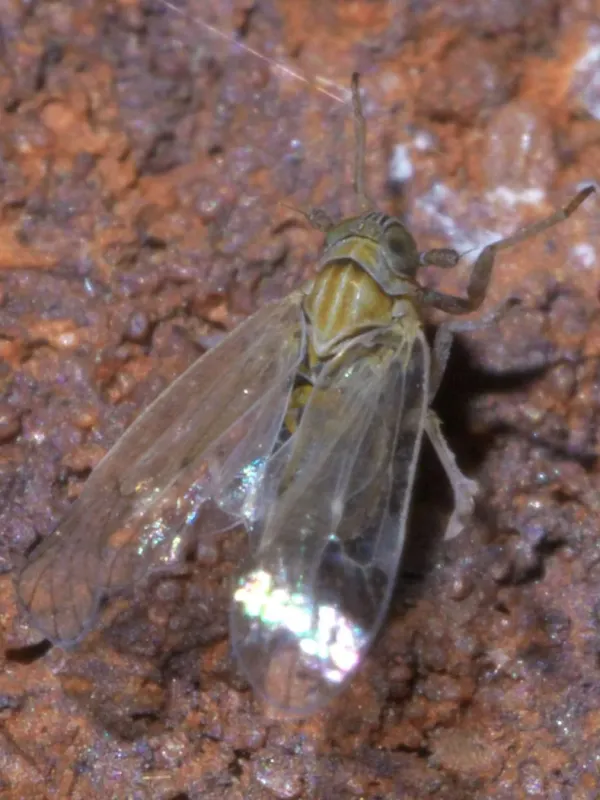
The Delphacid planthopper is a small insect, approximately 3-4 mm long, belonging to the family Delphacidae. The adult coloration ranges from yellowish-brown to nearly black, often varying between the sexes.
They are named for the distinctive net-like venation pattern on their wings. These insects exist in two forms: macropterous (long-winged) adults capable of migration and brachypterous (short-winged) adults.
Nymphs resemble the adults in body shape but are smaller and lack fully developed wings. They undergo several developmental stages, feeding primarily in the base of cereal grasses.
Identification in the field is usually done using sweep nets. Entomologists look for the characteristic jumping behavior when the foliage is disturbed, which is a tell-tale sign of their presence.
The insect overwintering stage is typically the older nymph instar, tucked away in the soil, plant debris, or crown areas of perennial grasses, ensuring they survive cold winters.
What it damages
This planthopper primarily attacks cereal crops, including wheat, barley, rye, and oats. The direct damage involves feeding on plant sap, which weakens the host plants and reduces overall vigor.
The most devastating aspect of their presence is their role as a vector for serious viral diseases, specifically the Oat Sterile Dwarf Virus. This virus prevents normal development and grain formation.
Infected plants show stunted growth, excessive tillering, and often fail to produce a healthy ear. The ear may become trapped in the leaf sheath, leading to total yield loss in affected areas.
The infestation often leads to yellowing and twisting of leaves, which can be misidentified as nutrient deficiencies. Such damage drastically decreases the photosynthetic capacity of the plants.
Economic damage is most significant when the infestation occurs during the early vegetative stages, as the virus can spread rapidly through the field, causing patch-like degradation.
When it appears
The planthopper has one generation per year (univoltine). Nymphs emerge in the spring as temperatures rise, usually above 8 degrees Celsius, to feed on growing cereal crops.
Adult emergence typically peaks in May and June, coinciding with the critical developmental phases of winter and spring grains. This is the period when they are most active in mating and laying eggs.
During the summer, the population cycles through its developmental stages. By late summer, new nymphs seek out suitable grasses or winter crop seedlings to begin their transition to dormancy.
Environmental factors like spring moisture significantly influence population density. Warm, humid springs provide ideal conditions for egg laying and nymph survival.
Monitoring the flight period is essential for timing insecticide applications, as the window for effectively reducing the population is relatively narrow during the adult stage.
Signs of infestation
Symptoms of an infestation start with chlorotic spots and streaks on the leaves. As feeding continues, the leaves may curl and turn brown, affecting the plant's overall appearance.
The most visible sign of viral transmission is stunted growth. The plant creates a dense cluster of unproductive shoots, often described as a "dwarf" appearance due to the shortened internodes.
Malformed ears that do not emerge from the leaf sheath are a classic diagnostic feature. These ears look like dense, deformed lumps and are a clear indication of a viral infection transmitted by the planthoppers.
Observation of insects using sweep nets reveals their concentration, especially in fields bordering permanent pastures or non-cultivated grassy strips.
The field appearance often shows distinct patches where growth has stopped, contrasting sharply with the healthy green surroundings of the rest of the crop.
Control measures
Effective management begins with strict crop rotation and physical isolation. Separating winter and spring cereal fields prevents the planthopper from migrating between crops.
Sanitation is key; eliminating grassy weeds around field margins removes the primary breeding grounds and virus reservoirs for the population.
Chemical control via systemic insecticides is necessary when the economic threshold is reached. These treatments are most effective against nymphs and adults before extensive viral spread occurs.
Seed treatment with systemic insecticides can provide early-season protection, significantly reducing the impact of primary infestations during the seedling stage.
- Regular monitoring using yellow sticky traps.
- Choosing resistant varieties where available.
- Timely cultivation to disrupt the life cycle in grassy areas.
Taxonomy
- Latin name
- Calligypona pellucida
- Order
- Hemiptera (bugs, aphids, leafhoppers)
- Family
- Delphacidae
- EPPO code
- CALGPE
Discussion
No discussions yet — be the first.