
Taro planthopper
Tarophagus colocasiae
Description
How to identify
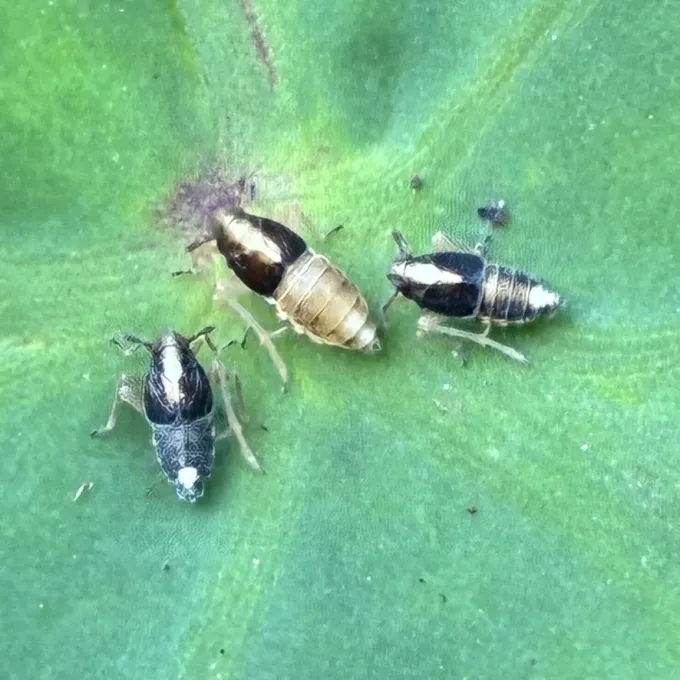
The taro planthopper (Tarophagus colocasiae) is a small insect belonging to the family Delphacidae within the order Hemiptera. Adult insects typically measure 3–4 mm in length and exhibit the characteristic appearance of planthoppers, often with dark wings.
Nymphs undergo several developmental stages, remaining on the host plant throughout their life cycle. They are highly active and tend to hide in leaf sheaths or on the underside of leaves, which often shields them from initial inspections.
This species thrives in humid tropical and subtropical climates, where environmental conditions support continuous year-round reproduction. Its presence is inextricably linked to the cultivation of taro and closely related aroids.
Females deposit eggs directly into the tissues of the leaf petioles or veins. This behavior not only provides protection for the developing eggs but also introduces small mechanical wounds that can facilitate secondary infections.
Taxonomically, this insect is a specialized herbivore adapted to the specific chemical and structural profile of taro plants. Its evolutionary success is due to its narrow host range, which ensures stability in its preferred tropical habitats.
What it damages
The primary host of this pest is edible taro (Colocasia esculenta). By utilizing its piercing-sucking mouthparts, the insect extracts sap directly from the phloem, causing direct physiological stress to the plant.
While taro is the main host, the pest may occasionally be found on other related aroids in the vicinity. This creates a potential reservoir for the pest within the agricultural landscape, complicating control efforts.
Heavy infestation leads to a significant reduction in overall plant vigor and tuber quality. Because the plant must divert energy to repair tissue and combat the stress of feeding, the final harvest yield is often substantially lower.
Chronic feeding results in leaf yellowing, stunting, and curling. These symptoms restrict the photosynthetic capacity of the plant, further hindering the development of the root system and the formation of healthy corms.
Perhaps the most critical form of damage is the transmission of viruses, such as the Alomae and Bobone diseases of taro. The insect acts as a vector, spreading these pathogens much faster and more destructively than its direct feeding damage.
Signs of infestation
The first indicator of an infestation is often the yellowing and wilting of young leaves, which may mimic signs of drought stress. Closer examination, however, reveals the underlying activity of the planthopper.
The presence of honeydew—a sticky, sugary substance secreted by the insects—is a diagnostic sign. This substance often supports the growth of black sooty mold, which coats the leaves and further inhibits photosynthesis.
When inspecting the base of the petioles or the leaf undersides, one can typically find colonies of adults and nymphs. Upon disturbance, these insects readily jump or scurry to hidden areas, demonstrating their defensive agility.
Fine stippling or pinprick-like marks appear on the leaf petioles, which are the sites of oviposition and feeding. These areas may eventually show signs of necrosis as the plant reacts to the tissue disruption.
Severe infestations cause the entire plant to appear stunted, with brittle and deformed leaves. In agricultural settings, this localized clustering of affected plants is a clear warning sign for immediate intervention.
Control measures
The foundation of effective management is the use of virus-free planting stock. Regular field scouting is essential to detect early-season populations before they reach threshold levels that justify intervention.
Cultural practices include the removal and destruction of heavily infested plants to reduce the local population density. Additionally, maintaining good weed control helps eliminate secondary hosts that might harbor the insects between cropping seasons.
Biological control, utilizing natural enemies like predatory bugs, spiders, and parasitoid wasps, is highly effective in maintaining a balance within the ecosystem. Encouraging these natural predators is a sustainable approach to pest management.
Chemical intervention should be limited to instances of severe infestation. When necessary, systemic insecticides are the most effective choice, as they ensure the active ingredient reaches the sap-feeding stages of the insect.
- Monitor fields using yellow sticky traps.
- Rogue out infected plants to prevent viral spread.
- Apply systemic insecticides during the cooler parts of the day.
Taxonomy
- Latin name
- Tarophagus colocasiae
- Order
- Hemiptera (bugs, aphids, leafhoppers)
- Family
- Delphacidae
- EPPO code
- TAROCO
Discussion
No discussions yet — be the first.