
European mole
Talpa europaea
Description
How to identify
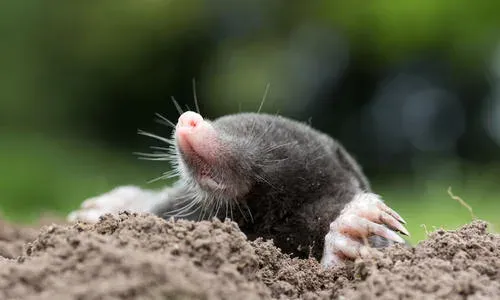
The European mole (Talpa europaea) is a small mammal belonging to the order Eulipotyphla and the family Talpidae. It is perfectly adapted for a subterranean life with powerful, spade-like forelimbs turned outwards for efficient soil displacement.
The mole has a cylindrical body covered in dense, velvet-like black fur. This fur is capable of lying in any direction, which prevents soil accumulation and allows the mole to move forward or backward through narrow tunnels with ease.
Its eyes are vestigial and almost hidden under the fur, while external ear flaps are absent to protect against soil ingress. The mole relies heavily on its keen sense of smell and sensitive whiskers to navigate the dark tunnel systems.
Adult moles typically measure between 12 and 16 cm in length. They are solitary creatures and fiercely territorial, maintaining complex networks of deep nesting chambers and shallow feeding tunnels.
Due to their high metabolic rate, moles must consume nearly their own body weight in food daily, primarily consisting of earthworms, insects, and other soil-dwelling invertebrates.
What it damages
The primary damage caused by moles is mechanical. As they construct tunnels, they often lift and break the root systems of vegetable crops, seedlings, and flowers, causing the plants to wither and die.
For gardeners, the most visible impact is the creation of molehills. These mounds of displaced soil ruin the appearance of lawns and athletic fields, creating uneven surfaces that complicate mowing and maintenance.
Moles can also damage irrigation pipes and drainage systems. Their tunneling activities create large voids in the soil, which can lead to ground subsidence and instability in paths, paving, or even building foundations.
While moles are insectivores, their tunnel networks serve as highways for various species of voles and mice. These rodents use the mole tunnels to access and devour roots, bulbs, and seeds, indirectly increasing the pest pressure on the garden.
In newly planted garden beds, mole activity can be catastrophic, as the disturbance to the topsoil layer leaves delicate young roots exposed to air, leading to rapid desiccation.
When it appears
European moles do not hibernate and remain active throughout the year. Their activity levels depend primarily on food availability and soil moisture levels rather than the season itself.
Spring is a period of peak surface activity. This is when the soil is soft after winter, and moles are busy expanding their territory for mating and rearing offspring, leading to an increase in fresh mounds.
During the heat of summer, when the topsoil becomes dry and hard, moles tend to retreat to deeper, cooler, and more humid layers of the ground where earthworms are still present, making them less visible.
Autumn brings a resurgence of surface activity as moles prepare for winter. They refurbish their tunnel networks and deepen their nesting chambers to ensure survival during periods of frost.
In winter, as long as the ground does not freeze to extreme depths, moles continue their tunneling activity underneath the snow and the frozen crust, maintaining their constant hunt for prey.
Signs of infestation
The most tell-tale sign of a mole presence is the sudden appearance of molehills—conical mounds of fresh soil pushed up from deeper underground tunnels.
Another classic indicator is the formation of surface ridges. These look like raised veins in the lawn or garden bed, created by the mole pushing the earth upward as it navigates just below the grass level.
Wilting plants that appear healthy but have their roots severed or exposed indicate that a mole tunnel has likely passed directly underneath the root zone.
- Patches of ground that feel spongy or collapse slightly when stepped on.
- Unexpectedly poor plant growth in specific rows compared to the rest of the garden.
- Frequent soil disturbance occurring overnight or after a heavy rainfall.
Observing the garden after wet weather is effective because damp soil makes it much easier to detect new structural changes in the terrain caused by subterranean movement.
Control measures
Controlling European moles is challenging due to their elusive nature. A successful strategy usually involves a combination of exclusion and physical trapping.
The most effective method for immediate population reduction is the use of specialized, professional-grade mole traps placed within the primary active tunnel runs.
To prevent lawn damage, installing a high-quality galvanized steel or heavy-duty plastic mesh beneath the grass level is the gold standard. This creates a permanent barrier that moles cannot penetrate.
Vibrational or sonic repellent devices can be used to deter moles from specific areas. However, these results are often inconsistent as moles may adapt to the noise or simply tunnel around the disturbance.
Removing the mole's food source, such as managing grub populations in the lawn, can discourage them from settling, though this requires careful soil management and may take significant time to show results.
Taxonomy
- Latin name
- Talpa europaea
- Family
- Talpidae
- EPPO code
- TALPEU
Discussion
No discussions yet — be the first.