
Pyrenean desman
Galemys pyrenaicus
Description
How to identify
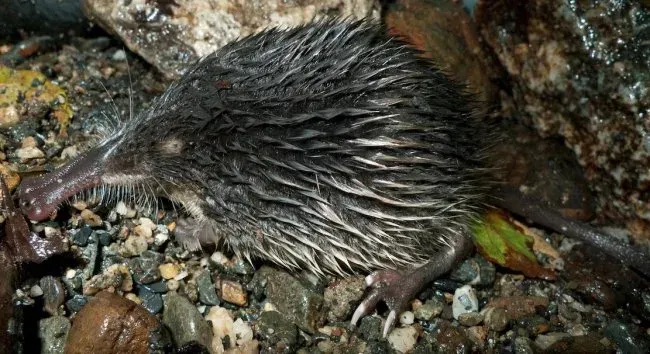
The Pyrenean desman is a unique semi-aquatic mammal belonging to the Talpidae family. It is easily identified by its long, flexible proboscis and a laterally compressed tail covered in scales and sensory hairs.
This animal is perfectly adapted to life in cold mountain streams. Its fur has exceptional waterproof properties, keeping the skin dry even after prolonged submersion in freezing water.
The desman features specialized limbs: the front feet are designed for digging burrows, while the hind feet are webbed to provide efficient swimming capabilities in turbulent currents.
Adult specimens measure between 11 and 16 centimeters in length, with a tail that often exceeds the body size. Despite its appearance, it is a very agile and cautious creature.
It is an endemic species native to the Pyrenees region, serving as a bioindicator for the health and cleanliness of mountain river ecosystems.
What it damages
The Pyrenean desman is not an agricultural pest. It belongs to the order Eulipotyphla, and its diet consists entirely of aquatic invertebrates such as caddisfly larvae, stoneflies, and small crustaceans.
It has no interest in crops, vegetables, or fruits. Its physiological structure and teeth are specialized for crushing the hard exoskeletons of insects, not for consuming plant matter.
There is absolutely no evidence of this animal damaging fields or orchards. Any assumption that it acts as a pest is scientifically inaccurate and biologically impossible.
The presence of a desman near agricultural lands is actually a positive sign, indicating that the nearby water sources are free from toxic contamination and synthetic pollutants.
Farmers do not need to implement any control measures, as these rare animals pose zero threat to agricultural production or human livelihood.
When it appears
The Pyrenean desman remains active throughout the entire year, as its mountain habitat does not experience deep freezes that would force it into hibernation.
The species is primarily nocturnal and crepuscular, meaning it performs most of its hunting activities during the night or twilight hours to avoid potential predators.
The breeding season typically occurs during warmer months, which align with the peak availability of aquatic prey, ensuring the survival of the offspring in harsh mountain environments.
Seasonal flood events, often triggered by snowmelt or heavy rainfall, can cause temporary shifts in the desman's territory as it seeks stable sections of the riverbank.
The animal's metabolism and hunting behavior fluctuate slightly based on the temperature and oxygen levels of the water, which dictate the activity of its prey.
Signs of infestation
The presence of the Pyrenean desman is difficult to detect due to its shy nature. The most common signs are hidden tunnel entrances located below the water line in riverbanks.
Feeding remains, such as discarded insect husks found on riverside rocks, can indicate the presence of a "dining site" where the animal has consumed its catch.
Footprints may be visible in soft, moist silt along the bank, although these are rarely preserved for long due to the fast-flowing nature of the watercourses.
A distinct musky odor, produced by scent glands, may sometimes be detected in the immediate vicinity of burrows during the breeding season.
Environmental DNA (eDNA) sampling in water remains the most accurate modern method for verifying the presence of this elusive species in a specific stream or river.
Control measures
The Pyrenean desman is a protected species under various national and international regulations. No control measures are permitted, as the species is of high conservation value.
Conservation efforts focus on maintaining water quality. Farmers are encouraged to manage runoff effectively to prevent pesticides and fertilizers from entering river systems.
Preserving natural vegetation along riverbanks is crucial, as this prevents erosion and provides the necessary structure for the desman to construct its dens.
Buffer zones around agricultural fields act as natural filters, reducing the impact of farm chemicals on aquatic habitats where the desman resides.
If a desman is observed in a working area, the correct professional approach is to ensure the area remains undisturbed to allow the animal to thrive in its natural habitat.
Taxonomy
- Latin name
- Galemys pyrenaicus
- Family
- Talpidae
- EPPO code
- GALMPY
Discussion
No discussions yet — be the first.