
European mole
Talpa
Description
How to identify
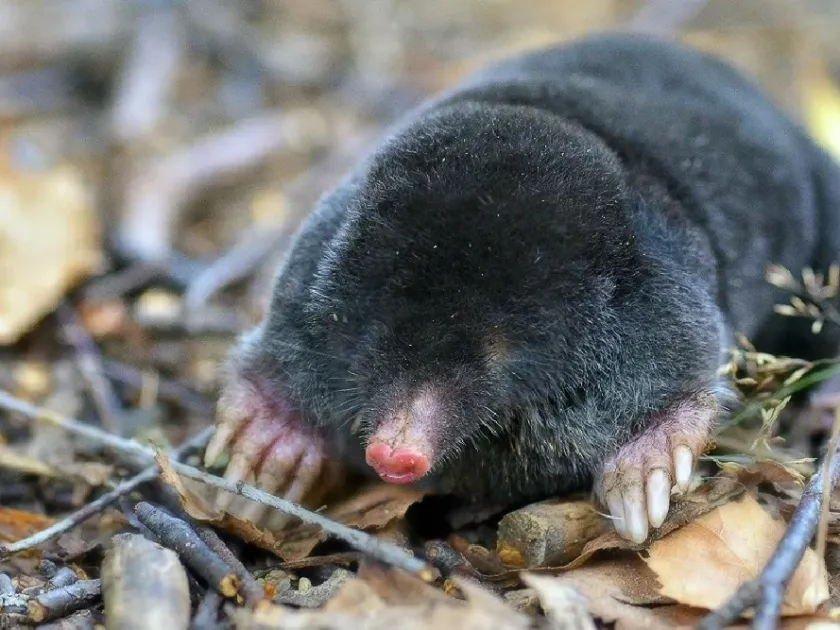
The European mole (Talpa europaea) is a mammal belonging to the order Eulipotyphla and the family Talpidae, adapted for a subterranean life.
Their bodies are cylindrical and covered with dense, velvety fur that grows in any direction, allowing the mole to move forward or backward in tunnels with ease.
The front limbs are highly specialized, broad, and spade-like, equipped with strong claws designed for rapid excavation and moving soil efficiently.
While their eyes are small and covered by skin, their hearing and sense of smell are extremely acute, compensating for the lack of vision in darkness.
An adult mole usually measures between 12 and 16 cm, possessing a pointed snout and a short, sensitive tail used for navigating their tunnels.
What it damages
Although moles are insectivores and primarily eat earthworms, their tunneling behavior causes significant indirect damage to crops and garden plants.
The creation of subterranean tunnels often disrupts the root systems of plants, causing roots to lose contact with soil and moisture, leading to dehydration.
Raised ridges of soil on the surface create uneven ground, which can destroy lawns, flower beds, and the structural integrity of vegetable rows.
Young trees and seedlings are particularly vulnerable, as their root systems can be easily destabilized, causing them to wilt and eventually die off.
Furthermore, mole tunnels provide an easy passage for mice and voles, which can cause secondary damage by feeding on roots, bulbs, and tree bark.
When it appears
The European mole is active throughout the entire year, as they do not hibernate and continue their tunneling activities even during colder months.
Spring is the period of peak activity, as the ground thaws and becomes rich in prey, leading moles to expand their territories and build new tunnels.
During the summer months, moles may retreat to deeper, cooler soil layers to avoid the heat and seek moisture, making them less visible on the surface.
In the autumn, activity often increases again as they prepare their nesting chambers and store food for the upcoming winter season.
Throughout the year, their presence is continuous, and they never leave the underground environment, making them a persistent challenge for gardeners.
Signs of infestation
The most distinctive sign of mole activity is the presence of molehills — mounds of soil pushed to the surface as they excavate their deep tunnel systems.
On lawns and cultivated areas, one can often see raised, meandering ridges where the mole has moved just beneath the surface of the ground.
Soft or collapsing ground underfoot is another indicator of an extensive network of tunnels built by the mole throughout the garden space.
Wilting plants and shrubs without apparent disease symptoms can often be traced back to disrupted roots caused by nearby subterranean digging.
- Fresh mounds of soil appearing after heavy rain or damp weather.
- Visible ridges along the surface of the lawn.
- Unexplained death of seedlings or small plants.
Control measures
Effective mole control relies on a combination of deterrents and physical barriers designed to protect the garden from subterranean invasion.
Vibrational or ultrasonic devices can be used to disturb the mole's sensitive senses, encouraging them to relocate to a less noisy area outside your plot.
The most permanent solution involves installing a wire mesh barrier deep into the ground around the perimeter of the garden to block their entry.
Reducing the availability of food sources, such as soil-dwelling grubs and worms, can also make your garden less attractive to moles over time.
In severe cases, mechanical traps can be used, but these must be placed correctly within active tunnels to be effective in managing the mole population.
Taxonomy
- Latin name
- Talpa
- Family
- Talpidae
- EPPO code
- TALPSP
Discussion
No discussions yet — be the first.