
Moss staphylinid
Tachyporus hypnorum
Description
How to identify
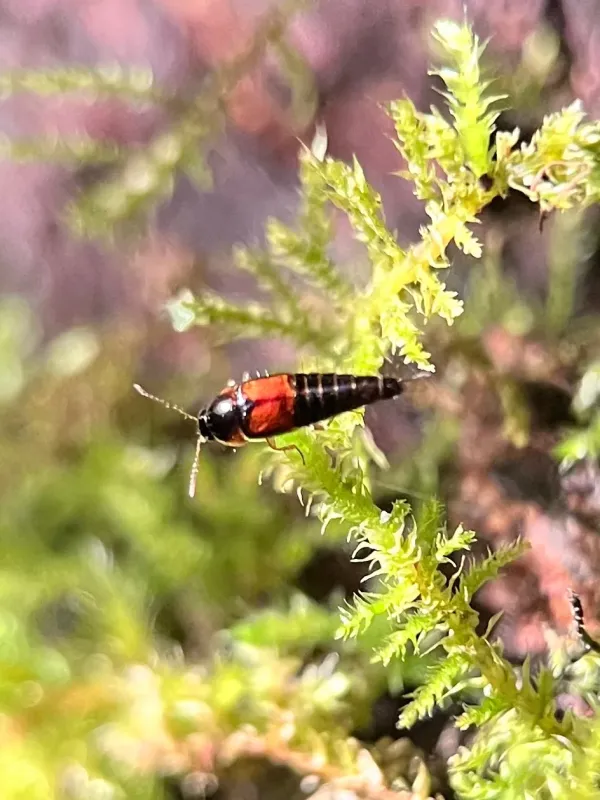
The moss staphylinid (Tachyporus hypnorum) is a beetle belonging to the Staphylinidae family, commonly known as rove beetles, which are known for their speed and agility.
The adult insect typically measures between 3 and 5 mm in length. Its body is distinctively drop-shaped, which helps differentiate it from other species within the genus Tachyporus.
The coloring of the insect ranges from brown to black, frequently featuring yellowish or reddish margins on the pronotum and elytra, providing camouflage in moss and leaf litter.
The larvae are slender and highly mobile, equipped with well-developed legs and specialized sensory organs that assist them in navigation through soil pores.
This beetle is characterized by its high metabolic rate and rapid movement, often escaping visual detection by burrowing into the topsoil when disturbed.
What it damages
While Tachyporus hypnorum is primarily viewed as a beneficial predator of small soil organisms, it can behave as a facultative pest under specific environmental stressors.
Damage occurs when natural prey, such as collembola or mites, is scarce, forcing the beetle to feed on the tender tissues of young seedling sprouts.
Crops affected include various cereals, oilseed rape, and emerging vegetable seedlings, where the beetles scrape or pierce the plant epidermis during the early growth stage.
Feeding injury appears as small, irregular pits on cotyledons and stem bases, which can weaken young plants and make them more susceptible to subsequent plant diseases.
In high-density populations, this supplemental feeding behavior can lead to reduced plant stands and significant economic losses in early spring crop establishment.
When it appears
The life cycle of the moss staphylinid is highly dependent on spring soil temperature, with activity commencing as soon as the ground thaws and warms sufficiently.
Adults emerge from hibernation sites in early spring, migrating to cultivated fields where they seek food and suitable moisture levels for their activity.
Egg-laying typically occurs during late spring and early summer, with the life stages progressing rapidly through the warmer months of the agricultural season.
The larval stage is spent within the soil profile, where they benefit from the humid microclimate, feeding and developing throughout the peak growing season.
Autumn brings the cooling period, signaling the beetles to retreat into deeper soil strata or stable vegetation debris to survive the winter months.
Control measures
Effective management begins with integrated agricultural practices, such as crop rotation and timely field preparation, to reduce the availability of breeding habitats.
Removing crop residues and controlling weeds before planting helps eliminate the protective cover that staphylinids require to survive and reproduce in the field.
Seed treatments with systemic insecticides are recommended in areas with known historical problems to protect emerging seedlings from early-season injury.
Conservation of biological control agents that prey on rove beetles can also help maintain natural balance, reducing the need for chemical interventions.
Monitoring programs involving ground traps allow for the assessment of population density, enabling growers to apply protective measures only when threshold levels are met.
Taxonomy
- Latin name
- Tachyporus hypnorum
- Order
- Coleoptera (beetles)
- Family
- Staphylinidae
- EPPO code
- TACPHY
Discussion
No discussions yet — be the first.