
Aleochara bilineata
Aleochara bilineata
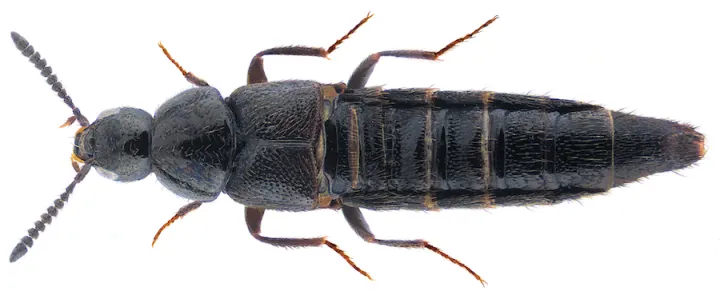
Description
How to identify
Aleochara bilineata is a species of rove beetle (family Staphylinidae) that plays a critical role in agricultural ecology. These beetles typically measure between 3 to 5 millimeters in length and are characterized by their elongated bodies and shortened elytra.
Their coloration is generally dark brown to black, with a pubescent surface. A key diagnostic feature for this species is the presence of specific sensory structures on their antennae that help them locate their hosts.
The lifecycle involves a complete metamorphosis, including egg, three larval stages, pupa, and adult. The first-instar larvae are highly mobile, searching actively through the soil for the puparia of their host flies.
As a specialized parasitoid, Aleochara bilineata primarily targets various species of Anthomyiidae flies. It has evolved to synchronize its life cycle with its hosts, ensuring a constant food supply for its offspring.
They are predominantly found in organic-rich soils where moisture levels are sufficient for both the beetle and the host populations to thrive.
What it damages
Aleochara bilineata is not a plant pest; it does not consume plant tissues, roots, or foliage. Therefore, it causes no economic damage to crops.
Instead, the beetle is considered a beneficial organism. Its larvae are parasitic, feeding on the pupae of major agricultural pests, most notably the cabbage root fly (Delia radicum).
By consuming these pests during their pupal stage within the soil, the beetle significantly reduces the emergence rate of the next generation of harmful flies.
This predatory action acts as a natural suppressive force, providing essential ecosystem services that maintain agricultural productivity.
Because they target the pupae directly, they prevent damage before it occurs, making them a cornerstone of integrated pest management (IPM) strategies for cruciferous crops.
When it appears
The activity of adult Aleochara bilineata begins in early spring, synchronized with the emergence of the adult flies they parasitize.
Peak populations are usually reached during the summer months, aligning with the prime oviposition period of the cabbage root fly.
The beetle completes its development through the summer, often producing multiple generations depending on environmental temperature and host availability.
As temperatures drop in autumn, the beetles move deeper into the soil profile to find refuge for overwintering, typically in the adult or pupal stage.
The beetle's ability to survive in the soil allows it to remain dormant during harsh conditions and re-emerge promptly when conditions become favorable.
Control measures
There is no need to control Aleochara bilineata, as it is a beneficial insect. Efforts should be directed toward preserving and encouraging their presence in agricultural fields.
Integrated pest management strategies should prioritize the protection of these beetles by avoiding the application of broad-spectrum soil insecticides that could decimate their populations.
Farmers are encouraged to use techniques that preserve soil structure, such as minimal tillage and the use of organic amendments, which favor the development of beneficial soil fauna.
By reducing the frequency of toxic pesticide applications, growers can foster a self-regulating environment where the beetle effectively manages pest populations.
- Avoid soil-applied insecticides that kill beneficial coleoptera.
- Implement cover cropping to maintain soil moisture and habitat.
- Monitor pest thresholds before considering chemical interventions.
Taxonomy
- Latin name
- Aleochara bilineata
- Order
- Coleoptera (beetles)
- Family
- Staphylinidae
- EPPO code
- ALEOBI
Discussion
No discussions yet — be the first.