
Rove beetles of the genus Tachinus
Tachinus
Description
How to identify
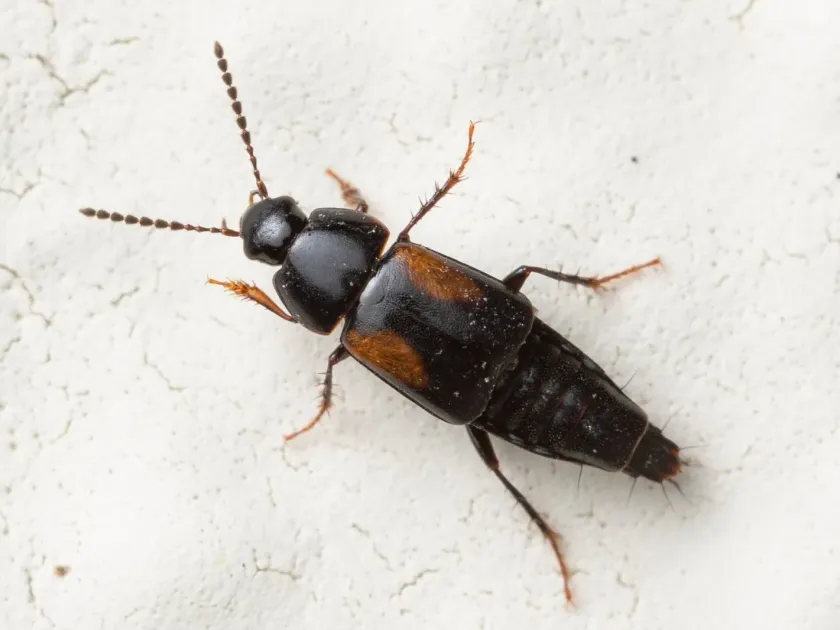
Rove beetles of the genus Tachinus belong to the family Staphylinidae, which are characterized by their shortened elytra that leave most of the abdomen exposed.
These beetles typically have a compact body with a noticeable sheen, often dark brown or black in color with reddish tints on the legs.
A distinctive feature is their flexible abdomen, which they can lift, and the presence of dense hairs on the body surface, which helps in identification through macro-observation.
Adult individuals are usually 3 to 7 millimeters long, making them difficult to spot during a quick visual inspection of crops in field conditions.
For accurate identification, agronomists use morphological analysis of the antennae and tarsal segments, which distinguishes this genus from other predatory rove beetle species.
What it damages
These beetles primarily cause damage under high-humidity conditions, concentrating on weakened plants or decaying organic matter in the root zone.
While many staphylinids are predators, some species of Tachinus may feed on seedling tissues, causing damage to the epidermis.
Damage is most commonly seen in vegetable crops grown in greenhouses, where high substrate moisture favors insect reproduction.
In cases of high population density, the pests can damage the root collar and young leaves, creating entry points for secondary bacterial and fungal infections.
They pose a particular danger to seedlings, as the disruption of tissue integrity at early stages leads to stunted growth or plant mortality.
When it appears
The activity of Tachinus species is directly dependent on temperature and soil moisture levels, typically peaking in the spring and summer.
The beetles prefer cool and damp environments, so their activity noticeably increases after heavy rainfall or when irrigation management in greenhouses is poor.
Larvae develop in the soil or under layers of leaf litter, making their life cycle hidden from an agronomist's visual inspection for long periods.
Adults are active at dusk, although in dense plantings, they can be found throughout the day in the immediate root zone of plants.
Seasonal population dynamics require monitoring using soil traps placed just before the start of the crop's active growth phase.
Signs of infestation
The first sign of infestation is the presence of specific bite marks on the lower part of the stem, often accompanied by signs of decay.
During plant inspections, yellowing and wilting of lower leaves can be observed, caused by damage to the vascular system near the root collar.
The presence of large numbers of beetles in the topsoil, detected by gently loosening the substrate, indicates a high population density.
Damaged tissue areas often become dark, soft, and emit an unpleasant odor due to the development of secondary microbial activity.
Another sign of infestation is the detection of characteristic pest droppings on the soil surface around the base of the affected plant stem.
Control measures
The key management strategy is adhering to cultural practices aimed at reducing excessive soil moisture and ensuring regular sanitation of the planting area.
It is essential to promptly remove plant debris, which serves as a natural breeding and overwintering site for this species of rove beetle.
Using mulch materials requires caution, as they can create favorable micro-environments that sustain pest populations.
- Application of biological products based on entomopathogenic fungi.
- Adjusting irrigation schedules to prevent water stagnation.
- Mechanical cultivation of the topsoil to disrupt the larval development cycle.
In critical cases, the use of contact-stomach insecticides is permitted, provided that strict adherence to the application regulations for vegetable crops is maintained.
Taxonomy
- Latin name
- Tachinus
- Order
- Coleoptera (beetles)
- Family
- Staphylinidae
- EPPO code
- TACNSP
Discussion
No discussions yet — be the first.