
Five-banded horse fly
Tabanus quinquevittatus
Description
How to identify
The five-banded horse fly (Tabanus quinquevittatus) is a member of the Diptera order, belonging to the Tabanidae family. It is a large insect characterized by five distinct light stripes on its abdominal tergites.
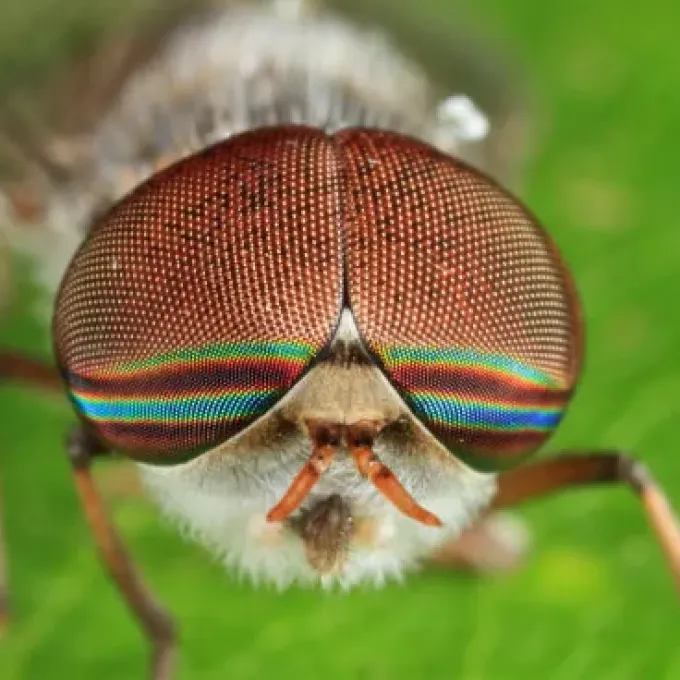
Females are blood-feeding insects equipped with powerful cutting-sponging mouthparts. Their large, often iridescent eyes provide excellent vision for locating warm-blooded hosts in open pasture environments.
The larvae of this species typically develop in damp soil or wetland areas near water bodies. They have a cylindrical body shape and are usually whitish or cream-colored, acting as predators in their habitat.
Adult flies are strong fliers and are highly active during warm, sunny weather. Their overall body color ranges from brown to dark mahogany, accented by the distinctive striping pattern.
Biological development involves a complete metamorphosis. The presence of nearby water sources is essential for the completion of their life cycle, particularly for egg-laying and larval stages.
What it damages
Tabanus quinquevittatus causes significant economic damage to the livestock industry. By persistently feeding on cattle, horses, and sheep, they disrupt normal grazing behavior.
The pain inflicted by their bites causes severe distress and irritation, leading to a constant defensive response from livestock, which exhausts the animals and reduces their energy intake.
Milk production in dairy cattle often drops significantly during peak fly season because the animals spend less time feeding and more time trying to evade the flies.
Beyond blood loss, these flies are mechanical vectors for various diseases, such as anthrax, anaplasmosis, and tularemia, posing a severe health risk to the entire herd.
Bite sites frequently become inflamed or infected, leading to secondary dermatological issues that require costly veterinary treatment and care.
When it appears
The adult activity period generally occurs during the summer months, typically ranging from June through August. They thrive in hot, sunny conditions with minimal wind.
The life cycle encompasses four stages: egg, larva, pupa, and adult. Depending on environmental factors and temperature, development can span up to a full year or more.
Eggs are laid in clusters on vegetation near water. Upon hatching, the larvae drop into the moist substrate, where they develop as predators feeding on other small invertebrates.
Pupation occurs in drier soil during the spring, leading to the emergence of the next generation of adults. The timing of this emergence is highly dependent on regional climate.
The duration of the adult fly's life is only a few weeks, during which they must secure blood meals to produce the next generation.
Signs of infestation
The primary sign of infestation is restless behavior in livestock, such as tail-switching, stamping hooves, and animals gathering tightly together to protect vulnerable body parts.
Physical evidence of bites includes small, bleeding wounds on the skin of the animal. Swelling or local allergic reactions often manifest as welts around the bite locations.
A noticeable decrease in the weight gain of young stock or a sudden drop in milk yield during summer indicates persistent fly harassment.
High fly concentrations near water troughs, ponds, or low-lying areas of the pasture confirm the presence of a localized population of Tabanus quinquevittatus.
Visual sighting of these large, fast-moving flies buzzing around animals is the most direct indicator of an ongoing pest problem.
Control measures
Managing the five-banded horse fly requires a multi-faceted approach, starting with the use of veterinarian-approved repellent sprays applied to livestock skin.
Physical traps, specifically those designed to mimic the shape and thermal profile of a host animal (such as black spherical traps), are effective at reducing local fly populations.
- Providing shaded shelters or barns for livestock during the hours of peak fly activity.
- Modifying the habitat by draining small stagnant water sources and clearing tall vegetation near watering sites.
- Installing mesh screens in stables and barns to protect animals.
- Treating bite wounds with antiseptics to prevent secondary bacterial infections.
Biological control methods, such as encouraging the presence of natural predators like birds and parasitic wasps, can help keep population numbers in check.
Given the mobility of adult flies, control measures are most effective when applied at the pasture or farm level rather than individual animal treatment alone.
Taxonomy
- Latin name
- Tabanus quinquevittatus
- Order
- Diptera (flies)
- Family
- Tabanidae
- EPPO code
- TABACO
Discussion
No discussions yet — be the first.