
Chrysops relictus
Haematopota pluvialis
Description
How to identify
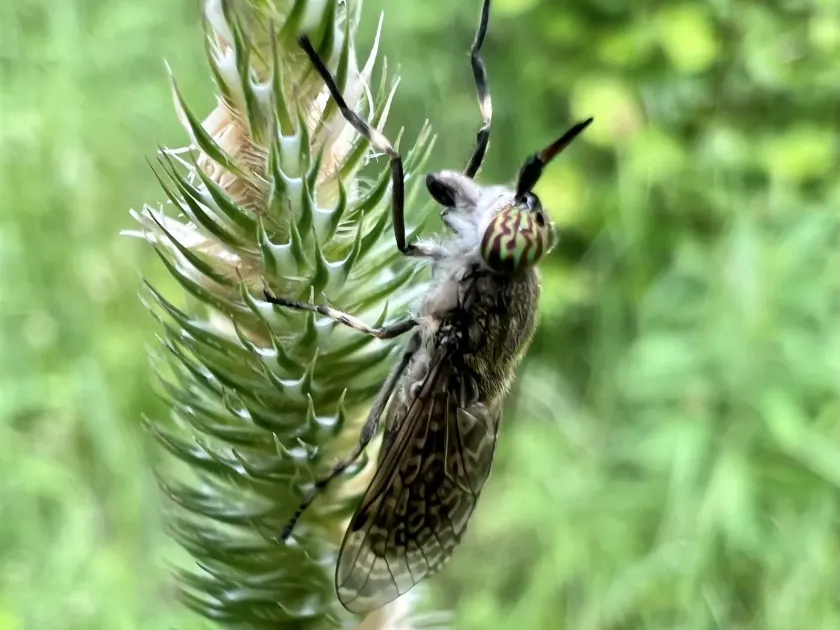
Haematopota pluvialis, commonly known as the common cleg or notched-wing horse fly, belongs to the Tabanidae family. It is easily identified by its marbled, mottled wing pattern.
Adults typically range from 8 to 12 mm in length. The female's eyes feature distinctive iridescent bands, which is a primary diagnostic feature for this specific species.
The body is covered with fine, grayish-brown hairs, providing excellent camouflage against natural surfaces. Their antennae are specialized for detecting prey through heat and movement.
While males feed strictly on plant nectar, females are hematophagous. They possess strong, knife-like mouthparts designed to lacerate skin and lap up the blood of host animals.
Larvae develop in moist soil or marshy areas near water bodies. They are spindle-shaped and can grow up to 20 mm, spending the majority of their life cycle in the soil.
What it damages
The common cleg is a significant pest in animal husbandry. It does not cause direct crop damage but severely impacts the welfare and productivity of farm animals.
Bites are painful and cause local inflammation, intense itching, and allergic reactions. Infested livestock become agitated, leading to significant stress and energy depletion.
This stress results in decreased milk production and slower weight gain in cattle. Constant disturbance forces animals to expend energy trying to ward off flies instead of grazing.
Clegs act as mechanical vectors for various pathogens, including anthrax and tularemia. Open bite wounds also provide entry points for secondary bacterial infections.
Herd productivity suffers as animals group together to defend themselves, significantly reducing the effective grazing time per day during the summer season.
When it appears
The flight season for adults generally spans from June to August. They are most abundant during hot, humid spells throughout the peak summer months.
The species is notably active during overcast or drizzly weather, which explains their common name. They are particularly aggressive when the barometric pressure drops before rain.
The life cycle is typically univoltine, taking one year to complete. Females lay masses of eggs on vegetation overhanging damp soil or near water sources.
Larvae overwinter in the soil, feeding on organic debris or small soil invertebrates. Pupation occurs in the spring in the upper, drier layers of the soil.
Activity is strictly diurnal. Clegs are most active during the day and seek shelter in dense vegetation as temperatures drop during the evening hours.
Signs of infestation
The primary sign of infestation is abnormal herd behavior, including tail-flicking, leg-stomping, and frantic attempts to move toward water or shade.
Bite marks are visible as small, bleeding wounds on the skin, often accompanied by localized edema. Areas with thin hair are usually targeted by the flies.
Observing high-speed, buzzing flights around livestock or sensing the flies' persistence in landing on the host are clear indicators of their local presence.
Control measures
Effective management requires a combination of physical, environmental, and chemical strategies to reduce the local population of these flies.
- Application of long-lasting repellents on cattle to deter biting attempts.
- Environmental management by draining stagnant water and clearing overgrown vegetation near grazing areas.
- Deployment of specialized heat-based traps that attract and capture female flies during their peak activity.
- Housing livestock in barns during mid-day hours to minimize exposure during the flies' most active periods.
- Using mesh curtains and shade structures to protect animals in outdoor paddocks.
Taxonomy
- Latin name
- Haematopota pluvialis
- Order
- Diptera (flies)
- Family
- Tabanidae
- EPPO code
- CHRZPL
Discussion
No discussions yet — be the first.