
Deer fly
Chrysops
Description
How to identify
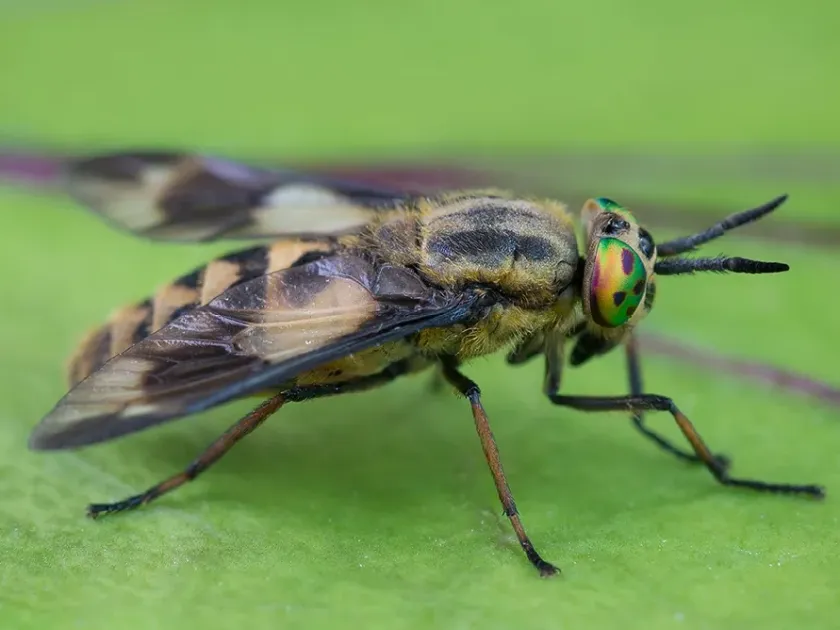
Deer flies belong to the genus Chrysops within the Tabanidae family. They are easily identified by their golden, green, or bronze metallic-colored eyes, which often feature distinct zig-zag patterns.
Adult flies possess a banded appearance with black and yellow patterns on their abdomen. A key diagnostic feature is the presence of dark, darkened bands across their wings, which helps distinguish them from other horse flies.
The larvae are typically found in moist soil near ponds, marshes, or swampy areas. They are cylindrical, tapering at both ends, and are well-adapted to life in aquatic or semi-aquatic environments.
Only the females possess the mouthparts necessary for piercing the skin of mammals to take a blood meal. Males are harmless, feeding exclusively on nectar and plant juices.
These flies are strong fliers and are highly active during warm, sunny weather. They are known for their persistent circling behavior around hosts before they land to bite.
What it damages
Deer flies are significant pests in the livestock industry. While they do not damage crops, their feeding behavior causes severe distress and physical harm to cattle, horses, and sheep.
The bite is notoriously painful because the fly lacerates the skin and injects saliva containing anticoagulants. This results in local swelling, itching, and potential secondary bacterial infections at the site.
Severe infestations lead to livestock stress, which significantly reduces milk production and slows weight gain. Animals often become agitated and spend more time trying to avoid bites than grazing.
They act as mechanical vectors for various pathogens, including tularemia and anthrax, posing a genuine veterinary risk to farm animals and reducing overall herd health.
Constant biting pressure can weaken an animal's immune system, making them more susceptible to other diseases and increasing the need for veterinary intervention.
When it appears
The adult activity period for deer flies typically spans from late spring through mid-summer. Peak activity coincides with warm temperatures and sunny days.
They are most prevalent in open fields, pastures, and near forested wetlands where they breed. Their activity is highest during the midday hours when temperatures are at their maximum.
The total life cycle of a deer fly can range from one to two years depending on the climate. The majority of this time is spent in the larval stage hidden in wet substrates.
Mass emergence events often occur in early summer, which is critical to monitor for farmers as these periods cause the most direct economic impact on grazing herds.
Monitoring the environment and local temperature trends can help predict the start of the season, allowing for timely application of preventive measures.
Signs of infestation
Visible distress in livestock, such as tail-swishing, skin-twitching, and restless movement or pacing, is a primary indicator of deer fly presence in a pasture.
Examination of the animals may reveal painful red welts, small puncture wounds, or localized bleeding, especially around the neck, back, and ears where the flies prefer to feed.
Observing the flies themselves—specifically their characteristic dark-banded wings and rapid circling flight—around animals is the most direct sign of an infestation.
Proximity to stagnant water sources, mudflats, or marshy terrain strongly suggests a habitat suitable for Chrysops breeding and localized population spikes.
In barn settings, the presence of flies on windowsills or ceilings during daylight hours indicates that they are actively seeking hosts in the vicinity.
Control measures
Effective control involves the use of pyrethroid-based insecticides or repellents applied directly to livestock via sprays, pour-ons, or ear tags to provide long-lasting protection.
Environmental management, such as draining stagnant water or clearing vegetation along pond edges, can disrupt the breeding cycle and reduce local populations.
Visual and odor-based traps can be deployed around pastures to capture adult flies, providing a non-chemical supplementary method for population suppression.
Using physical barriers like mesh screening on livestock housing and keeping animals inside during peak fly activity hours can significantly mitigate the impact of biting flies.
- Routine inspection of livestock for signs of bites.
- Maintaining pasture hygiene to remove standing water.
- Using protective horse blankets during outdoor activities.
Taxonomy
- Latin name
- Chrysops
- Order
- Diptera (flies)
- Family
- Tabanidae
- EPPO code
- CHSOSP
Discussion
No discussions yet — be the first.