
Spotted Horsefly
Tabanus punctifer
Description
How to identify
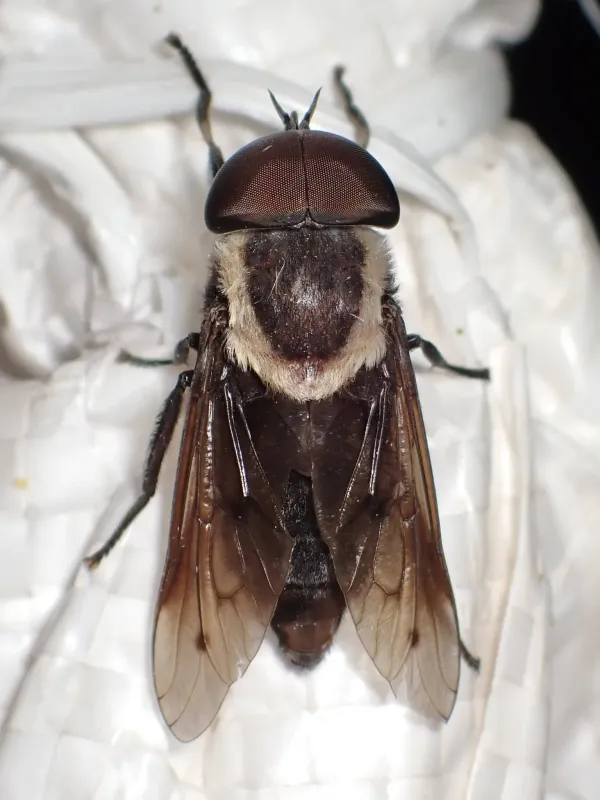
The spotted horsefly (lat. Tabanus punctifer) belongs to the order Diptera, family Tabanidae. It is a large insect with a powerful piercing-sucking mouthpart adapted to penetrate the skin of mammals.
The species exhibits significant sexual dimorphism. Females possess large, complex compound eyes that provide a wide field of view and distinctive spotted wing patterns, which inspired their common name.
The adult body is covered in short, dense hairs, with coloration ranging from dark gray to brownish. Adults are strong fliers, capable of traveling long distances in search of a blood meal.
Larvae are semi-aquatic or soil-dwelling, inhabiting moist environments near water bodies. They have cylindrical bodies equipped with specialized locomotor ridges that aid in burrowing through substrates.
The life cycle consists of four stages: egg, larva, pupa, and adult. The complete development cycle typically takes one to two years depending on the regional climate.
What it damages
While males feed primarily on plant nectar, females are obligate hematophages. They mainly attack livestock, including cattle, horses, and sheep, causing significant distress.
Direct damage to agriculture includes the indirect impact on pasture quality; high insect populations cause cattle to move constantly and bunch up, leading to severe trampling and vegetation degradation.
Through their bites, horseflies act as mechanical vectors for various infectious diseases. They are known to transmit pathogens responsible for tularemia, anthrax, and anaplasmosis.
High insect activity during the grazing season drastically reduces animal productivity. Stressed cattle exhibit reduced milk yields, while beef breeds show a significant decline in daily weight gain.
Economic damage also results from skin lesions. Multiple bites can lead to dermatitis, severe allergic reactions, and secondary bacterial infections, negatively affecting hide quality.
When it appears
Adult spotted horseflies are most active during the warm months, typically from early June through August. Their activity is highly dependent on ambient temperature and relative humidity levels.
Females are most active on hot, sunny days with minimal wind. In overcast conditions or when temperatures drop below 15°C (59°F), their flight activity decreases significantly.
Feeding peaks occur during the morning and late afternoon hours, avoiding the midday heat. During these times, horseflies aggressively target grazing herds.
The larval stage is characterized by a prolonged developmental period with active feeding throughout the growing season. Larvae overwinter deep in the soil to escape freezing temperatures.
Pupation occurs in spring or early summer under optimal soil moisture conditions, followed by the emergence of new adults approximately two to three weeks later.
Signs of infestation
A primary sign of horsefly presence is noticeable herd restlessness: animals may flick their tails, run in circles, or stand in water to escape the biting insects.
Visible blood droplets and small, raised, edematous wheals can be found on the skin where bites have occurred. The bites are painful due to saliva containing anticoagulants.
When surveying pastures near water, one may observe swarms of adults hovering over damp soil. On hot afternoons, adults often rest on sun-exposed fences or building walls.
A decline in livestock productivity and a drop in overall herd health, in the absence of other underlying pathologies, often suggest a heavy infestation of these blood-feeding pests.
The presence of wetlands, stagnant water pools, or swampy lowland areas serves as a reliable indicator of potential breeding sites for larvae.
Control measures
Effective management requires an integrated approach combining repellents, insecticidal treatments, and environmental habitat modification.
- Drain swampy areas and clear vegetation from the banks of ponds and streams to reduce breeding grounds.
- Use insecticide-impregnated ear tags or collars on livestock to provide ongoing protection.
- Deploy Malaise traps or visual target traps, which attract horseflies based on shape and color.
- Apply certified pyrethroid-based insecticides to livestock during peak fly seasons.
Strategic grazing management is a key protective measure: shifting grazing times to nighttime or early morning hours when fly activity is lowest significantly reduces stress.
Biological control involves supporting natural predators, such as birds and parasitoid wasps that target horsefly eggs, which is best achieved by maintaining healthy local ecosystems around pastures.
Taxonomy
- Latin name
- Tabanus punctifer
- Order
- Diptera (flies)
- Family
- Tabanidae
- EPPO code
- TABAPU
Discussion
No discussions yet — be the first.