
Salt marsh horse fly
Tabanus nigrovittatus
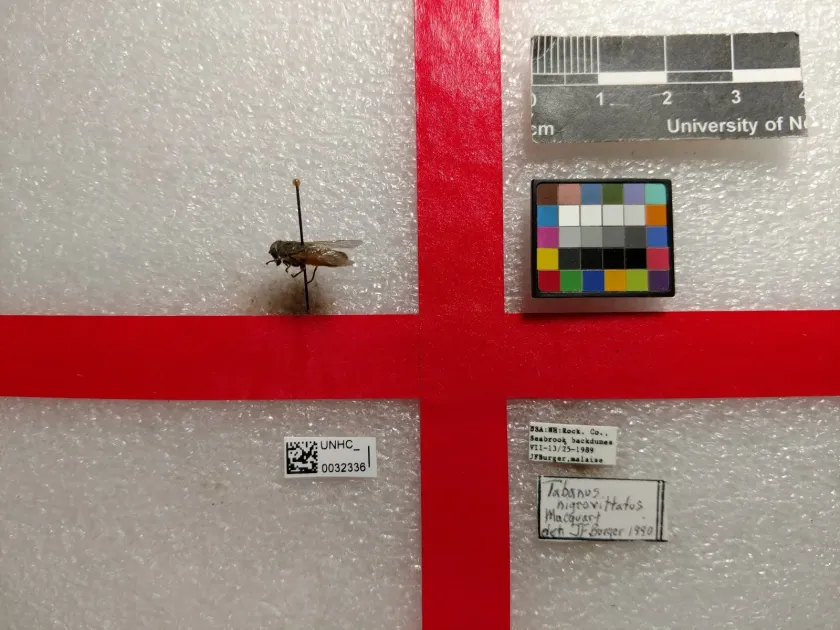
Description
How to identify
The salt marsh horse fly (Tabanus nigrovittatus) is a prominent species of the Tabanidae family, order Diptera. It is specifically adapted to coastal and saline environments where it thrives in high-salt soil conditions.
Adults possess specialized mouthparts adapted for piercing skin and feeding on blood. Typically ranging from 10 to 15 mm in length, these flies are easily recognizable by their greyish-brown coloration and distinct wing patterns.
Females are characterized by eyes separated by a narrow frons, which is a key diagnostic feature used by entomologists for precise identification of this particular species.
Larvae develop within moisture-rich, saline coastal soils, which provide the necessary habitat for their predatory growth phase before emerging as winged adults.
They are primarily diurnal insects, exhibiting peak flight activity during warm, sunny weather when they actively hunt for hosts by visual and olfactory cues.
What it damages
The primary economic impact of the salt marsh horse fly is directed towards the livestock industry, as they are aggressive pests for cattle, horses, and sheep.
The economic loss is often indirect: constant irritation of livestock results in decreased milk production, slower weight gain, and general degradation of animal health.
The bite of the horse fly is notoriously painful because it involves the injection of salivary anticoagulants, which trigger immediate inflammatory responses and local edema.
Beyond the direct pain, these insects function as mechanical vectors for several serious livestock diseases, including tularemia and various blood-borne infections.
Severe infestations can lead to physical exhaustion in herds, as animals spend significant energy reacting to fly attacks rather than focusing on grazing and energy storage.
When it appears
The active season for salt marsh horse flies begins in late spring and continues throughout the summer, usually peaking in mid-July and August depending on temperature.
The species undergoes a complete metamorphosis, moving through egg, larval, pupal, and adult stages. Females lay large clusters of eggs on vegetation near salt-affected coastal habitats.
Larvae are carnivorous and dwell within the damp soil of salt marshes, where they actively feed on smaller invertebrates to sustain their rapid development.
Generation turnover is heavily influenced by soil moisture levels. High water tables in coastal areas typically result in higher populations of emerging adults.
As temperatures drop in late autumn, the adult population dies off, with only the larvae overwintering safely buried in the deep soil layers.
Control measures
Management of the salt marsh horse fly is challenging due to their breeding habitats in expansive wetlands, necessitating a focus on protecting the host animals.
- Applying approved topical insecticides or repellents to livestock during the active fly season.
- Deployment of specialized traps that utilize visual cues to capture adult horse flies near grazing areas.
- Adjusting grazing schedules to keep animals indoors or under shaded structures during the peak daytime activity hours.
- Maintaining clear buffer zones around livestock areas to reduce the attractiveness of the environment to egg-laying females.
- Using automated fly-spray systems in milking parlors or barn entrances to provide relief for the animals.
Taxonomy
- Latin name
- Tabanus nigrovittatus
- Order
- Diptera (flies)
- Family
- Tabanidae
- EPPO code
- TABANI
Discussion
No discussions yet — be the first.