
Banded horse fly
Tabanus bromius
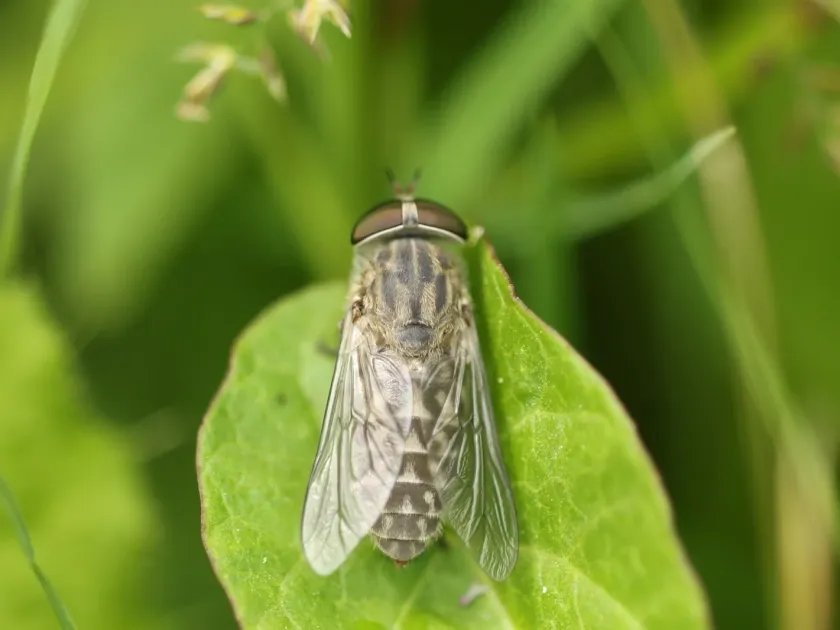
Description
How to identify
The banded horse fly (Tabanus bromius) is a prominent member of the Tabanidae family, known for its status as a significant livestock pest.
Adult flies typically measure between 13 and 18 mm in length, characterized by a grey-brown body and transparent, efficient wings.
A key identification feature is the eyes: in females, they are separated by a narrow stripe, while in males, the eyes meet at the midline.
Larvae develop in moist, muddy environments near water sources; they are spindle-shaped and possess characteristic pseudopods for movement.
The species undergoes a complete metamorphosis, requiring specific humidity levels in the soil for the survival of the larval and pupal stages.
What it damages
While Tabanus bromius does not feed on crops directly, it causes severe economic losses in the livestock industry.
The female flies are aggressive blood-feeders, causing painful bites that lead to extreme distress, fatigue, and weight loss in cattle and horses.
Frequent biting prevents animals from grazing efficiently, which results in a significant reduction in milk production and overall weight gain.
Beyond the physical trauma, these insects act as mechanical vectors for various viral, bacterial, and parasitic diseases.
In cases of heavy infestation, the cumulative stress and secondary skin infections can lead to serious health declines in the affected herds.
When it appears
The activity period for adult flies occurs during the warm summer months, typically from June through August.
They are most active on sunny, hot, and humid days, showing a peak in activity during the middle of the day, specifically between 10:00 and 16:00.
Their distribution is highly concentrated around pastures, meadows, and areas with stagnant or slow-moving water sources.
During cooler, overcast, or windy conditions, their activity decreases significantly as they seek shelter in vegetation.
The life cycle is closely linked to the availability of damp soil, which is required for egg-laying and larval development.
Control measures
Effective management of Tabanus bromius requires a combination of animal protection and habitat modification.
- Applying synthetic pyrethroid repellents directly to the skin or coat of livestock.
- Providing shade or indoor housing for animals during peak fly activity hours to minimize attacks.
- Utilizing protective fly rugs or mesh covers for horses and cattle in heavily infested areas.
- Land management strategies such as draining stagnant pools and clearing marshes where larvae develop.
- Installing automated visual or light-based insect traps around livestock enclosures to reduce local fly populations.
Regular maintenance and sanitation of barns and shelters can help decrease the resting sites for adult flies.
When using chemical treatments, it is essential to follow veterinary guidelines to ensure food safety in milk and meat production.
A proactive, multi-faceted approach is the most successful way to mitigate the harmful impacts of horse fly infestations.
Taxonomy
- Latin name
- Tabanus bromius
- Order
- Diptera (flies)
- Family
- Tabanidae
- EPPO code
- TABABR
Discussion
No discussions yet — be the first.