
Large horsefly
Tabanus bovinus
Description
How to identify
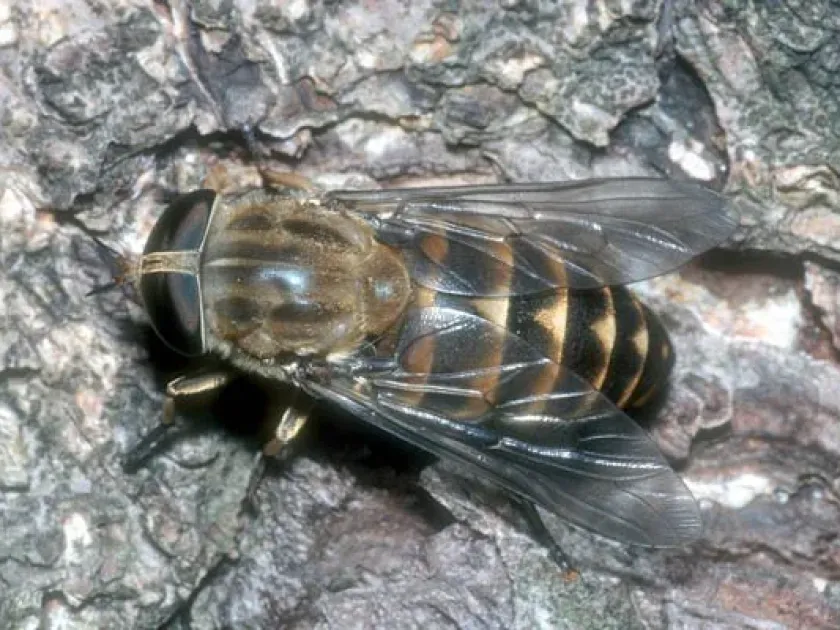
The large horsefly (Tabanus bovinus) is a prominent member of the Tabanidae family, known for its significant size and aggressive behavior toward large mammals.
Adult flies typically measure between 20 and 25 millimeters in length, featuring a robust, brownish-grey body covered in fine, short hairs that provide camouflage.
The eyes of the female are separated by a narrow gap, a distinctive trait that aids in identifying the species. These compound eyes offer an exceptional field of view for spotting hosts.
The mouthparts are highly specialized in females, designed for piercing tough mammalian skin and lapping up blood, which is essential for protein-rich egg maturation.
The life cycle involves larval stages that predominantly occur in damp soils or near aquatic environments, where they act as opportunistic predators of other small invertebrates.
What it damages
The primary economic impact of Tabanus bovinus is the severe disruption of livestock behavior, leading to significant drops in milk yield and weight gain due to chronic stress.
Female horseflies deliver painful bites by slicing through the skin and injecting saliva containing anticoagulants, which induces localized swelling, pain, and itching.
Beyond the immediate physical discomfort, they serve as mechanical vectors for various diseases, including anthrax, tularemia, and several parasitic infections.
Secondary infections often develop in bite wounds because the animals frequently rub against structures, causing open lesions that attract other flies and pathogens.
Constant biting pressure forces cattle to expend excessive energy in defensive movements, such as tail flicking and running, rather than grazing efficiently.
When it appears
The flight season for the large horsefly generally spans from late spring through early autumn, with peak populations usually observed during mid-summer months.
They are most active during bright, sunny, and calm weather conditions, specifically when ambient temperatures rise above 20°C, which facilitates their high-energy flight.
Activity levels fluctuate significantly based on humidity and temperature; cool, overcast, or windy days drastically reduce their tendency to fly and search for hosts.
The timing of the peak population is closely linked to the availability of moist breeding sites; drought conditions can lead to a notable decrease in the total number of flies.
In terms of daily cycles, these insects exhibit maximum activity during the peak daylight hours, typically between late morning and late afternoon.
Signs of infestation
An unmistakable sign of infestation is visible restlessness in the herd, with animals shaking their heads, flicking tails, and running across the pasture to avoid flies.
Closer examination of livestock reveals distinct bite marks, which often appear as red, raised, or weeping lesions on thin-skinned areas like the neck, underbelly, and flanks.
The presence of large, buzzing flies hovering around the animals is an immediate indicator of a population present in the immediate vicinity of the pasture.
Livestock showing signs of frantic behavior or attempting to submerge themselves in mud or water are often reacting to the persistent pressure of horsefly attacks.
Persistent scratching or grooming in specific areas of the body can highlight the location of the bites and the subsequent inflammatory response caused by the saliva.
Control measures
Effective management requires an integrated approach, focusing on both direct protection of the animals and the reduction of local breeding habitats near the farm.
- Application of topical repellents and contact insecticides that provide residual protection against blood-feeding dipterans.
- Installation of specialized sticky traps or visual traps that mimic the size and heat signature of a host animal to lure and capture flies.
- Strategic clearing of dense brush and clearing of overgrown drainage ditches to limit the moisture needed for larval development.
- Scheduling grazing periods to avoid the peak flight times of horseflies, particularly during the hottest parts of the day.
- Use of protective mesh coverings or fly-repellent ear tags to minimize the amount of exposed skin on valuable cattle.
Taxonomy
- Latin name
- Tabanus bovinus
- Order
- Diptera (flies)
- Family
- Tabanidae
- EPPO code
- TABABO
Discussion
No discussions yet — be the first.