
Sympherobius pygmaeus
Sympherobius pygmaeus
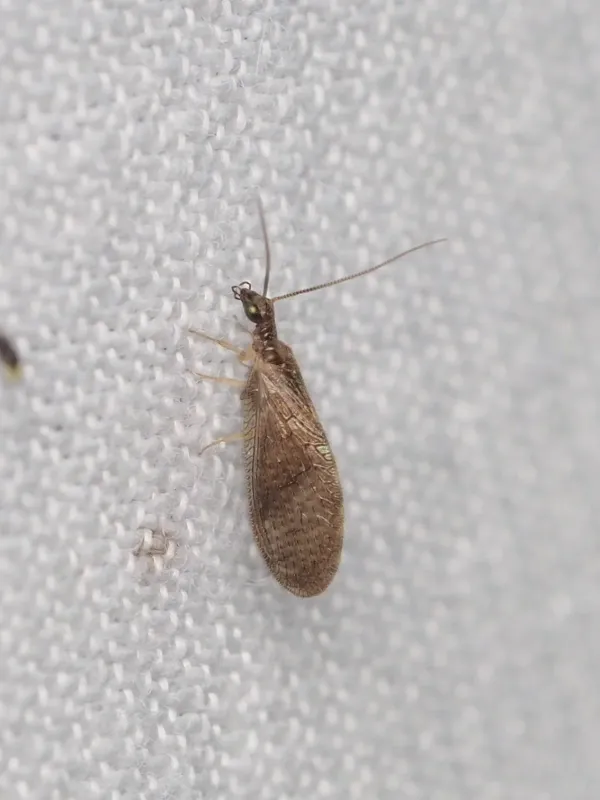
Description
How to identify
Sympherobius pygmaeus is a species of insect belonging to the family Hemerobiidae, commonly known as the brown lacewing order Neuroptera.
These insects are characterized by their delicate, net-like wing venation and a brownish, camouflaged body that allows them to blend into tree bark.
The adults are small, typically ranging from a few millimeters, making them discreet inhabitants of the forest and orchard canopies.
Larvae are predatory, equipped with specialized, curved, and sickle-shaped mandibles designed for piercing and consuming soft-bodied prey.
Identification often requires careful examination of wing structure and specialized genital features to distinguish them from other species within the genus.
What it damages
It is important to clarify that Sympherobius pygmaeus is not a plant pest; rather, it is a beneficial predator that protects various crops.
These lacewings primarily feed on aphids, mealybugs, scale insects, and spider mites that cause significant damage to fruit trees and ornamental plants.
By consuming these primary pests, the lacewing acts as a natural biological control agent, significantly reducing the need for chemical intervention.
In cases where broad-spectrum pesticides are used, the population of these beneficial predators is often destroyed, leading to subsequent pest outbreaks.
Their presence in an orchard is an indicator of a healthy and balanced ecosystem where natural regulatory mechanisms are functioning effectively.
When it appears
The seasonal activity of this species begins in late spring, following the rise in temperatures that triggers the end of their diapause.
Depending on the climatic conditions, multiple generations can occur throughout the growing season, with peak activity coinciding with pest outbreaks.
Adults are mostly nocturnal or crepuscular, meaning they are most active during the twilight hours when they hunt and locate suitable egg-laying sites.
Overwintering occurs in sheltered areas such as bark crevices, leaf litter, or other debris, where they enter a state of dormancy.
As autumn approaches, the life cycle transitions toward preparation for the winter period, reducing overall movement and feeding activity.
Signs of infestation
Detection is best achieved by observing the presence of active larvae on leaves or branches, particularly where aphid colonies are established.
Adult lacewings may be identified during site monitoring using light traps or by inspecting the trunks and canopy of host trees.
Evidence of their activity includes the presence of drained aphid shells, which appear as shriveled, empty husks on the leaf surface.
The lack of significant damage despite the presence of moderate aphid populations often suggests that effective natural predators are at work.
A diverse range of beneficial insects, including the presence of Sympherobius species, serves as a sign of high environmental quality in agricultural areas.
Control measures
No control measures are needed for Sympherobius pygmaeus, as it is a highly beneficial insect that serves as a tool for ecological pest management.
The primary strategy should be the preservation of this species through the adoption of Integrated Pest Management (IPM) practices.
Reducing the frequency of non-selective pesticide applications will allow natural predator populations to recover and maintain pest numbers below economic thresholds.
Enhancing habitat complexity through hedgerows or native plantings provides refuge for lacewings and other beneficial species during the off-season.
By protecting these insects, growers promote long-term agricultural sustainability and minimize reliance on hazardous synthetic chemicals.
Taxonomy
- Latin name
- Sympherobius pygmaeus
- Family
- Hemerobiidae
- EPPO code
- SYMHPY
Discussion
No discussions yet — be the first.