
Boriomyia
Boriomyia
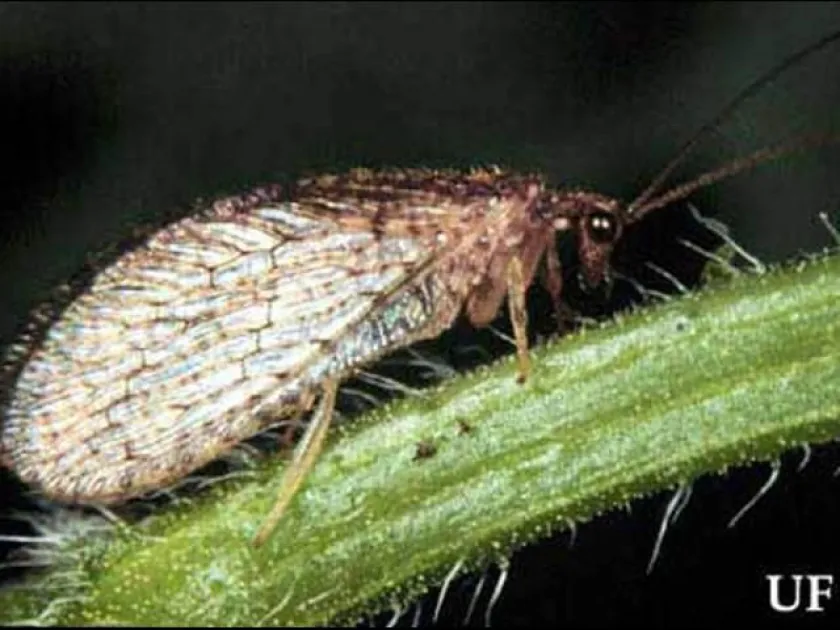
Description
How to identify
Boriomyia is a genus of insects belonging to the order Neuroptera, family Hemerobiidae (brown lacewings). These small insects are distinguished by their complex, net-like wing venation and brown, mottled coloration, which provides excellent camouflage.
Adult Boriomyia possess biting mouthparts, though they feed primarily on small pests. They are most active during crepuscular or nocturnal hours, often hiding in crevices during the day.
The larvae are specialized predators. They feature elongated bodies and prominent, sickle-shaped mandibles (jaws) designed to pierce and extract fluids from their prey, such as aphids and spider mites.
The life cycle undergoes complete metamorphosis: egg, three larval instars, pupa within a silken cocoon, and the adult stage. This complex cycle allows them to adapt to various environmental conditions.
Unlike many other insects associated with crops, these species are considered beneficial organisms rather than pests, serving as essential guardians of plant health.
What it damages
Boriomyia causes no damage to crops. They are purely entomophagous, meaning they derive nutrition exclusively from other insects and mites, never from plant tissues or sap.
Their impact on agriculture is entirely positive. By preying on aphids, scale insects, and mites, they prevent severe infestations that could otherwise lead to leaf curling, stunted growth, and virus transmission.
These insects are particularly valuable in orchard management and forest protection, where they keep populations of tree-dwelling pests below the economic threshold.
Because they do not damage the plant, they can be considered an integral part of sustainable and organic farming practices, helping to maintain natural ecological balance.
Promoting a population of Boriomyia reduces the need for synthetic pesticide applications, thereby contributing to the production of cleaner and healthier crops.
When it appears
The seasonal activity of Boriomyia adults typically begins in early spring, synchronized with the onset of favorable temperatures and the initial appearance of prey colonies.
The larvae are at their most active throughout the summer months, particularly when aphid reproduction peaks on the fresh growth of trees and shrubs.
Multiple generations can occur throughout the growing season, provided there is a consistent food source and suitable climatic conditions for their development.
Overwintering usually takes place in the pupal stage, encased in a silken cocoon, often tucked away in the rough bark of trees, leaf litter, or debris.
The timing of their emergence is finely tuned to the life cycles of their prey, ensuring that the next generation of predators has immediate access to food upon hatching.
Signs of infestation
Detecting Boriomyia can be challenging due to their secretive nature and effective camouflage against tree bark. They are rarely noticed by casual observers.
The most reliable sign of their presence is a natural, unexplained decrease in aphid or mite populations in areas where no chemical insecticides have been applied.
During careful inspection of stems and foliage, one might observe the highly active larvae, which resemble small, brownish creatures moving deliberately while hunting.
Silken cocoons found on the bark of trees during the dormant season are indicative of a thriving population of these beneficial insects in the vicinity.
Visual identification is possible by looking for the characteristic wing structure and brownish color, which distinguishes them from green lacewings (Chrysopidae).
Control measures
As Boriomyia is a beneficial predatory insect, there are no control measures designed to eliminate them. Instead, the focus should be on preservation and habitat enhancement.
The most critical step in preserving these populations is to minimize the use of broad-spectrum insecticides, which kill both pests and their natural enemies.
Adopt Integrated Pest Management (IPM) strategies, which prioritize biological controls and selective pesticides that have minimal impact on non-target predatory insects.
Maintaining diverse habitats around orchards and gardens, such as hedgerows or wild borders, provides essential refuge and overwintering sites for Boriomyia.
- Avoid preventive spraying of synthetic chemicals.
- Utilize biorational pesticides whenever possible.
- Preserve natural nesting sites (bark, leaf litter).
- Monitor populations to confirm the presence of natural enemies before intervening.
Taxonomy
- Latin name
- Boriomyia
- Family
- Hemerobiidae
- EPPO code
- BORISP
Discussion
No discussions yet — be the first.