
Drepanepteryx phalaenoides
Drepanepteryx phalaenoides
Description
How to identify
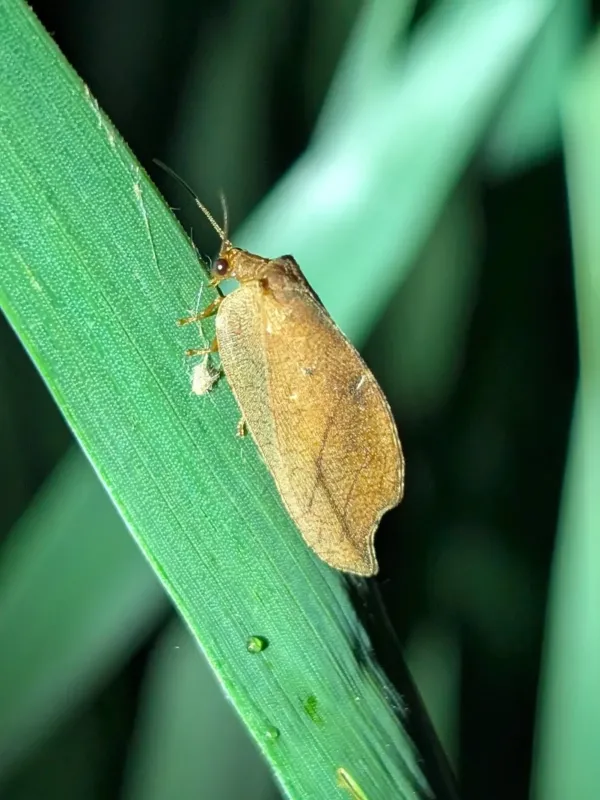
Drepanepteryx phalaenoides, known as the Hook-tipped Lacewing, belongs to the family Hemerobiidae. This insect is distinguished by its unique wing shape, which resembles a withered leaf.
The adult insect typically reaches a wingspan of 25 to 30 millimeters. Its cryptic coloration acts as camouflage against tree bark, making it difficult to detect.
As a member of the order Neuroptera, it undergoes complete metamorphosis, including egg, larval, pupal, and adult stages.
The larvae are specialized predators with sickle-shaped mandibles, which they use to pierce the exoskeleton of their prey.
This species is found primarily in woodlands and garden environments, where it plays a critical role in the natural ecosystem.
What it damages
This species is not a pest; rather, it is a highly beneficial predator. It does not damage crops, foliage, or fruit.
The larvae are active hunters of aphids, scale insects, and other small garden pests, effectively reducing their populations.
Because it is a predator, its presence is a sign of a healthy, balanced garden environment where natural pest control is occurring.
Misidentifying this insect as a pest leads to the unnecessary application of chemical pesticides, which harms the entire ecosystem.
No agricultural damage is attributed to Drepanepteryx phalaenoides, making it a valuable ally for farmers and gardeners.
When it appears
The adult lacewings emerge in early spring and remain active throughout the summer months as temperatures rise.
Larval activity peaks during the mid-summer when aphid colonies are most abundant on host plants.
The species produces multiple generations, allowing it to provide sustained natural pest control throughout the growing season.
As autumn approaches, adult insects seek shelter in crevices or under debris to prepare for the winter dormancy period.
The species overwinters as an adult, which allows it to start hunting early in the following spring as soon as prey becomes available.
Signs of infestation
The main indicator of their presence is spotting the camouflaged adults resting on tree trunks or branches.
Larvae can be observed moving through colonies of aphids, where they actively feed on the pests.
The absence of damage on plants, despite the presence of insects, confirms their role as non-phytophagous predators.
Their physical resemblance to dried leaves is the most distinct visual sign for identifying the adults in a field or garden setting.
There are no diagnostic symptoms such as leaf curling or boreholes associated with this insect, as it does not consume plant tissue.
Control measures
No control measures are needed for this species as it is an essential part of biological pest management.
The best practice is to preserve the natural habitat of these insects, including maintaining leaf litter and patches of native vegetation.
Gardeners should avoid using broad-spectrum insecticides, which would eliminate these beneficial predators along with target pests.
Promoting integrated pest management (IPM) helps maintain a high population of Hemerobiidae in agricultural areas.
- Implement integrated pest management strategies.
- Avoid non-selective insecticide spraying.
- Maintain wildlife-friendly corridors in gardens.
Taxonomy
- Latin name
- Drepanepteryx phalaenoides
- Family
- Hemerobiidae
- EPPO code
- DREEPH
Discussion
No discussions yet — be the first.