
Brown lacewing
Boriomyia subnebulosa
Description
How to identify
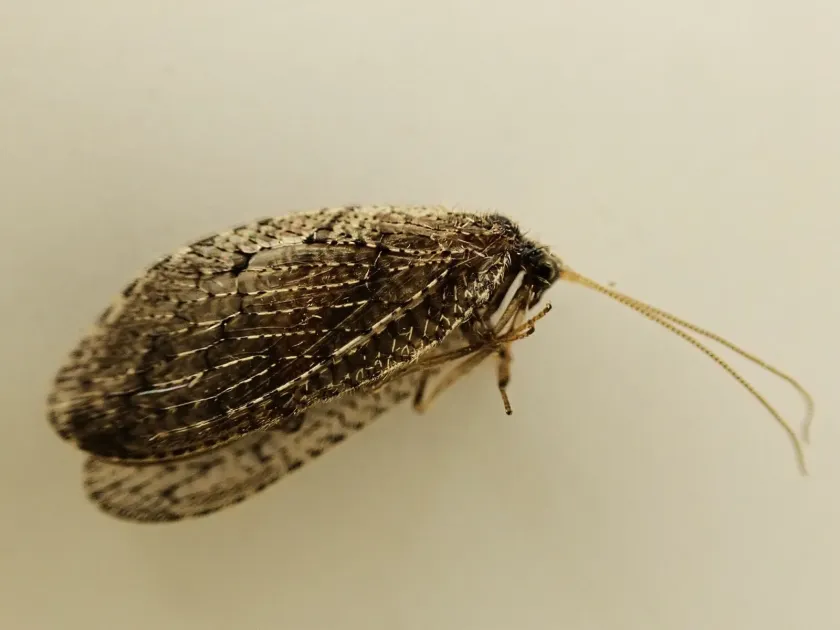
The brown lacewing (scientific name: Boriomyia subnebulosa) belongs to the order Neuroptera and the family Hemerobiidae. These insects are characterized by their delicate, net-veined wings, which feature a mottled brown and grey pattern, allowing them to blend perfectly with tree bark.
Adults are relatively small, typically measuring 10–12 mm in length, and are easily distinguished from the common green lacewing by their duller coloration and shorter antennae.
The larvae are active predators. While they are often considered beneficial in many ecosystems, their specific ecological role can vary depending on the local environmental conditions and the availability of primary prey species.
Identification often requires careful observation, as they share morphological similarities with other species within the family Hemerobiidae found in gardens and forested areas.
The species undergoes complete metamorphosis: eggs, three larval instars, pupation inside a silken cocoon, and the adult stage, which is usually the overwintering form.
What it damages
While often seen as a beneficial insect, Boriomyia subnebulosa can cause concern in agricultural settings if populations explode, as they may compete with other natural predators.
They primarily inhabit fruit trees and berry bushes. Under stress or when their preferred prey (aphids or mites) is scarce, the larvae may inflict mechanical damage on developing buds and soft shoots.
Direct damage to plant tissues is generally localized, appearing as small wounds or necrotic spots on young, tender leaves where the larvae have been feeding.
The indirect impact on orchards is often more significant, as their presence may disrupt the established biological control chain by displacing other specialized predatory insects.
Orchards managed with heavy chemical inputs often see higher population fluctuations of this species due to the collapse of the natural predator-prey equilibrium.
When it appears
Adults emerge in early spring, typically once daily temperatures consistently rise above 10–12 degrees Celsius, signaling the beginning of the active season.
The reproductive peak occurs during late spring and early summer, providing optimal conditions for egg-laying across a variety of orchard crops.
Multiple generations may emerge throughout a single growing season, which allows the species to react quickly to favorable environmental conditions and abundant food supplies.
High population densities are most frequently observed during mid-summer, closely mirroring the population trends of aphids and other small soft-bodied insects.
As autumn approaches and temperatures drop, the insects move into a dormant stage, finding secure overwintering sites underneath the loose bark of woody plants.
Signs of infestation
The most common sign of their presence is the discovery of small, white, silk-like cocoons tucked away in the deep fissures of fruit tree bark during winter pruning.
Direct observation of the larvae moving across foliage or within aphid colonies is a reliable indicator of an active population inhabiting the area.
Signs of plant stress, such as localized wilting or curling of the youngest leaves, may occur when larval population densities are high enough to cause minor physiological damage.
The presence of shed larval skins (exuviae) left behind after molting on the underside of leaves confirms recent insect activity and development stages.
In cases of significant infestation, localized discoloration on the bark around the overwintering sites may occasionally be visible.
Control measures
Effective management focuses on Integrated Pest Management (IPM) practices to maintain a healthy balance between natural predators and potential pest species.
Orchard sanitation is paramount: removing dead bark and thinning out tangled branches reduces available habitat for many small insects, including lacewings.
If chemical control is deemed necessary, prioritize targeted, low-toxicity treatments that have minimal impact on the beneficial insect community within the orchard.
Promoting local biodiversity by planting hedgerows and wildflower borders provides alternative food sources and refuges for natural enemies, stabilizing the ecosystem.
- Implement regular monitoring using sticky traps to detect population spikes.
- Avoid the use of broad-spectrum insecticides that kill beneficial predatory insects.
- Encourage bird activity in the orchard to naturally regulate insect populations.
- Maintain optimal soil moisture and nutrient levels to help trees recover from any feeding damage.
- Perform periodic tree inspections to remove heavily infested sections during early development.
Taxonomy
- Latin name
- Boriomyia subnebulosa
- Family
- Hemerobiidae
- EPPO code
- BORISU
Discussion
No discussions yet — be the first.