
Brown lacewing
Hemerobius
Description
How to identify
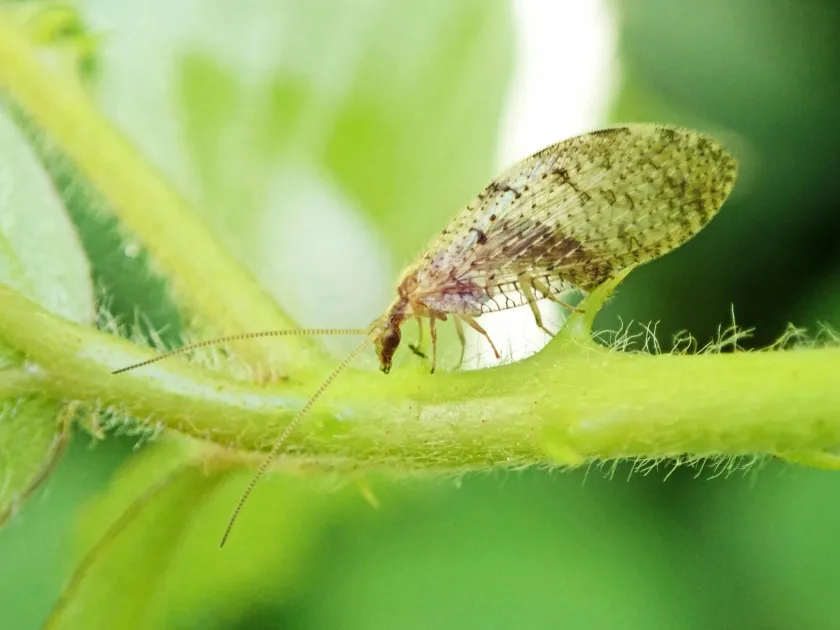
The brown lacewing, scientifically known as Hemerobius, belongs to the family Hemerobiidae within the order Neuroptera. These insects are distinguished by their brown, delicate, net-veined wings.
Adults typically measure between 10 to 20 mm in wingspan and exhibit a camouflaging brownish coloration that helps them blend in with tree bark and foliage.
The larvae are specialized predators with elongated bodies and large, sickle-shaped mandibles used to grasp and drain their prey's bodily fluids.
They undergo complete metamorphosis consisting of four stages: egg, larva, pupa, and adult. The pupal stage often occurs within a silken cocoon hidden in crevices.
These insects are highly active hunters, crucial for maintaining balance in forest ecosystems, orchards, and gardens worldwide.
What it damages
It is critical to classify Hemerobius not as a pest, but as a highly beneficial entomophagous insect. They do not feed on plant tissue or damage crops.
Both adults and larvae are voracious predators of soft-bodied insects, including aphids, whiteflies, scale insects, and spider mites, which are major agricultural pests.
By consuming large quantities of these pests, they provide essential natural regulation, reducing the need for chemical intervention in agricultural production.
Their role in greenhouse environments is particularly significant, where they act as effective biological control agents for managing localized pest outbreaks.
In summary, the presence of brown lacewings is a positive indicator of an active and healthy biological control system within a garden or farm.
When it appears
Activity usually begins in early spring, as temperatures rise, triggering the emergence of overwintering adults and the start of their reproductive cycle.
During the summer months, brown lacewing populations peak, coinciding with the rapid growth of aphid populations which provide abundant food sources.
Depending on geographical location and climate, multiple generations can emerge during a single growing season to suppress successive waves of pests.
As daylight hours decrease and temperatures drop in autumn, these insects enter diapause or seek protective cover to survive the winter months.
They are primarily nocturnal or crepuscular, meaning they are most active during twilight and nighttime, which helps them avoid diurnal predators.
Control measures
Since the brown lacewing is a beneficial predator, there is no need to control its population; instead, management practices should focus on conservation.
To support their population, growers should avoid broad-spectrum insecticides that indiscriminately kill both pests and beneficial predatory insects.
Integrated Pest Management (IPM) strategies, including the use of selective biorational pesticides, are recommended to maintain their presence on the farm.
Planting a diversity of flowering plants provides shelter and alternative food sources for adults, helping to maintain a stable population throughout the season.
Overall, reducing chemical reliance and providing natural habitats significantly increases the efficiency of Hemerobius in managing garden pests naturally.
Taxonomy
- Latin name
- Hemerobius
- Family
- Hemerobiidae
- EPPO code
- HEMBSP
Discussion
No discussions yet — be the first.