
Sympherobius barberi
Sympherobius barberi
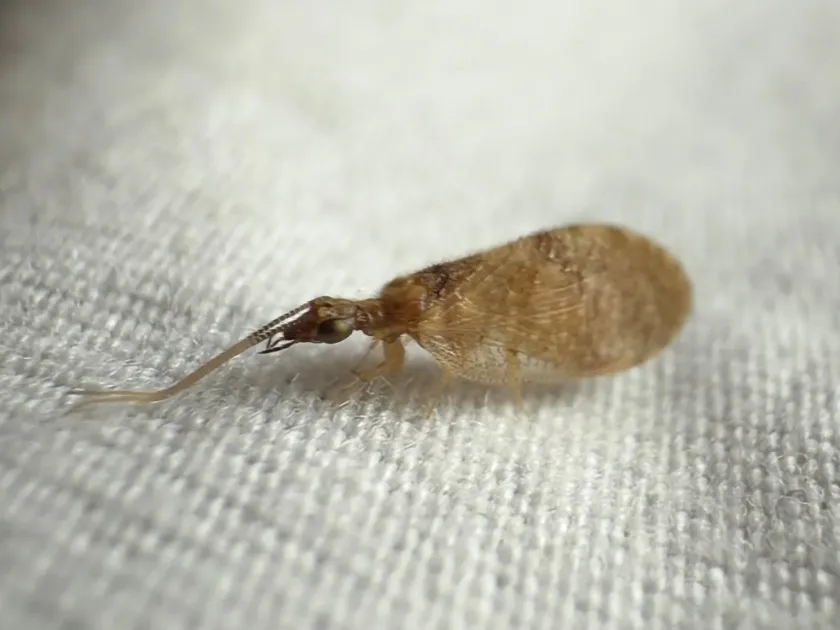
Description
How to identify
Sympherobius barberi is a member of the Hemerobiidae family (brown lacewings), which belong to the order Neuroptera. While many brown lacewings are considered beneficial predators, Sympherobius barberi can exhibit behaviors in specific agricultural environments that warrant attention from agronomists.
Adult insects are small, typically brownish or gray, featuring delicate, net-like wing venation. When at rest, their wings are held roof-like over their bodies, which serves as a highly effective camouflage against tree bark and foliage.
The larvae are fusiform and possess well-developed mandibles specialized for piercing and sucking. Their morphology is similar to other lacewing larvae, making identification challenging without a microscope or expert entomological knowledge.
The development cycle consists of egg, three larval instars, pupation within a silken cocoon, and the adult stage. The species can complete several generations annually depending on regional climate conditions.
Ecological plasticity allows this species to survive in diverse habitats, adapting its life cycle to the available food sources and local weather patterns in garden ecosystems.
What it damages
Damage caused by Sympherobius barberi is primarily observed when their population density exceeds natural carrying capacity, often due to the elimination of their natural predators by broad-spectrum pesticides.
These insects damage crops by feeding on the sap of young buds and tender shoots. This feeding habit causes localized cell death, leading to stunted growth and leaf distortion.
Developing fruit or ornamental flowers may show signs of tissue injury, which degrades the plant's overall aesthetic and commercial value. Severely affected shoots often wither and turn necrotic.
The feeding process creates entry points for secondary pathogens, such as bacteria and fungi, which can complicate the health status of the host plant significantly.
In greenhouses or nursery settings, infestation can lead to uniform weakening of young seedlings, potentially causing heavy economic losses if left unchecked.
When it appears
Adult activity typically begins in late spring, coinciding with the rise in temperatures and the onset of the plant's active growth phase.
Peak populations are usually recorded in mid-to-late summer, following the emergence of subsequent generations that thrive in warmer, humid microclimates.
As autumn approaches and temperatures drop, the insects move toward hibernation sites, often selecting protected areas like bark crevices, leaf litter, or topsoil layers.
Environmental factors, particularly high humidity, can accelerate the pupal development phase, leading to more overlapping generations per growing season.
Monitoring should be initiated in early May, focusing on the undersides of leaves and the terminal growth points where eggs are commonly deposited.
Signs of infestation
Early warning signs include the appearance of tiny chlorotic spots on the foliage, which expand into larger, discolored patches as the larvae continue to feed.
Curling or cupping of young leaves is a frequent symptom of physiological stress induced by the sap-feeding behavior of the insects.
The presence of fine, sticky excretions on the leaf surface may lead to the development of sooty mold, appearing as a dark, powdery substance on the leaves.
Discovering silken cocoons within leaf axils or under loose bark confirms the presence of the pest population on the host plant.
An increased presence of ants on the plant may indirectly signal an infestation, as they are often attracted to the honeydew or sap leaks caused by the insects.
Control measures
Management of Sympherobius barberi requires an integrated approach that prioritizes biological balance and cultural controls over chemical interventions.
Sanitation practices are critical, including the removal and destruction of infested plant parts and clearing debris where the insect might overwinter.
Biological control agents, such as promoting existing predatory beetles or applying entomopathogenic fungi, provide a sustainable way to suppress population growth.
Chemical control should be applied strictly as a last resort, utilizing selective insecticides that minimize mortality rates among beneficial insects like natural lacewings or ladybirds.
- Installation of sticky traps for population monitoring.
- Regular pruning to improve air circulation and canopy health.
- Balanced irrigation to prevent plant stress and vulnerability.
Taxonomy
- Latin name
- Sympherobius barberi
- Family
- Hemerobiidae
- EPPO code
- SYMHBA
Discussion
No discussions yet — be the first.