
Beech-maple prominent
Symmerista leucitys
Description
How to identify
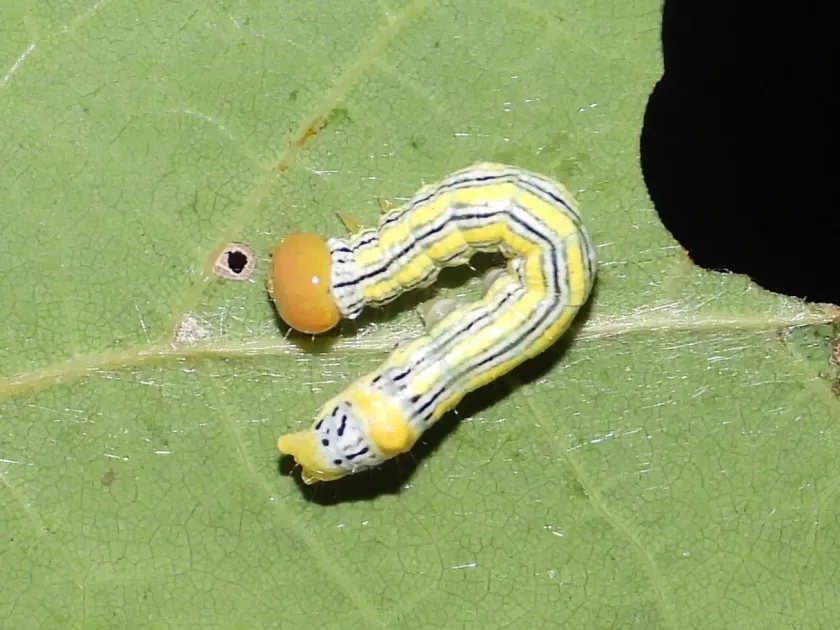
The beech-maple prominent (Symmerista leucitys) is a moth species in the family Notodontidae. The larvae are distinguished by their bright yellow and black stripes and a prominent bump on the dorsal side of the posterior segments, which gives them their common name.
Adult moths are relatively small with a wingspan of approximately 40–45 mm. Their forewings feature greyish-brown patterns that provide excellent camouflage against tree bark, while the hindwings are usually paler, often whitish or light grey.
The lifecycle follows a complete metamorphosis: egg, larva, pupa, and adult. Eggs are typically laid in clusters on the undersides of leaves, ensuring that hatching larvae have immediate access to their primary food source.
Young larvae exhibit gregarious behavior, feeding together in groups. This social structure helps them survive early developmental stages by providing protection against environmental stress and small predators.
Larval development consists of several instars, with the caterpillars growing significantly in size and requiring increasing amounts of foliage as they mature toward the final pupation stage.
What it damages
This pest primarily attacks trees of the genera Fagus (beech) and Acer (maple). Large populations can lead to severe defoliation, where the larvae consume the vast majority of the leaf area in a stand.
The loss of foliage forces trees to use stored energy reserves, which stresses the plants and reduces their overall vigor. Repeated defoliation can lead to twig dieback and render the trees susceptible to secondary pathogens.
In forest plantations, heavy infestations can result in significant losses in wood increment. The slowed growth rate and compromised health of the trees reduce their commercial value and ecological function.
Although mature trees often survive singular outbreaks, young saplings and ornamental trees are at much higher risk of mortality if left untreated during peak larval feeding periods.
Environmental impacts include changes in the light penetration within the forest canopy, which affects the understory plant communities following large-scale defoliation events.
When it appears
Adult moths emerge in late spring or early summer, depending on regional temperature patterns. Mating occurs shortly after emergence, followed by oviposition on the foliage of suitable host trees.
The larval stage is most active throughout the summer months. Peak feeding intensity, which corresponds to the most visible damage, usually occurs from mid-July through August as the caterpillars approach their full size.
Pupation takes place in early autumn. The larvae descend from the branches to the ground, spinning cocoons in the leaf litter or shallow soil to survive the winter months in a state of diapause.
Climate variables play a critical role in population dynamics. Warm and consistent summers often correlate with higher survival rates for both eggs and larvae, leading to subsequent outbreaks.
Monitoring efforts should be synchronized with the emergence of adult moths, typically monitored via light traps or pheromone baits, to provide early warning of potential infestation levels.
Signs of infestation
Early symptoms include small holes in the leaf blades, often found in clusters where young larvae have recently hatched. As the caterpillars grow, these holes expand into large, irregular gaps.
The presence of larval frass (excrement) on the ground or on the lower leaves is a clear indicator of active feeding in the canopy above. This is one of the most reliable methods for ground-level detection.
Observing the undersides of leaves during the peak feeding season will often reveal groups of larvae. Their striking appearance, characterized by longitudinal yellow stripes, makes them relatively easy to spot upon inspection.
Leaves that are heavily skeletonized, leaving behind only the larger veins, give the canopy a translucent or "lacy" appearance. This visual change is a diagnostic symptom of a significant infestation.
Late-season browning of the foliage, which looks similar to premature autumn senescence, is another sign that the tree has been under significant stress from caterpillar feeding throughout the summer.
Control measures
Biological control agents, particularly Bacillus thuringiensis (Bt), are highly effective and are the preferred method in forestry settings. They specifically target lepidopteran larvae with minimal impact on non-target species.
Chemical intervention with systemic insecticides may be necessary in nurseries or high-value urban park landscapes where the potential for economic or aesthetic loss is high and immediate control is required.
Silvicultural management, such as promoting mixed-species stands, can disrupt the host-finding capabilities of the moth and limit the spread of outbreaks compared to monocultures.
Encouraging natural predators, such as birds and parasitic wasps, helps maintain the pest population at equilibrium. Maintaining natural habitats within or near forests is key to sustainable long-term control.
Regular surveillance programs help forest managers assess risk levels annually. Identifying high-risk areas allows for targeted, preventative action rather than widespread and costly reactive treatments.
Taxonomy
- Latin name
- Symmerista leucitys
- Order
- Lepidoptera (butterflies)
- Family
- Notodontidae
- EPPO code
- SYMMLE
Discussion
No discussions yet — be the first.