
Red-humped oakworm
Symmerista canicosta
Description
How to identify
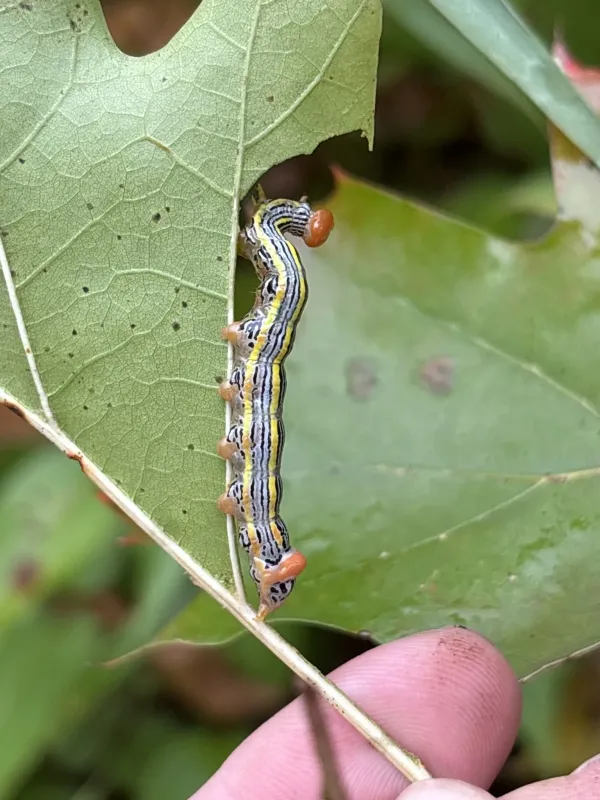
The Red-humped oakworm (Symmerista canicosta) is a moth species belonging to the Notodontidae family. The larvae are easily recognizable by their orange-red head and the distinctive striped pattern along their bodies.
Adult moths are relatively small, grayish-brown insects. They are nocturnal and are typically observed flying during the summer months when they mate and lay eggs on host trees.
The life cycle consists of four distinct stages: egg, larva (which goes through five instars), pupa, and adult moth. Most populations complete one generation per year, though climate influences this cycle.
Pupation usually occurs in the leaf litter. The pupae remain dormant throughout the winter, protected by the organic layer on the forest floor, until they emerge as adults in the following spring.
Identification is easiest during the larval stage when they feed in groups. Despite their conspicuous appearance, they often remain hidden in the canopy until significant damage occurs.
What it damages
The primary hosts for this species are various oak species (Quercus spp.). In cases of high population density, they may move to other deciduous species found within the same forest stand.
As a defoliator, the Red-humped oakworm consumes the leaf blade. Early instars perform light feeding, but later stages can cause massive canopy loss by eating all parts of the leaf except the midribs.
Repeated defoliation is highly damaging to tree health. It leads to the depletion of starch reserves, which inhibits the tree's ability to resist subsequent environmental stressors, such as droughts or frosts.
Significant infestations can result in reduced growth rates, branch dieback, and in extreme cases, the mortality of entire trees, especially those that are already stressed or aged.
The economic impact is substantial in terms of forest productivity and the aesthetic quality of urban landscapes where oak trees are used for shade and ornamental purposes.
Signs of infestation
One of the earliest signs of infestation is the presence of skeletonized leaves in the upper canopy. The leaves appear translucent because the larvae have consumed the soft tissue between the veins.
Accumulation of frass (larval droppings) on the ground or understory vegetation is a clear indicator that the larvae are active in the branches above. Large amounts of frass are characteristic of later instar colonies.
The premature thinning of the canopy is a critical visual cue. When an oak tree appears to be losing its foliage in mid-summer, it is usually a result of severe defoliation by this pest.
Branches that are suddenly bare, even while neighboring trees remain healthy, suggest a localized colony of Symmerista canicosta at work.
Observing groups of caterpillars feeding together on the edges of leaves confirms the identity of the pest, as they often exhibit colonial behavior during their development.
Control measures
Monitoring using pheromone-baited traps provides data on adult emergence, which is crucial for scheduling potential intervention strategies before the next generation of larvae hatches.
Biological control, specifically the use of Bacillus thuringiensis (Bt), is highly effective. It targets the larvae specifically while preserving non-target organisms and the overall forest ecosystem balance.
In forest management, selective insecticide treatments may be applied when monitoring thresholds are exceeded, ensuring the survival of valuable timber or protected oak stands.
Maintaining a healthy, diverse forest environment encourages natural enemies such as parasitic wasps and predatory birds, which are essential in keeping Symmerista canicosta populations below economically damaging levels.
Silvicultural practices that promote tree vigor help trees withstand minor defoliation events, reducing the need for direct chemical intervention.
Taxonomy
- Latin name
- Symmerista canicosta
- Order
- Lepidoptera (butterflies)
- Family
- Notodontidae
- EPPO code
- SYMMCA
Discussion
No discussions yet — be the first.