
Red-humped oakworm moth
Symmerista albifrons
Description
How to identify
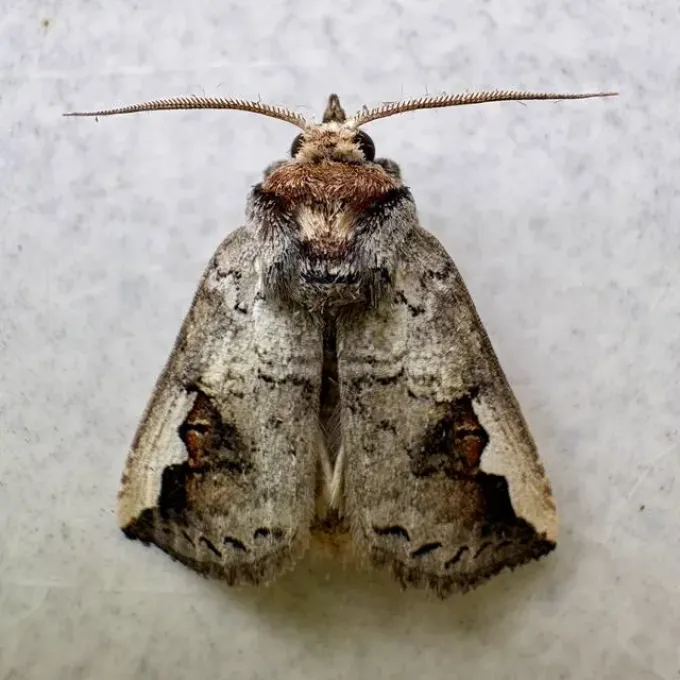
The Red-humped oakworm moth (Symmerista albifrons) belongs to the family Notodontidae and is a well-known defoliator of various deciduous trees in North America.
Adult moths are characterized by a white patch on the tips of the forewings, which provides effective camouflage when resting on light-colored bark or foliage.
Larvae are easily recognized by their smooth, yellow, and black striped bodies with a prominent orange-red head, which gives them their common name.
The moth undergoes complete metamorphosis, passing through egg, larval, pupal, and adult stages, with most of the damage occurring during the larval stage.
The life cycle is closely synchronized with the phenology of their host trees, ensuring that larvae have fresh foliage available during their rapid growth phase.
What it damages
The primary hosts of this species include various oak species, but they are also known to feed on beech and other hardwoods when populations reach outbreak levels.
Young larvae feed in groups on the underside of leaves, causing skeletal damage, while older larvae consume entire leaf blades, leaving only the midribs.
Heavy infestations can lead to total defoliation of the tree canopy, which severely weakens the tree's ability to produce energy through photosynthesis.
Repeated defoliation over consecutive years often results in crown dieback, reduced growth rates, and increased susceptibility to other biotic and abiotic stressors.
While mature, healthy trees can often survive a single season of defoliation, repeated attacks can lead to the mortality of weakened or smaller specimens.
When it appears
Adults typically emerge in late spring or early summer, following the warming of the soil, which triggers the end of their pupal diapause.
The larval stage is active from mid-summer through early autumn, which is the period when the most significant damage to the host canopy occurs.
The species overwinters as a pupa within a thin, parchment-like cocoon buried in the soil or protected by leaf litter at the base of the host tree.
Development is usually univoltine (one generation per year), although regional climate variations can occasionally lead to different activity patterns.
Scouting for early signs of activity should begin shortly after leaf expansion, as this is when the first generation of larvae begins their initial feeding.
Signs of infestation
Early-season signs include small, skeletonized patches on leaves, often localized on the lower branches where initial egg masses were deposited.
Frass (caterpillar droppings) accumulating on the ground beneath the canopy is a strong indicator of an active and potentially large larval population.
Brownish, tattered foliage in late summer is a classic symptom, caused by the extensive feeding of mature caterpillars throughout the tree canopy.
Direct observation of the larvae feeding in clusters on the undersides of leaves confirms the presence of this specific pest.
An increased presence of predatory wasps, birds, and spiders in the tree canopy can also serve as a biological indicator of an outbreak.
Control measures
Biological control agents, such as Btk (Bacillus thuringiensis kurstaki), are highly effective against young larvae and have minimal impact on non-target species.
For small trees or ornamental plantings, physical removal of larval clusters by hand can be a viable management strategy during the early growth stages.
Promoting natural predators and parasitoids is essential for long-term suppression of populations, as these insects often regulate numbers effectively in natural settings.
Chemical applications should be reserved for high-value trees or severe outbreaks where other methods have failed to prevent unacceptable levels of defoliation.
Maintaining soil health and cleaning up leaf litter at the base of the tree can help reduce the number of successful pupations for the following season.
Taxonomy
- Latin name
- Symmerista albifrons
- Order
- Lepidoptera (butterflies)
- Family
- Notodontidae
- EPPO code
- SYMMAF
Discussion
No discussions yet — be the first.