
White-ribbed Prominent
Symmerista albicosta
Description
How to identify
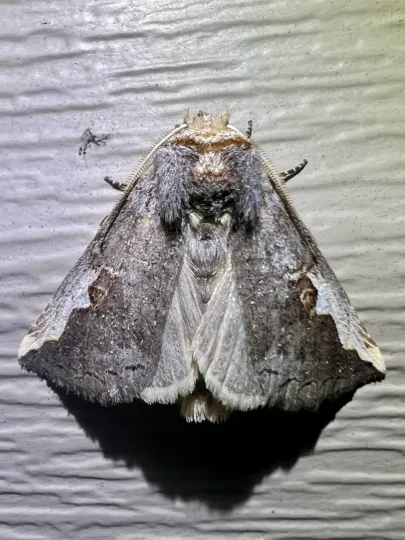
The White-ribbed Prominent (Symmerista albicosta) is a moth belonging to the family Notodontidae. Adult moths exhibit a cryptic coloration pattern, which provides excellent camouflage against the bark of host trees during the day.
The larvae, or caterpillars, are characterized by distinct longitudinal stripes, which help them blend into the foliage. They possess a robust head capsule, a trait typical of many Notodontid species that feed on woody vegetation.
Taxonomically, this species is classified within the order Lepidoptera. It plays a significant role in forest ecosystems as a specialized phytophage, with population levels closely tied to the health and availability of its host trees.
The life cycle consists of the egg stage, five larval instars, a pupal stage, and the adult moth. Overwintering typically occurs in the pupal stage within the leaf litter of the forest floor, providing protection from harsh winter temperatures.
Development is tightly synchronized with the phenology of host trees. The timing of egg hatching, coinciding with the emergence of fresh buds and leaves, is critical for the survival of the offspring.
What it damages
The primary hosts for the White-ribbed Prominent are broad-leaved trees, specifically species within the genera Quercus (oak) and Fagus (beech). Damage is characterized by intensive foliage consumption.
Early-instar larvae feed primarily on the underside of the leaf, leaving the upper cuticle intact, which creates characteristic translucent spots. As larvae grow, they begin skeletonizing the leaves, consuming everything except the main veins.
Mass outbreaks of this pest can lead to complete defoliation of trees across large areas. This significantly weakens the trees' vigor, leaving them susceptible to secondary infestations by wood-boring beetles.
Weakened trees experience reduced annual growth, causing direct economic losses in forest management. Repeated defoliation over several years can result in branch dieback or the death of the entire tree.
Damage is particularly detrimental to young saplings and reforestation projects, which lack the stored energy reserves required to produce a secondary flush of leaves after severe infestation.
When it appears
Adult flight typically occurs in late spring or early summer, depending on regional climatic conditions. During this time, mating occurs and eggs are deposited on the leaves of host trees.
The active feeding period for larvae occurs throughout the peak growing season, most commonly in June and July. This is the period when visual evidence of infestation is most apparent in forest stands.
By mid-to-late summer, the larvae complete their development and descend into the soil to pupate. In most regions, the species completes one generation per year, limiting the speed at which populations recover.
Population monitoring is conducted using light traps to capture adults and visual surveys of tree crowns for egg clusters. Pheromone monitoring is also highly effective for timing management interventions.
Warm and moderately humid weather conditions favor the development of the pest, increasing the survival rates of eggs and early-stage larvae.
Signs of infestation
The first sign of infestation is the appearance of small holes and translucent "windows" on leaves, caused by young larvae feeding. Over time, leaves take on a skeletonized, net-like appearance.
The presence of frass (larval excrement) on the surfaces of lower-level leaves and the forest floor is a clear indication that a significant caterpillar population is active in the canopy.
Inspecting the crowns often reveals clusters of larvae feeding together on branches. When disturbed by wind or vibration, larvae may lower themselves on silken threads, which is a diagnostic behavior.
A change in the overall color of the forest canopy to grayish-brown by mid-summer indicates severe defoliation. Trees appear stressed and begin premature leaf drop.
- Presence of egg masses on the underside of leaves.
- Observation of larvae during visual canopy surveys.
- Specific feeding traces leaving only the leaf skeleton.
- Significant accumulation of frass under infested trees.
Control measures
In forest management, control of the White-ribbed Prominent focuses on biological methods. The use of biological insecticides based on Bacillus thuringiensis is effective for controlling larvae while minimizing impact on beneficial predatory insects.
Chemical intervention is justified only during mass outbreaks that threaten the integrity of high-value timber stands. Systemic insecticides are sometimes used in these critical situations to achieve high efficacy.
A crucial component of sustainable protection is the preservation of natural predators, including parasitic wasps and predatory insects. Maintaining forest biodiversity acts as the best preventative measure against massive outbreaks.
Silvicultural measures include the creation of mixed-species forest stands, which are less susceptible to total infestation by a single pest species. Improving tree health and vigor increases natural resistance.
Regular monitoring allows foresters to detect population spikes early, enabling intervention before the pest can cause extensive damage to the ecosystem or economic assets.
Taxonomy
- Latin name
- Symmerista albicosta
- Order
- Lepidoptera (butterflies)
- Family
- Notodontidae
- EPPO code
- SYMMAC
Discussion
No discussions yet — be the first.