
Cottontail rabbit
Sylvilagus
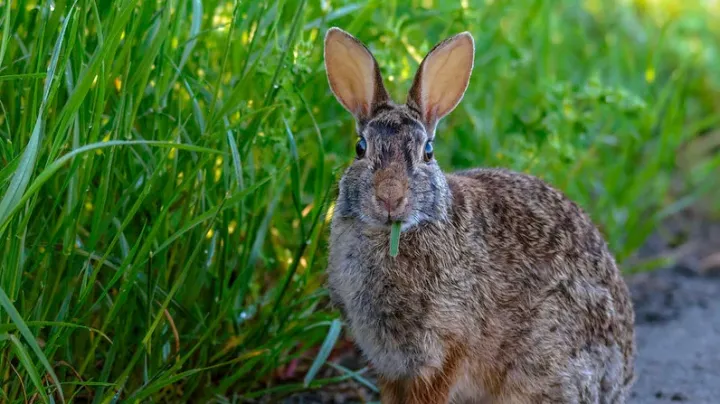
Description
How to identify
Cottontail rabbits (genus Sylvilagus) belong to the Leporidae family. Unlike European rabbits, they do not dig deep burrows, preferring to hide in dense vegetation or abandoned shelters.
Visually, they are distinguished by shorter ears compared to hares and a compact build. Their coat color ranges from grayish-brown to reddish-brown, providing perfect camouflage in various terrains.
These animals are primarily crepuscular and nocturnal, making them difficult to detect on the property. They have a high reproductive rate, which makes their population dangerous to agro-ecosystems if left unchecked.
Systematically, they belong to the order Lagomorpha, family Leporidae. The genus includes over 15 species adapted to environments ranging from deserts to humid forests.
It is important to distinguish them from wild hares: cottontail rabbits exhibit stronger territorial attachment and often settle near vegetable gardens or nurseries.
What it damages
Cottontail rabbits are serious pests capable of destroying young vegetable plantings, especially during early growth stages. They feed on leaves, stems, and fruits of almost all horticultural plants.
They pose a specific threat to orchards, as they gnaw on the bark of young trees and shrubs during winter. This weakens the plant, opens the door to infections, and often leads to the death of the sapling.
Affected crops include brassicas, legumes, carrots, lettuce, and various decorative flowers. Rabbits can consume a significant portion of a crop in a single night.
Besides eating vegetative mass, they may dig up roots of perennial plants, causing nutrient deficiency and subsequent wilting.
In plant nurseries, these pests cause massive economic losses by chewing through conductive tissues of young woody stems, rendering them unsuitable for sale.
When it appears
Rabbit activity continues year-round, but the nature of damage changes seasonally. During summer, they focus on succulent vegetable crops and grasses.
With the onset of autumn and the depletion of food sources, they switch to tree bark, making the winter period the most dangerous for young orchards.
The breeding season occurs in spring and summer, leading to a sharp increase in the number of individuals. During this time, young rabbits actively seek food, increasing the pressure on crops.
In winter, due to food shortages under snow, rabbits become bolder and approach residential buildings and agricultural storage sites.
The biological cycle involves multiple litters per season, which allows the species to quickly recover its population after control measures are applied.
Signs of infestation
The main sign of rabbit presence is the specific tooth marks left on tree bark. Cuts on branches look like clear, slanted lines left by sharp incisors.
In garden beds, you may notice neatly gnawed plants, as if they were cut with a knife. Unlike insects, rabbits consume the whole plant or parts of it, leaving only stubs.
Characteristic droppings, which appear as small dry pellets scattered around the site, are a common indicator. They often accumulate near feeding or resting areas.
Trails through thick grass leading from shelters to the garden also indicate persistent pest presence.
Finding burrows or nesting areas under bushes or stacks of lumber serves as proof that rabbits have established a home on the property.
Control measures
The most effective method of protection is installing physical barriers. Hardware cloth or wire mesh with small holes, buried 15–20 cm into the ground, effectively prevents pest entry.
To protect tree trunks, special plastic or wire guards are used, which prevent animals from gnawing the bark.
Maintaining cleanliness on the site is recommended: removing tall grass, brush piles, and debris eliminates safe shelter and nesting sites for rabbits.
The use of repellents, which feature specific odors or bitter tastes, can deter rabbits from garden beds.
In large farms, sound or light deterrent devices are used. However, their effectiveness decreases over time as the animals quickly become accustomed to constant stimuli.
Taxonomy
- Latin name
- Sylvilagus
- Family
- Leporidae
- EPPO code
- SYLLSP
Discussion
No discussions yet — be the first.