
Black-tailed jackrabbit
Lepus californicus
Description
How to identify
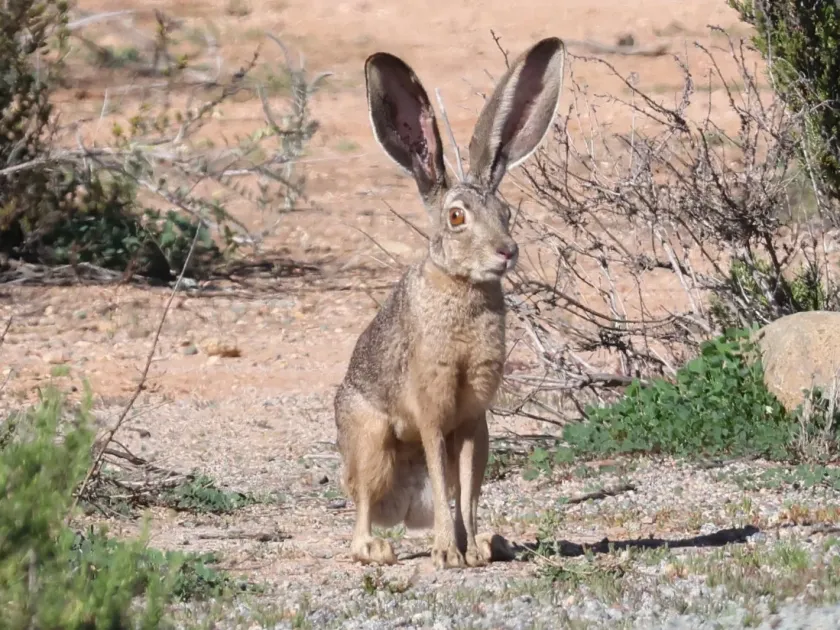
The black-tailed jackrabbit, scientifically known as Lepus californicus, belongs to the Leporidae family. It is easily identified by its long ears with distinct black tips and a prominent black streak running along the upper side of its tail.
These animals are perfectly adapted to open landscapes, possessing a brownish-gray coat that provides camouflage in dry grasslands and arid environments. They do not dig burrows, resting instead in shallow ground depressions known as forms.
Adult jackrabbits typically weigh between 2.5 and 3.5 kilograms and reach lengths of up to 60 centimeters. They are well-known for their long, powerful hind legs which allow them to move quickly across agricultural fields.
The species is highly prolific, with females capable of producing several litters in a single year, leading to rapid population growth that can quickly overwhelm agricultural plots.
Jackrabbits are predominantly crepuscular and nocturnal, which allows them to feed on crops under the cover of darkness, often remaining unseen by farmers during daylight hours.
What it damages
Black-tailed jackrabbits cause significant economic loss by consuming various agricultural products. They frequently feed on grain crops, alfalfa, clover, and a variety of commercial vegetable crops.
In orchards and tree nurseries, they pose a severe threat to young trees. By gnawing the bark at the base of the trunk, they can girdle the tree, effectively cutting off nutrient transport and causing the tree to wither and die.
Beyond direct consumption, the physical trampling of crops by large groups of jackrabbits leads to substantial harvest losses. A heavy infestation can reduce the total yield of a field by 20 to 30 percent.
The damage is particularly critical during the seedling stage, as the loss of young plants often forces farmers to reseed entire sections, increasing overall production costs.
During periods of drought, when natural forage in wild areas dries up, jackrabbits often migrate to irrigated fields, concentrating their damage on high-value crops.
Signs of infestation
Signs of jackrabbit presence include specific feeding marks on plants. The gnawing marks on bark or stems usually appear at a slant, distinguishing them from the chewing patterns of smaller rodents.
The presence of worn, well-defined paths or runways crossing fields between resting areas and feeding grounds is a primary indicator of high jackrabbit activity.
Small, spherical, compressed fecal pellets found scattered near the crops or at the base of trees are clear evidence of their presence in the area.
Visible patches of bare soil within a field where vegetation has been completely destroyed indicate a high population density that requires immediate monitoring and control measures.
In winter, fresh damage to the bark of fruit trees is a diagnostic sign of jackrabbit activity, confirming the need for protective measures to prevent long-term tree injury.
Control measures
Controlling black-tailed jackrabbit damage requires a multi-layered approach, focusing on exclusion, habitat modification, and protective deterrents.
The most effective method for protecting trees in orchards or nurseries is the installation of physical barriers, such as woven wire fencing or protective trunk wraps that prevent animals from accessing the bark.
Habitat management is crucial; keeping field edges and fence lines free of dense weeds and brush eliminates the daytime cover that jackrabbits rely on for safety.
Repellents can be applied to crops or tree trunks to make the vegetation unpalatable to jackrabbits, although these must be reapplied periodically to maintain efficacy.
- Installing high-quality fencing around fields and orchards.
- Using olfactory or taste-based deterrents to protect sensitive vegetable crops.
- Applying light-based or motion-activated devices to discourage nocturnal feeding.
Taxonomy
- Latin name
- Lepus californicus
- Family
- Leporidae
- EPPO code
- LEPUCA
Discussion
No discussions yet — be the first.