
European rabbit
Oryctolagus
Description
How to identify
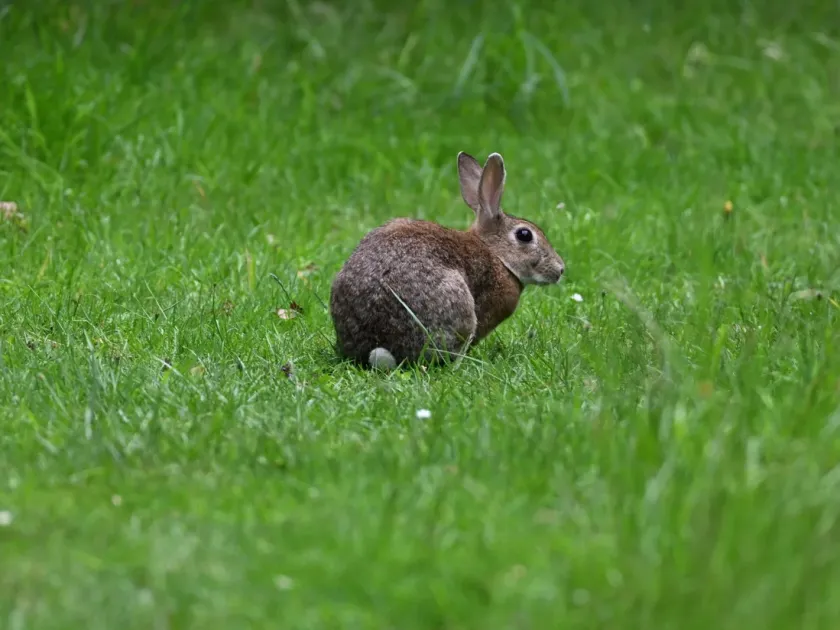
The European rabbit (Oryctolagus cuniculus) belongs to the order Lagomorpha and the family Leporidae. It is a small mammal characterized by long ears, powerful hind legs for jumping, and a highly gregarious nature.
Unlike hares, rabbits are colonial animals that build extensive underground burrow systems, which provide them with shelter and a base for their foraging activities.
Their fur typically ranges from gray to brown, offering excellent camouflage against agricultural landscapes, which helps them avoid detection during foraging.
They are famous for their extreme reproductive rate, with females producing several litters per year, enabling a population to grow exponentially in favorable conditions.
As obligate herbivores, they have a constant need for high-quality vegetation, making them a persistent threat to various agricultural crops and reforestation efforts.
What it damages
Rabbits cause significant damage to grain crops such as wheat, barley, and oats by grazing on young seedlings, often destroying large patches of the crop early in the season.
In orchards and nurseries, European rabbits are notorious for girdling trees; they eat the bark of young saplings, which disrupts the tree's ability to transport nutrients, leading to death.
Vegetable gardens are particularly susceptible, as rabbits target leafy greens, root vegetables, and legumes, often consuming the entire plant down to the crown.
Their burrowing activity causes soil erosion and physical damage to infrastructure, including irrigation pipes and field leveling, which complicates harvesting.
- Cereal crops
- Young orchard trees
- Vegetable crops
- Forage pastures
When it appears
Activity remains high throughout the year, but damage to crops is most pronounced during the winter and early spring when alternative wild food sources are scarce.
During the spring, the emergence of a new generation of rabbits coincides with the germination of spring crops, leading to increased pressure on newly planted fields.
In summer, rabbits often concentrate near lush, irrigated fields, where they cause intensive grazing pressure on high-protein crops.
Autumn brings renewed grazing on newly emerged winter cereals, which is critical for the plants' survival and future yield potential.
Winter conditions force the rabbits to shift their diet toward the bark of woody plants, causing structural damage to saplings and ornamental garden trees.
Signs of infestation
One of the most obvious signs of rabbit presence is the existence of multiple burrow entrances (warrens) near field borders, hedgerows, or rocky outcrops.
The pattern of feeding is distinct; rabbits cut vegetation cleanly, leaving a sharp, diagonal or flat edge, which differs from the ragged tearing seen with other herbivores.
The presence of scat, which appears as small, spherical, dry pellets scattered throughout the field, is a strong indicator of a settled rabbit colony.
Girdling on the trunks of young trees, characterized by vertical tooth marks at the base, confirms that rabbits are active and looking for winter food.
Direct sightings of animals at dawn or dusk, often in groups, are the most reliable way to confirm their presence on a farm or plantation.
Control measures
Physical exclusion is the most reliable control method; installing wire-mesh fencing that is buried at least 30 cm deep prevents rabbits from entering sensitive crop areas.
Individual tree guards made of sturdy plastic or hardware cloth are essential for protecting saplings from being girdled during the dormant season.
Cultural control includes removing piles of brush, debris, and overgrown weeds around field edges, which eliminates the hiding spots rabbits rely on for protection.
Repellents can be applied to crops or tree trunks to deter rabbits, although their effectiveness is often short-lived and requires frequent reapplication.
In severe cases, integrated pest management approaches, including habitat modification and managed population control, are necessary to mitigate widespread agricultural damage.
Taxonomy
- Latin name
- Oryctolagus
- Family
- Leporidae
- EPPO code
- ORYTSP
Discussion
No discussions yet — be the first.