
Tawny owl
Strix aluco
Description
How to identify
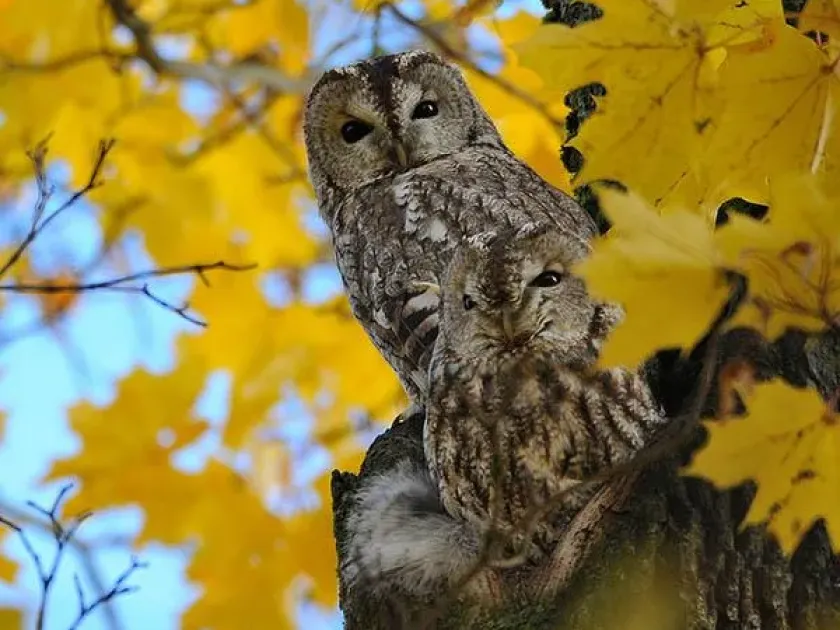
The Tawny owl (Strix aluco) is a medium-sized owl belonging to the Strigidae family. It is a strictly nocturnal bird known for its round, earless head and large, dark eyes.
Its plumage is typically mottled with brown or grey, providing perfect camouflage against tree bark during the daytime when the owl rests in hollows or dense foliage.
These birds are sedentary, meaning they stay within their home range year-round, which makes them permanent natural pest control agents in agricultural landscapes.
They are famous for their eerie, vocal calls, often described as a hooting sound that echoes through rural areas during the night.
The wings are broad and rounded, allowing for the silent flight necessary to ambush small prey in fields and orchards.
What it damages
The Tawny owl is not a crop pest. It does not feed on seeds, vegetables, or fruits, and therefore poses no threat to agricultural production or yields.
On the contrary, its diet consists almost entirely of small mammals, primarily mice, voles, and rats, which are major agricultural pests.
Farmers often mistakenly view all predatory birds with suspicion, but the Tawny owl serves as a vital component of integrated pest management (IPM) strategies.
By consuming large numbers of rodents, they reduce the damage caused to grain stores and standing crops, acting as free biological pest controllers.
Their presence in an agricultural setting is a sign of a healthy, functioning ecosystem where natural balances are maintained.
When it appears
As a sedentary species, the Tawny owl remains in the same territory throughout all four seasons, providing year-round protection for farmland.
Spring is a critical period when breeding pairs are highly active while foraging for food to feed their growing owlets, which coincides with the crop planting season.
During the summer months, they continue to frequent fields and orchards, keeping rodent populations under control while the crops are maturing.
Autumn brings increased movement of juvenile owls, which may explore new areas surrounding farms, expanding the reach of their rodent-control activities.
In winter, as natural prey becomes harder to find in forests, Tawny owls often approach farmsteads and granaries where rodents congregate, providing extra protection during the colder months.
Signs of infestation
The most common sign of a Tawny owl's presence is the discovery of pellets — small, hard lumps composed of indigestible fur and bones regurgitated by the bird.
Their vocalizations, particularly at dusk and dawn, are the most audible indicator that a predator is hunting in the immediate vicinity.
Evidence of nesting in old hollow trees, farm buildings, or owl boxes confirms that the owls have established a territory on the property.
Visible reduction in rodent activity, such as fewer burrow entrances and trails in grain fields, is a practical indicator of their predatory efficiency.
In some cases, feathers or scratch marks on posts may also indicate the presence of a bird of prey that has been using the spot to observe the fields.
Control measures
There is no need for control measures against the Tawny owl, as they are highly beneficial to agricultural operations and pose no risk to crops.
To encourage their presence, farmers are advised to maintain mature trees with hollows and protect existing nesting sites around the farm area.
Installing nesting boxes can be an effective way to attract Tawny owls to specific areas where rodent pressure is particularly high.
It is strongly recommended to avoid or strictly limit the use of anticoagulant rodenticides, as these poisons can bioaccumulate and kill the owls that consume the prey.
Promoting the Tawny owl as a natural ally is a key step in sustainable farming, reducing the need for chemical rodent control and enhancing biodiversity.
Taxonomy
- Latin name
- Strix aluco
- Family
- Strigidae
- EPPO code
- STRXAL
Discussion
No discussions yet — be the first.