
Short-eared owl
Asio flammeus
Description
How to identify
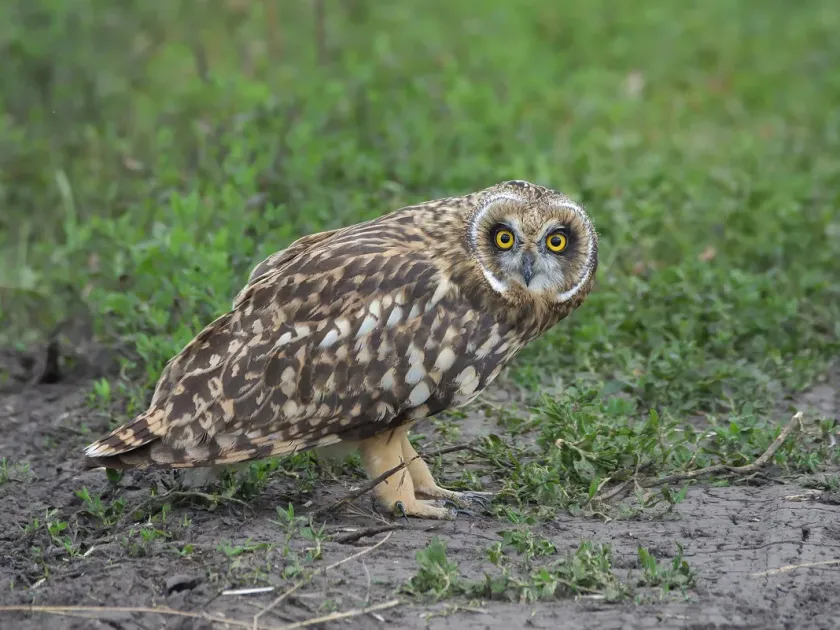
The Short-eared owl (Asio flammeus) is a bird of the order Strigiformes and the family Strigidae. It is a medium-sized owl known for its yellow eyes, dark facial disks, and very short ear tufts that are rarely visible.
This species is distinct for being active during daylight and twilight hours. It prefers open landscapes such as grasslands, marshes, and agricultural fields where it can hunt for its primary prey: small mammals.
The physical appearance features a buff-colored body with dense brown streaks, providing perfect camouflage against dry grasses and stubble fields during the nesting season.
With a wingspan of about one meter, the Short-eared owl performs a characteristic floppy, moth-like flight pattern when hunting, allowing it to glide low over fields to detect rodent movement.
The biology of this owl is closely tied to the cycle of rodent populations. They are known for their ability to congregate in areas where rodent outbreaks occur, acting as an opportunistic and effective natural control agent.
What it damages
The Short-eared owl is not a plant pest; rather, it is a highly beneficial predator for any agricultural operation. By focusing its hunting activity on voles and mice, it directly reduces the damage these pests cause to crops.
Rodents cause significant economic losses by consuming seeds, damaging grain sprouts, and burrowing in fields. A family of owls can consume thousands of rodents over the course of a single year.
The owl's presence on farmland serves as a natural form of pest management, potentially reducing the need for intensive chemical applications that are hazardous to the environment and human health.
Protecting these owls promotes a healthier ecosystem where the balance between predators and prey is maintained, ensuring long-term sustainability for crop production.
Any negative impact from these birds is nonexistent in an agricultural context, making them one of the most valuable avian allies for farmers managing large open-field crops.
Control measures
Conservation of the Short-eared owl is essential for farmers interested in natural pest control. Efforts should focus on preserving their habitat and preventing anthropogenic mortality on the farm.
The most critical measure is the complete prohibition of field burning. As these owls nest on the ground, spring fires are catastrophic for their reproductive success and overall population stability.
Minimizing the use of toxic rodenticides is necessary to prevent secondary poisoning. Predators that consume poisoned prey suffer significant health impacts and population declines, which in turn reduces the natural control of future pest outbreaks.
Implementing farm management practices that maintain grass cover in buffer zones and near field edges provides critical shelter for both the owls and their nesting sites.
- Strict prohibition of controlled burning of fields.
- Reduction in the use of high-toxicity chemical pesticides.
- Preservation of permanent grassland and natural field boundaries.
- Monitoring of rodent populations to support natural predator-prey cycles.
Taxonomy
- Latin name
- Asio flammeus
- Family
- Strigidae
- EPPO code
- ASIOFL
Discussion
No discussions yet — be the first.