
Little owl
Athene noctua
Description
How to identify
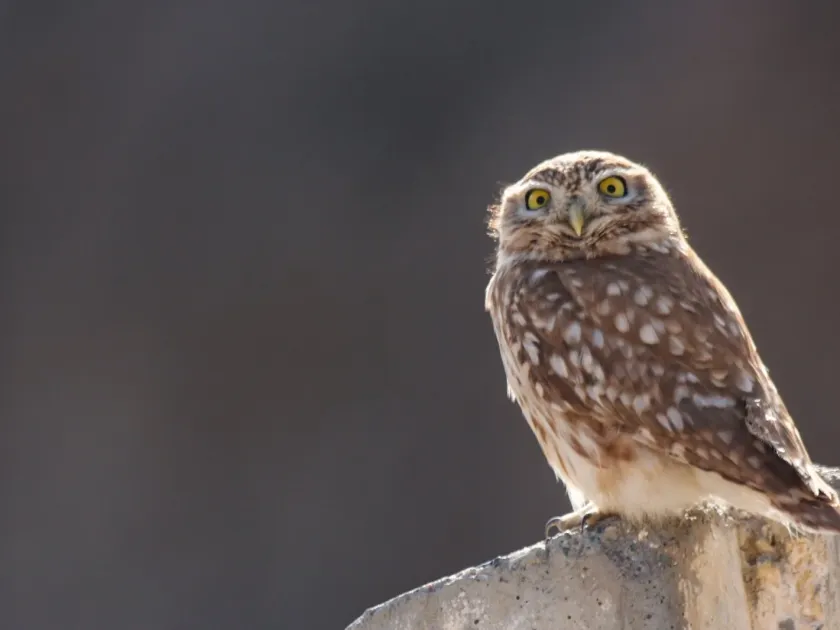
The little owl (Athene noctua) belongs to the order Strigiformes and the family Strigidae. It is a small, compact bird with a large, rounded head and prominent yellow eyes.
The plumage is grayish-brown with distinct white spots, providing excellent camouflage against stone walls, tree bark, and wooden structures commonly found on farms.
Adult little owls typically reach a body length of 20–25 cm with a wingspan of approximately 50–60 cm, making them one of the smallest owl species in Europe.
Unlike many other owl species, the little owl lacks ear-like feather tufts, which contributes to its distinct, rounded silhouette when perched.
Their flight pattern is unique, characterized by rapid wingbeats and deep undulations, which allows them to navigate effectively between storage buildings and orchards.
What it damages
From an agricultural standpoint, the little owl is not a crop pest as it is a predator, but it can become a nuisance in specific farm management contexts.
The main issue arises when these birds roost in granaries, warehouses, or processing facilities, where their droppings can contaminate raw products and storage equipment.
In high-hygiene food processing environments, the presence of these birds violates sanitation protocols, potentially leading to audit failures or safety concerns.
They may occasionally damage packaging materials or insulation within buildings while establishing nesting sites or resting spots for their hunting activities.
While often beneficial for keeping rodent populations low, their concentration in industrial farm zones requires management to ensure operational cleanliness.
When it appears
The little owl is a non-migratory, sedentary species, maintaining its presence on farm territory throughout the entire calendar year.
During the winter months, these birds often move closer to farm buildings and human structures to seek shelter from cold weather and access rodent populations.
In spring, the birds become more territorial due to the start of the breeding season, which typically begins in March or April.
Summer is the peak period for activity, as the birds actively hunt to provide food for their offspring, which increases their visibility near storage areas.
Autumn marks the dispersal of juveniles, which can lead to new, younger birds appearing on the farm property as they search for their own territories.
Signs of infestation
The presence of little owls is most easily identified by their pellets—compressed masses containing the indigestible remains of prey, such as bones, fur, and insect parts.
Accumulations of white, chalky droppings on walls, roof beams, or machinery are reliable indicators that the birds frequently inhabit or visit these specific locations.
Auditory signs include sharp, piercing calls or whistles, often described as a repetitive "kiew-kiew" or "koo-koo," frequently heard at dawn or dusk.
Discovery of nesting sites in wall cavities, crevices of brick buildings, or under corrugated roofing indicates a well-established pair on the premises.
The presence of prey remains left in "larders" or near feeding perches is a clear sign that the birds are actively using the facility to process their catch.
Control measures
The most effective strategy is the physical exclusion of the birds by sealing all gaps in roofs, ventilation shafts, and wall crevices with fine-gauge wire mesh.
Maintaining a clean farm environment by removing stacks of timber, old machinery, or debris reduces the available nesting and hunting perches for the owls.
Ultrasonic deterrent devices can be employed in sensitive areas to create an uncomfortable environment for the birds without causing them physical harm.
Visual deterrents, such as reflective tape or rotating scare-tactics, may provide temporary relief in open areas where birds congregate to hunt for rodents.
Because little owls are natural predators of mice and rats, it is often advisable to manage their impact rather than eliminate them, as they provide valuable ecosystem services to the farm.
Taxonomy
- Latin name
- Athene noctua
- Family
- Strigidae
- EPPO code
- ATENNO
Discussion
No discussions yet — be the first.