
Little owl
Athene brama
Description
How to identify
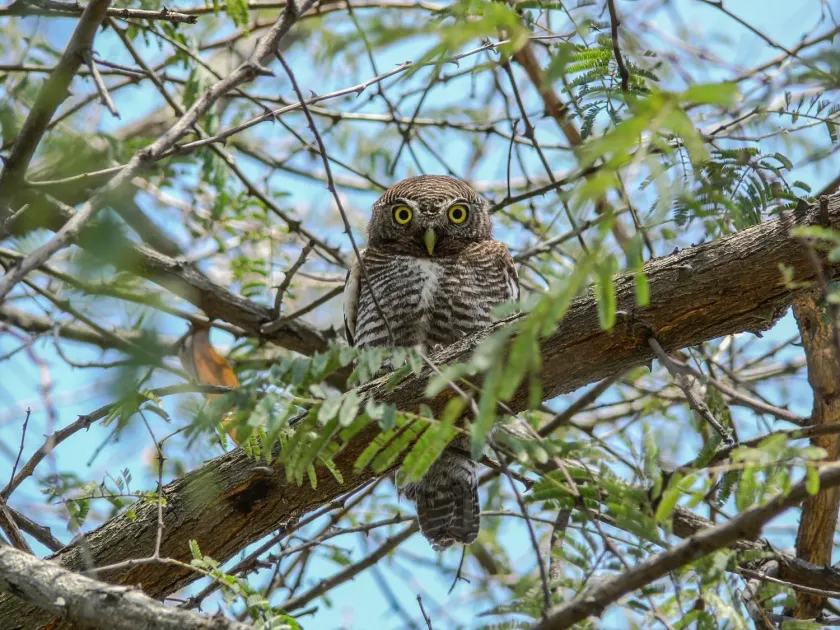
The little owl (Athene brama) is a small bird of prey belonging to the Strigidae family. It is characterized by a compact body, a rounded head without visible ear tufts, and a distinctive mottled plumage pattern in shades of brown and grey.
Measuring between 20 and 23 centimeters, this bird features white spotting across its feathers, providing excellent camouflage against tree bark and rocky ground. Its yellow irises and white eyebrow-like markings give it a very expressive and piercing appearance.
The flight of the little owl is undulating and rapid, often alternating between wingbeats and glides. Unlike strictly nocturnal owls, this species is frequently active during daylight hours, making it highly visible to farm personnel.
The vocalizations of the little owl include a range of sharp, staccato calls, such as a repetitive 'kiew-kiew'. These sounds are critical for identification during field assessments and evening inspections of agricultural land.
Morphologically, the little owl is well-adapted to varied terrains. Its relatively large wings in proportion to its body mass allow for precise and agile movements, which it uses to patrol its territory and locate potential prey items.
What it damages
While the little owl primarily feeds on insects and small rodents, its presence can negatively affect agricultural output. Excessive populations in monoculture environments can disrupt the natural balance by suppressing beneficial avian insectivores.
These birds often occupy orchard areas, where they cause mechanical damage to thin branches and young buds by using them as vantage points. This impact reduces the overall yield and structural integrity of fruit-bearing trees.
The accumulation of bird droppings under frequently used perches alters the soil chemistry, potentially leading to localized pH imbalances that hinder the growth of sensitive crop varieties planted underneath.
By patrolling fields for prey, little owls may inadvertently disturb the nesting habits of beneficial predatory insects or small birds that help manage crop pest populations, indirectly increasing the need for chemical interventions.
In regions where berries or specific small fruits are grown, the presence of these birds can lead to crop loss due to trampling or accidental damage during the birds' foraging and territorial flights through the canopy.
When it appears
The peak activity of the little owl occurs during the breeding season, which typically commences in early spring. During this time, the birds are highly territorial and defensive of their nesting sites, often causing disruptions in the field.
The summer period, when the young are being reared, demands high energy intake, forcing the owls to increase their hunting frequency. This phase coincides with critical developmental stages of many agricultural crops.
In autumn, as the young owls disperse and establish new territories, there is often a temporary surge in the local population within hedgerows and field margins, necessitating increased vigilance from farmers.
Winter months see a reduction in field activity as the birds tend to seek shelter in farm buildings or dense vegetation, where food sources like small mammals remain more accessible despite lower temperatures.
Seasonal patterns are essential for agricultural planning. Understanding these cycles allows for the implementation of preventative measures exactly when the owl's hunting activity poses the greatest risk to specific field crops.
Signs of infestation
A primary indicator of little owl presence is the accumulation of 'pellets'—compressed indigestible remains like bones and fur—found beneath trees or on structures. These are classic signs of a permanent roosting or hunting site.
White, crusty fecal deposits on utility poles, fence posts, or tree branches indicate high-traffic perches. These visual markers are easy to identify during routine farm health checks.
Acoustic monitoring is highly effective; the distinct, repetitive calling behavior of the species during twilight hours serves as a definitive indicator of their settlement within the agricultural zone.
Physical damage to foliage and thin twigs, coupled with the observation of 'scared' smaller birds, provides evidence of a predator's influence in the immediate vicinity of a specific orchard or field plot.
Regular monitoring of tree canopies for signs of damage or fecal accumulation allows farmers to map the activity patterns of the owls and determine whether their impact is localized or widespread across the fields.
Control measures
The most effective management strategy involves removing unused structures, such as isolated old poles or dead branches in the middle of fields, which provide the vantage points necessary for successful owl hunting.
Using bio-acoustic deterrents that mimic the calls of larger raptors or alarm signals can effectively discourage little owls from settling in specific critical areas of the agricultural land.
Installing visual deterrents, such as silhouettes of larger predators or reflective surfaces that create unpleasant movement in the wind, helps to decrease the attractiveness of the field to these birds.
Promoting biodiversity along field margins encourages the presence of competitor species, which can limit the resources available to little owls, thereby keeping their local population naturally regulated.
For high-value crops, the use of protective netting can provide a physical barrier, preventing the birds from landing on the produce and minimizing mechanical damage during the most vulnerable stages of the crop growth cycle.
Taxonomy
- Latin name
- Athene brama
- Family
- Strigidae
- EPPO code
- ATENBR
Discussion
No discussions yet — be the first.