
Long-eared owl
Asio otus
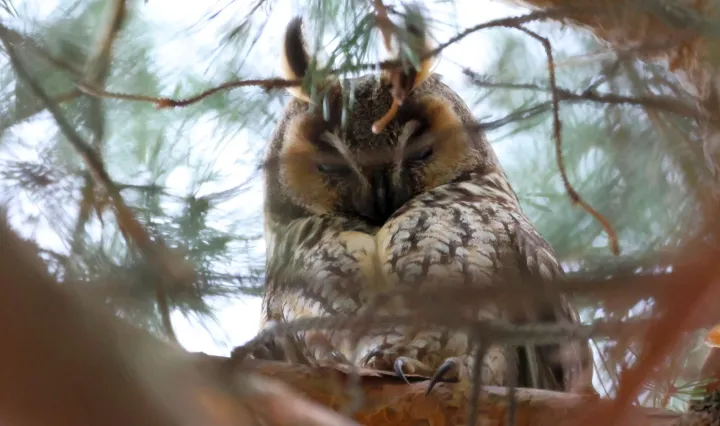
Description
How to identify
The long-eared owl (Asio otus) is a member of the Strigidae family. It is easily recognized by its long, prominent ear tufts, which are actually feathers and not related to its auditory organs.
The plumage of the long-eared owl is a mottled brown and buff color, providing excellent camouflage against the bark of trees during the daytime.
These owls typically nest in dense coniferous or mixed woodlands and often utilize old nests of magpies or crows found in windbreaks near agricultural fields.
With a wingspan of up to 100 centimeters, the long-eared owl is a highly efficient nocturnal predator adapted to hunting in open fields and edge habitats.
They are widely distributed and can be found in various environments, showing a preference for areas where tree cover provides shelter during the day and open land offers hunting grounds.
What it damages
The long-eared owl is not a plant pest. It does not feed on any agricultural crops, vegetables, or fruit, and it poses no threat to farming operations.
The agricultural value of the long-eared owl is strictly beneficial, as it is a natural predator of several major agricultural rodent pests.
Its primary diet consists of small rodents such as voles and mice, which are known to cause extensive damage to crops, seedlings, and root systems in agricultural fields.
By keeping rodent populations in check, the long-eared owl acts as a natural biological control agent, reducing the need for chemical intervention.
Farmers who encourage the presence of these owls are fostering a healthier ecosystem where the natural balance limits the impact of agricultural pests.
Control measures
There are no control measures for long-eared owls as they are highly beneficial to the agricultural sector and are protected by law in many countries.
To promote their presence, farmers should preserve mature trees and windbreaks that provide suitable nesting and roosting spots for the owls.
Reducing or eliminating the use of toxic rodenticides is crucial, as poisoned rodents can cause secondary poisoning in owls that hunt them.
Sustainable agricultural practices that favor biological control are highly compatible with the presence of long-eared owls on the farm.
Integrating these birds into the farm environment is an excellent way to maintain a natural, cost-effective solution for rodent pest management.
Taxonomy
- Latin name
- Asio otus
- Family
- Strigidae
- EPPO code
- ASIOOT
Discussion
No discussions yet — be the first.