
Burrowing owl
Athene cunicularia
Description
How to identify
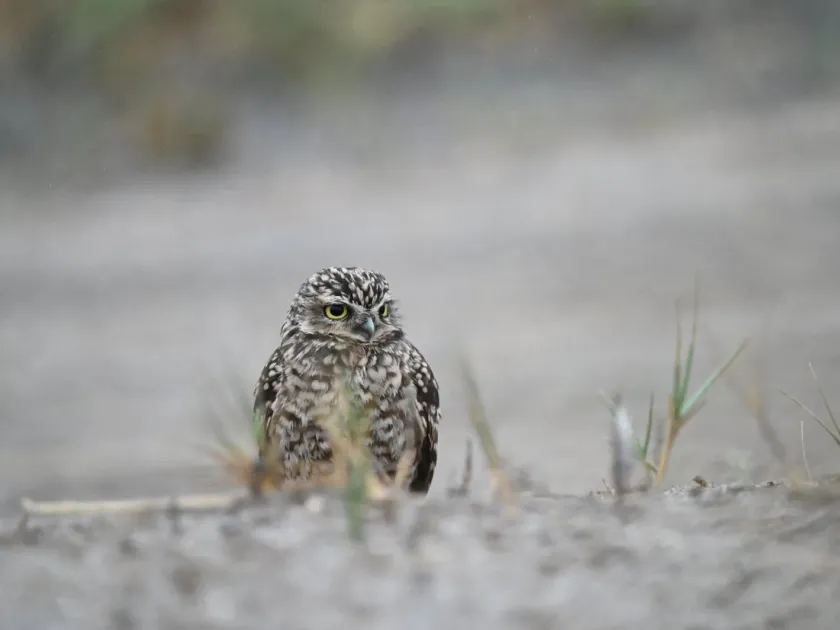
The burrowing owl (Athene cunicularia) is a small, long-legged owl found throughout the open landscapes of North and South America.
Unlike most owl species, they live in underground burrows, which they typically take over from burrowing mammals like ground squirrels or prairie dogs.
They are primarily diurnal or crepuscular, meaning they are active during the day and twilight, making them easily observable by farmers.
Adult owls reach about 20–25 centimeters in height and are characterized by their brown, spotted plumage and bright white eyebrows.
They are highly social birds and often nest in colonies, occupying specific territories that remain stable over several breeding seasons.
What it damages
The burrowing owl is not an agricultural pest; on the contrary, it serves as a valuable biological control agent for farmers.
Their diet consists largely of insects, such as beetles and grasshoppers, and small mammals that often damage crops, including mice and voles.
In terms of agricultural impact, the presence of these birds helps to keep rodent populations in check without the need for synthetic rodenticides.
The only minor conflict occurs if they nest in critical infrastructure, such as irrigation pipes or earthen embankments, which may suffer damage.
However, their positive contribution to pest management far outweighs these localized disturbances in most farming operations.
When it appears
Breeding season is the period of peak activity, generally occurring from spring through mid-summer, when demand for prey is highest.
During the summer months, owls are most visible as they hunt for their rapidly growing chicks, providing maximum pest control benefits.
In the autumn, young owls begin to disperse from the colony, which can lead to a shift in their distribution across fields.
Winter behavior varies; in northern regions, they may migrate, while in warmer climates, they remain near their burrows throughout the winter.
Agricultural work, such as harvesting or tilling, should be coordinated to avoid disturbing nesting sites during the height of the breeding season.
Signs of infestation
The most common sign of a burrowing owl colony is the presence of burrows in open, sparsely vegetated fields with signs of recent activity.
Look for evidence such as fecal matter near the burrow entrance or scattered remains of insects and small vertebrates (pellets).
Observation of the birds themselves, often standing on fence posts or near the burrow entrance, is the most reliable way to confirm their presence.
Distinctive calls, which can range from a chattering noise to a soft cooing sound, are often heard during the dawn and dusk hours.
A simple visual survey of the field edges during early morning hours will often reveal if a colony is utilizing the area.
Control measures
Active control or eradication is strongly discouraged, as these birds are often protected species and beneficial to the ecosystem.
To discourage owls from nesting in problematic areas, farmers should focus on habitat modification rather than destruction.
Maintaining taller vegetation in non-production areas can make a site less attractive for burrowing owls, as they prefer short, open grass.
Avoiding the use of broad-spectrum pesticides ensures that the owls have a healthy, safe food supply, keeping them in the vicinity of the crops.
- Protecting existing burrows away from machinery traffic.
- Using non-lethal deterrents if nesting occurs in restricted zones.
- Promoting integrated pest management (IPM) to benefit local raptors.
Taxonomy
- Latin name
- Athene cunicularia
- Family
- Strigidae
- EPPO code
- ATENCU
Discussion
No discussions yet — be the first.