
Little owl
Athene
Description
How to identify
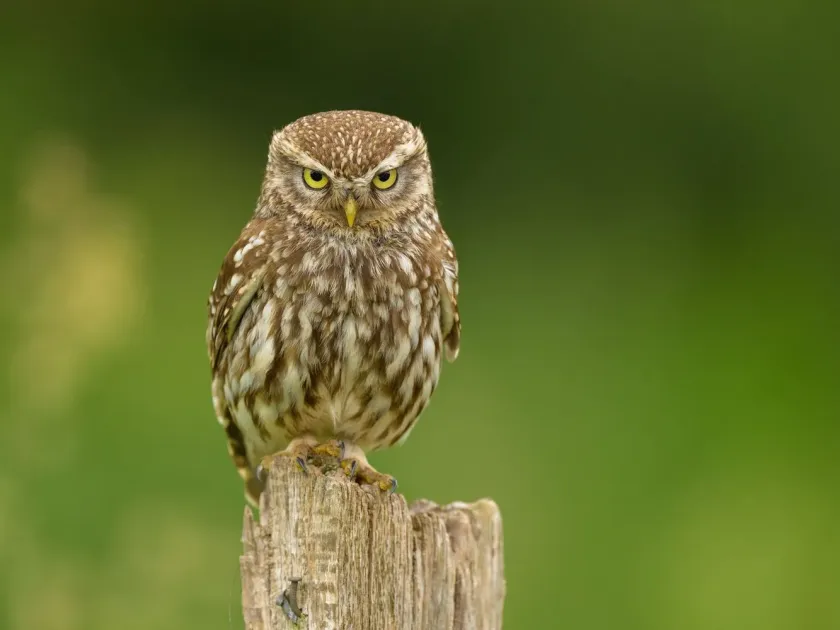
The little owl (Athene noctua) is a small, compact raptor belonging to the Strigidae family. It is one of the most recognizable owl species, often associated with human agricultural landscapes.
The bird has a distinct brown-grey plumage with white spotting, providing excellent camouflage against tree trunks or rocky crevices. Its large, bright yellow eyes give it a piercing, alert appearance.
With a body length of about 22 centimeters, the little owl is built for agility rather than speed. Its short, rounded wings and short tail allow for maneuverability in tight, wooded, or built-up areas.
Unlike many other owl species, the little owl is frequently active during the day, especially when feeding nestlings, which makes it easier to observe in farm environments.
It prefers habitats such as orchards, farmland, and farm buildings, where it finds both shelter and a steady supply of prey.
What it damages
The little owl is not a plant pest. It is an obligate carnivore, meaning it consumes only animal prey and does not cause any direct damage to agricultural crops or vegetables.
Its impact is purely structural or hygienic. If these owls take up residence in barns or grain silos, their droppings can contaminate equipment or storage areas.
In some cases, they may prey upon small domestic poultry. While this is rare for adults, they may target small chicks if they are left unprotected in the open.
Despite these minor nuisances, the little owl provides significant ecosystem services by predating on mice, voles, and insects, which are the real agricultural pests.
Farmers should consider the benefits of their presence in controlling rodent populations, which often cause far more financial loss than the owls themselves.
When it appears
Little owls are sedentary birds and remain in the same territory throughout the year. They do not migrate, making them a permanent fixture on the farm throughout the seasons.
During the spring breeding season, their activity increases as they engage in courtship displays and look for suitable nesting sites in buildings or old trees.
Summer is the most active time, as the parents must hunt continuously to satisfy the hunger of their growing brood of owlets.
In autumn, the younger birds disperse to establish their own territories, which may lead to temporary occupation of new farm buildings.
Winter finds them conserving energy. They often seek out the shelter of barns or sheds where the ambient temperature is slightly warmer due to livestock presence.
Signs of infestation
The most common sign of their presence is their territorial call, a sharp, repetitive «kiew» or «woo-it» sound often heard at dawn or dusk.
Pellets are a major diagnostic sign. These are compact balls of undigested hair, bones, and insect exoskeletons that the owl regurgitates regularly at its favorite perches.
Whitewash marks from droppings on rafters, window sills, or stone walls serve as clear evidence that the owls are regularly occupying a specific spot.
You may also find caches of prey, such as headless rodents or insects, tucked away in crevices near their nesting site or favourite lookouts.
In the spring, visual sightings of the birds perched on fences or poles during the day are a strong indicator of an active nest nearby.
Control measures
As a protected species in many regions and a natural enemy of agricultural pests, extermination is not recommended and is often illegal.
To discourage them from occupying storage buildings, use physical exclusion methods such as wire mesh over ventilation holes or gaps in the roof.
Ensure that all storage areas are sealed properly. Preventing access is much more effective and humane than trying to remove the birds once they have established a nest.
Avoid the use of anticoagulant rodenticides. If an owl eats a poisoned rodent, it can suffer secondary poisoning, which disrupts the natural biological control system.
If their presence is problematic, provide alternative nesting boxes in nearby trees or woods to encourage them to vacate sensitive barn areas.
Taxonomy
- Latin name
- Athene
- Family
- Strigidae
- EPPO code
- ATENSP
Discussion
No discussions yet — be the first.